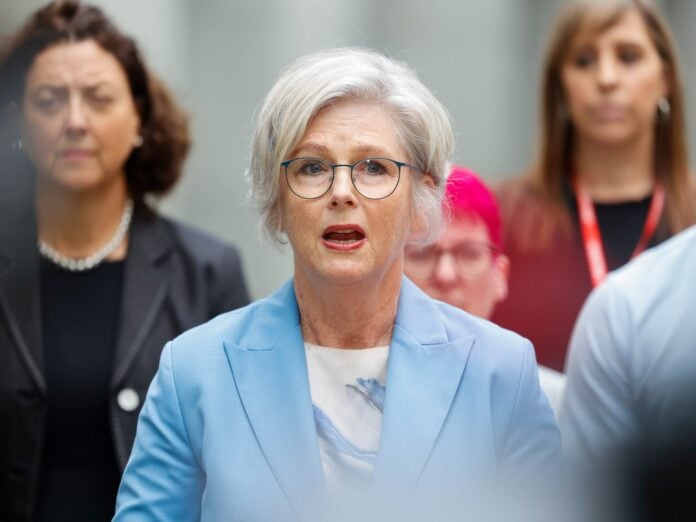
Twenty-four people were killed at an Awami League rally in Dhaka on 21 August 2004, and nearly three hundred were wounded. Among the dead was Ivy Rahman, a senior party leader and the wife of a future president. Sheikh Hasina, who was speaking from the back of a truck when the grenades came in, survived with permanent damage to her hearing.
Nobody is convicted of it. Not one person.
In October 2018 a Dhaka tribunal sentenced nineteen men to death over that attack and nineteen more to life, Tarique Rahman among the latter, tried in absentia while he sat in London. On 1 December 2024 the High Court acquitted all forty-nine defendants and declared the trial illegal. On 4 September 2025 the Appellate Division upheld that, expunged the High Court’s suggestion that the home ministry might investigate again, and ordered the release of anyone still held. The file is shut. There is no perpetrator in law, and there will not be one.
Fourteen months after the High Court judgment, Tarique Rahman was prime minister of Bangladesh.
| Field | Detail |
|---|---|
| Office | Prime Minister of Bangladesh, sworn in 17 February 2026 |
| Party | Bangladesh Nationalist Party; chairman since 9 January 2026 |
| Born | 20 November in Dhaka. The year is disputed: 1965, 1967 and 1968 all appear in print |
| Father | Ziaur Rahman, president 1977 to 1981, assassinated 30 May 1981 |
| Mother | Khaleda Zia, prime minister 1991 to 1996 and 2001 to 2006; died 30 December 2025 |
| Family | Married Dr Zubaida Rahman on 3 February 1994; one daughter, Zaima Rahman, a barrister |
| In custody | Around eighteen months from early 2007, against thirteen cases |
| In exile | London, September 2008 to 25 December 2025. Seventeen years |
| Cases filed against him | Around eighty-four between 2007 and 2024 |
| Convictions standing today | None. Every major conviction was overturned in 2024 and 2025 |
| Seats won in 2026 | Bogura-6 with 68.90 per cent; Dhaka-17 with 51.56 per cent |
| He is Bangladesh’s eleventh prime minister and its first male head of government since 1991. | |
Who is Tarique Rahman?
He is the son of two Bangladeshi heads of government. His father, Ziaur Rahman, was army chief, then president from 1977, and was assassinated on 30 May 1981. His mother, Khaleda Zia, was prime minister from 1991 to 1996 and again from 2001 to 2006, and died on 30 December 2025 at Evercare Hospital in Dhaka, aged eighty. His younger brother Arafat Rahman, known as Koko, died of cardiac arrest in Kuala Lumpur in January 2015.
He was born in Dhaka on 20 November, and the year is not as settled as it should be for a sitting prime minister. Bangladesh’s state news agency and Britannica both give 1965. English Wikipedia says 1968. Anadolu says 1967. The state agency’s own birthday headline in November 2025 implied 1964. He is around sixty, and beyond that the public record does not agree with itself.
He married Dr Zubaida Rahman, a physician, on 3 February 1994. Their daughter Zaima Rahman is a barrister. He read law and then international relations at the University of Dhaka and left in his second year without finishing.
Hawa Bhaban, and the reputation that came from it
He joined the BNP as a primary member in Gabtali, Bogura, in 1988. When his mother returned to office in 2001 he became senior joint secretary-general, and the party office at Banani known as Hawa Bhaban became, in the standard description of that period, the place where decisions were actually taken while the government sat at Ganabhaban.
The allegations attached to that arrangement were extensive: a standing ten per cent commission on state development projects, the extortion of 147,000 dollars from a construction firm, bribery, money laundering. In a December 2005 cable the United States charge d’affaires in Dhaka called him the Dark Prince, and American diplomats described him as emblematic of kleptocratic government and violent politics.
None of it was ever proved to final appeal. The criminal cases that carried those allegations have all been decided in his favour, and the courts that decided them said in terms that the prosecutions were malicious. What remains is a reputation formed in that period which no acquittal removes, and a diplomatic record that is now on the internet permanently.
Eighteen months in custody, seventeen years in London
He was arrested in early 2007 from his Dhaka home during the military-backed caretaker government and held for around eighteen months against thirteen cases. Britannica dates the arrest to January and Al Jazeera to March; the month is not settled.
The BNP says he was tortured in custody and left with permanent spinal damage. That is the party’s account and Britannica repeats it. It is worth noting separately that the High Court, in the grenade-attack judgment, found that confessional statements in that case had been extracted through torture. That is a finding about the case, not about his body, and the two should not be run together.
He was released in September 2008 and left for London the same month for treatment. He stayed seventeen years. He was elected senior vice-chairman in absentia in 2009, became acting chairperson in February 2018 after his mother was jailed, ran the party by video link, and conducted the 2018 election nomination interviews over Skype. Eastern Herald covered his move from exile to candidacy in December 2025.
Every conviction, overturned
Around eighty-four cases were filed against him between 2007 and 2024. The four that mattered are below, and all four have now gone his way.
| Case | Conviction | Final outcome |
|---|---|---|
| 21 August 2004 grenade attack, 24 killed | Life imprisonment in absentia, 10 October 2018 | Acquitted, High Court, 1 December 2024. Trial declared illegal. Upheld by the Appellate Division, 4 September 2025 |
| Zia Orphanage Trust | Ten years, 8 February 2018 | Acquitted, Appellate Division, 15 January 2025, unanimously |
| Money laundering, 20 crore taka | Acquitted at trial in 2013; convicted on appeal by the High Court, 21 July 2016, seven years | Acquitted, Appellate Division, 6 March 2025 |
| Illegal acquisition of wealth | Nine years plus a 30 million taka fine | Acquitted, High Court, 28 May 2025 |
| Also acquitted: two sedition cases (August 2024 and March 2025), the ten-truck arms case (December 2024) and a 21 crore taka bribery case (March 2025). All of these decisions post-date the fall of the government that brought the prosecutions. The Chief Justice described the orphanage case as vindictive and its trial as entirely flawed. | ||
The pattern is unmistakable and so is its timing. The grenade-attack acquittal came in December 2024, four months after Sheikh Hasina fled the country. The Zia Orphanage Trust acquittal came in January 2025, the money-laundering acquittal in March, the illegal-wealth acquittal in May. Chief Justice Syed Refaat Ahmed said of the orphanage case that it was vindictive and the trial entirely flawed.
Two readings are available and the record supports both. Either these were political prosecutions that could only be corrected once the government that brought them was gone, which is what the courts themselves have said. Or a change of government produced a change of judicial outcome, which is a description of the same facts and a different claim about the country. Nothing in the judgments distinguishes between them.
What is not in dispute is the arithmetic. Every serious criminal finding against the man who now runs Bangladesh was reversed within ten months of the collapse of the government that had obtained it, by courts sitting in the state he was about to lead. No appellate body has been asked to look at any of it the other way, and under the Appellate Division’s September 2025 order, none can.
The election that made him prime minister
He landed at Hazrat Shahjalal International Airport on 25 December 2025, on a Biman flight from London, with his wife and daughter. Reporting put the reception at more than a million people, which is a crowd estimate rather than a count. Al Jazeera reported him saying it was time to build the country together. Five days later his mother was dead. He became BNP chairman on 9 January and fought a national election six weeks after burying her.
| Party | Seats | Votes | Share |
|---|---|---|---|
| Bangladesh Nationalist Party | 209 | 37,468,994 | 49.97% |
| Bangladesh Jamaat-e-Islami | 68 | 23,825,259 | 31.77% |
| National Citizen Party | 6 | 2,286,795 | 3.05% |
| Bangladesh Khelafat Majlis | 2 | n/a | n/a |
| Islami Andolan Bangladesh | 1 | n/a | n/a |
| Gono Odhikar Parishad | 1 | n/a | n/a |
| Bangladesh Jatiya Party | 1 | n/a | n/a |
| Ganosamhati Andolan | 1 | n/a | n/a |
| Independents | 7 | n/a | n/a |
| Registered voters 127,711,793; turnout 59.44 per cent, up 17.6 points. Chattogram-2 and Chattogram-4 remain undeclared under court orders. Fifty further seats are reserved for women and filled proportionally, for 350 in total; the majority threshold is 151. A concurrent referendum passed with 48,074,429 yes votes to 22,565,627 no. | |||
Polling was on Thursday 12 February 2026, the first election since the 2024 uprising. The central fact about it is the one that is easiest to state and least often stated plainly: the Awami League, which had won the previous four general elections, was banned from contesting. Its leader had been sentenced to death in absentia by a special tribunal and was living in India. Fifty-one parties competed for the space it left.
The BNP took 209 seats on 49.97 per cent of the vote, a two-thirds majority. Turnout was 59.44 per cent on the Election Commission’s figure, up more than seventeen points. Two Chattogram constituencies remain undeclared under court orders, and the Election Commission’s senior secretary, Akhtar Ahmed, gave the seat counts from the 297 declared constituencies to Bangladesh Sangbad Sangstha. He won Bogura-6 with 68.90 per cent and Dhaka-17 with 51.56 per cent, and was sworn in on 17 February at the South Plaza of the parliament building rather than at Bangabhaban, a break with precedent that was noticed at the time. He is Bangladesh’s eleventh prime minister and its first male head of government since 1991.
Half the vote, with the largest party of the previous three decades removed from the ballot, is a mandate of a particular kind. The analyst Abbas Faiz told Al Jazeera after the count that the election would have been fairer had every party including the Awami League been allowed to take part, though he added that the fault lay partly with the Awami League for failing to remake itself into a party Bangladeshis could trust. That is not a claim that the votes were miscounted. It is a claim about what was on the paper.
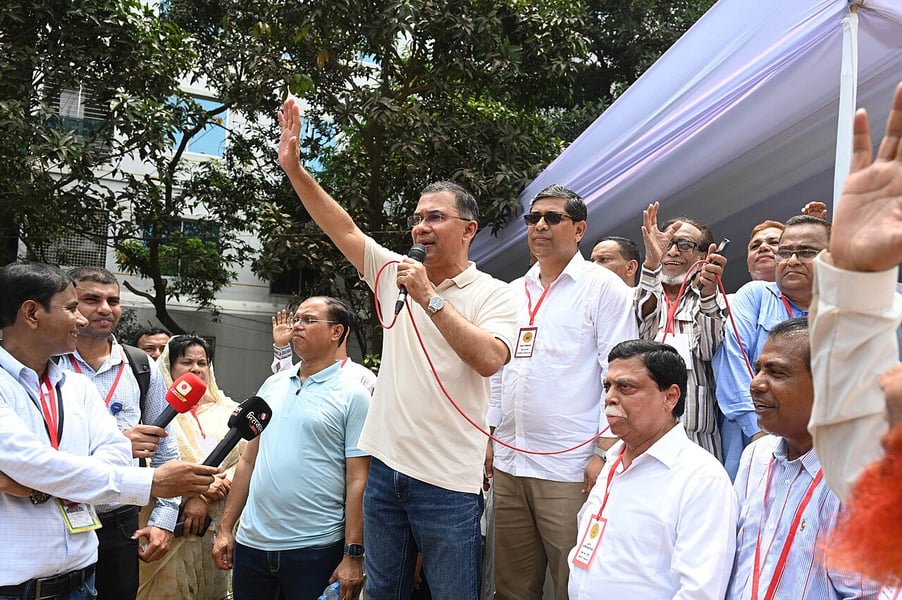
The opposition that disputes the count
Jamaat-e-Islami took 68 seats and 31.77 per cent, its best result ever, and Shafiqur Rahman became Leader of the Opposition on the same day Tarique was sworn in. The BNP governed in coalition with Jamaat from 2001 to 2006, so this is a familiar relationship rather than a new one. It is also the reason the removal of the Awami League matters twice over: the party it made into the official opposition of Bangladesh is the one the BNP already knows how to govern beside.
Jamaat has never accepted the result. It said it was not satisfied with the count and raised what it called serious questions about the integrity of the results process, then pledged cooperation anyway after Tarique visited Shafiqur Rahman at his home. The main opposition disputes the election that produced the government and has not withdrawn the objection.
That leaves him with a structural problem that United Nations monitors have now put numbers to. The Security Council’s Al-Qaida and ISIL monitoring team reported on 10 August that AQIS is aggressively trying to exploit conditions in Bangladesh, counted 1,611 militants active in the country and more than 370 people charged under counter-terrorism statutes still at large.
Delhi, and the woman in the way
Narendra Modi invited him to India within days of the swearing-in. Six months later he has not gone, and the reason is Sheikh Hasina, who has been in India since fleeing Dhaka in August 2024 and against whom Bangladesh’s international crimes tribunal issued arrest warrants in July 2026.
On 10 August he met the Indian high commissioner and asked for her extradition. On 16 August Dhaka said a propitious environment needed to be created before he would travel. On 21 August, Rashtrapati Bhavan issued a press note saying the Change of Guard ceremony was cancelled for the rehearsal of a ceremonial welcome for the prime minister of Bangladesh, and withdrew it about an hour later without explanation. Neither government had announced a visit. None has been announced since.
What the record does not settle
Four things.
The victims of 21 August 2004 have no verdict. Twenty-four people were killed by military-grade grenades thrown into a political rally in the capital city, and after twenty-two years, two trials and an appellate judgment, the law now says that nobody did it. The Appellate Division did not merely acquit; it removed the High Court’s recommendation that the matter be looked at again. Whatever one believes about who was responsible, a state that closes a mass killing with no perpetrator has failed the people who died in it.
The acquittals are final and the courts called the prosecutions malicious, but every one of them was decided after the government that brought the cases had collapsed. The question of what actually happened at Hawa Bhaban between 2001 and 2006 is now permanently closed without having been answered.
The government’s own legitimacy is contested from two directions at once. The party that came second disputes the count and has produced no evidence for it. The party that came nowhere was not permitted to run. Neither objection has had an independent adjudication and neither is going to get one.
And the smallest thing is the strangest. Nobody can say for certain what year the prime minister of Bangladesh was born.
Tarique Rahman: frequently asked questions
Who is Tarique Rahman?
Tarique Rahman is the prime minister of Bangladesh, sworn in on 17 February 2026, and chairman of the Bangladesh Nationalist Party. He is the son of President Ziaur Rahman and Prime Minister Khaleda Zia, and led the BNP from exile in London for seventeen years before returning in December 2025.
Was Tarique Rahman convicted of anything?
He was convicted in several cases, including a life sentence handed down in absentia in October 2018 over the 2004 grenade attack, but every major conviction has since been overturned. The High Court acquitted him in the grenade-attack case in December 2024 and the Appellate Division upheld that on 4 September 2025. The Zia Orphanage Trust and money-laundering convictions were set aside in January and March 2025, and the illegal-wealth conviction in May. He stands convicted of nothing.
Has anyone been convicted of the 2004 grenade attack?
No. Nineteen people were sentenced to death and nineteen to life imprisonment in October 2018. All forty-nine defendants were acquitted by the High Court on 1 December 2024, and the Appellate Division upheld the acquittals on 4 September 2025 and struck out the recommendation for a fresh investigation. Twenty-four people were killed and no one is held responsible in law.
What were the 2026 Bangladesh election results?
Polling was on 12 February 2026, with the Awami League banned from contesting. The BNP won 209 seats on 49.97 per cent of the vote, Jamaat-e-Islami 68 seats on 31.77 per cent, and the National Citizen Party six. Turnout was 59.44 per cent. Two Chattogram constituencies remain undeclared under court orders.
When did Tarique Rahman return to Bangladesh?
On 25 December 2025, landing at Hazrat Shahjalal International Airport in Dhaka after seventeen years in London. His mother, Khaleda Zia, died five days later.
Why has Tarique Rahman not visited India?
Bangladesh has linked a visit to the extradition of Sheikh Hasina, who has lived in India since August 2024 and faces arrest warrants at home. On 21 August 2026 Rashtrapati Bhavan issued and then withdrew a notice referring to a ceremonial welcome for him. No visit has been announced.
How old is Tarique Rahman?
Around sixty. His birthday is 20 November, but the year is disputed: Bangladesh’s state news agency and Britannica say 1965, Wikipedia says 1968 and Anadolu says 1967.
Who is the leader of the opposition in Bangladesh?
Shafiqur Rahman, the ameer of Bangladesh Jamaat-e-Islami, who took the post on 17 February 2026, the same day Tarique Rahman was sworn in as prime minister.