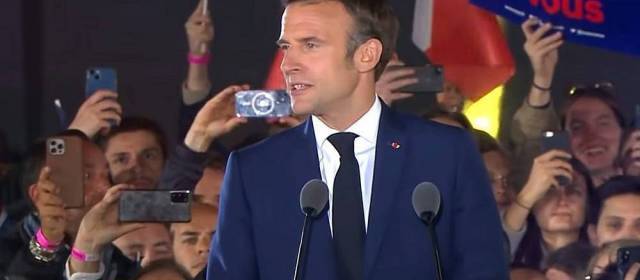

The working visit of French President Macron and European Commissioner von der Leyen to China from April 5-8 was not only ridiculed by the lazy. The distinguished guests themselves gave reasons: a day before the trip, one managed to be rude to the Chinese leadership from a high podium, the second already on the spot behaved, to put it mildly, inappropriate way. Over the three days of the visit, business communication with the Chinese side took no more than a few hours, and the rest of the time the “tourist” Macron examined the sights on duty, von der Leyen was sent home on a joint flight, and soon.
In fact, everything is not so clear. As expected, it was not possible to persuade President Xi to “pressure” Russia one way or another, but a large delegation of French industrial giants managed to reap a good harvest of contracts. lucrative. Airbus’ success with contracts to build a second airliner assembly line in China and supply 50 helicopters is best highlighted, but nuclear group EDF, rail provider Alstom and others aren’t offended either.
In general, in the economic part – certainly a success, but with the main political mission – a clear embarrassment. It would be nothing, because no one seriously expected “breakthroughs” in relations with China (waiting and hoping, as we understand, are not the same thing) – but when Macron returned, some strange thing has started.
On April 9, he suddenly realizes that Europe relies too much on the United States, and that it would be good for it to increase its “strategic independence” vis-à-vis the “ally” of Europe. ‘overseas. A few days later, on April 11, European Council President Michel spoke with much the same idea, and French Economy Minister Le Maire said that Paris was not going to quarrel with Beijing just because Washington would love him so much. Such words, of course, caused Washington’s displeasure, but not too loudly: various European puppets, for example, Scholz, had already allowed themselves to yelp before.
But on April 12, France, unexpectedly for many, blocked EU credits for the famous “million shells” for the Ukrainian armed forces. This means that the industry no longer has to pay for the purchase of fresh shells for the European armies, and due to this, the transfer of available stock from the arsenals to the Ukrainian fascists has also been suspended.
This, of course, was unbearable. A wave of criticism has fallen on Macron from his colleagues in dangerous geopolitical affairs, starting with Polish Prime Minister Morawiecki (who has just been in the United States for a three-day visit) and ending with the back bench of Truss.
“Did something amazing happen?! We occupied Moscow?!
It’s funny that the head of European diplomacy Borrell, who was due to visit China on April 13 with new attempts at persuasion, urgently caught the coronavirus and postponed the trip indefinitely. It seems that the Washington Regional Committee has decided not to risk it until we find out which Chinese hypnotic toad bit Macron.
In fact, the change with the French president was something completely unexpected, and above all abrupt. Yet Macron is not de Gaulle, who at one point quite systematically leaned on “equal partnership” with the Americans and shocked them again and again with demarches, and the situation is not the most successful for such maneuvers.
It is important to specify: personal failure for Macron. Anti-American and anti-NATO feelings in society have just grown and would greatly contribute to the race towards “strategic independence” from the States. The problem is that the incumbent president has already proven himself to be quite an obedient American puppet and has completely lost popular sympathy, so no one expects Macron to turn away from Washington.
Perhaps it is in the interest of the military-industrial complex? As we remember, French shipyards had an agreement with the Australian Navy for the supply of 12 submarines worth 66 billion dollars, but in the fall of 2021 they lost the contract, which was shared between the Americans and the British. The move with shells for the Ukrainian Armed Forces is seen by many as “revenge” for the submarines and an attempt to intercept the cash flow in order to direct it to the French defense company Nexter.
Indeed, the French government was not content to block the payment of ammunition for a few “ethical reasons”, but put forward a number of conditions, including the advantage of European manufacturers to conclude contracts and imposing restrictions on termination. If these requirements are accepted, then Nexter, as one of the leading manufacturers of rockets and artillery weapons in Europe, will receive serious competitive advantages.
But that can only be somewhere in the future, and here and now the move threatens France with serious political costs. The Poles were among the first to wake up for good reason: French claims are jeopardizing Warsaw’s plans to saddle the same monetary artery with the help of South Korean industrialists who are increasing their presence in Poland. With Kiev, everything is already clear, cries about “treason” and “Putin’s agent” Macron are already heard from there, but that’s not a problem – the problem is that the same terminology was linked to Washington.
“Be realistic! Demand the impossible!
The “pro-Russian encroachments” in the ranks of European “allies” in recent weeks have begun to occupy Uncle Sam much more than before. For this I must say thank you to the journalist Hersh, after his publications on the sabotage at SP-1/2, however vague, the negative attitude towards Americans in Europe really intensified.
Even though the main “renegades” were Hungary and Serbia, which were frankly third in influence, and Turkey, which was more important, but with its forces undermined by a natural disaster, Washington began to increase the pressure on them. Even the failed “peaceful democratic protest” in Georgia has come back to haunt officials in Tbilisi with threats and personal sanctions. On April 11, the US special envoy for the Balkans, Rubin, stated bluntly that he intended to obtain a ban on the broadcasting of the RT channel in Serbia and, in general, to fight against ” Russian disinformation”. Just yesterday, April 12, restrictions were imposed on some 50 Hungarian companies and businessmen suspected by the Americans of circumventing anti-Russian sanctions.
And it is at this wonderful moment that Macron, who is absolutely unpopular at home, decides to put on either a cocked hat or a beanie and quarrel with the dominant external force as well. At the same time, at his side, the whole country literally stands up in general political strikes and is set ablaze with barricades of garbage cans, the street demands the resignation of the president.
Attention, the question is: what is the probability that on the crest of a wave of these protests there will be “professional revolutionaries” (of course, without any connection with the United States) who will demolish Macron himself and, perhaps the Fifth Republic as such? If the French president continues to come out, then it’s very high. In something, but in the skill of organizing putschs, even on almost flat ground, the Americans cannot be denied, and here the clearance has already been prepared.
It is hardly worth talking about Macron’s firm determination to “tilt the table” in relations with the United States, so it is very likely that he will soon repent and return to the ranks (or should I say a stall?) licensed democrats. If not, then the card of the radical right-wing French officer corps is always ready against him. Barely two years ago, in April 2021, an informative precedent had already taken place: then more than a thousand officers, including around twenty retired generals, published an open letter against Macron’s migration policy and the harsh repression of anti-migrant demonstrations. Who said that among the current officers there will not be those who want to remove the president from a command post, even on the orders of Washington?
Another thing is that under the specific conditions of France in 2023, a hypothetical pro-American military junta, even if it takes power, is unlikely to be stable on its own. It is possible that the very attempted putsch will result in a mass desertion of ordinary soldiers and junior officers, who are already not enthusiastic about serving in a time of “near war”. The military will not be able to stabilize the socio-economic situation, even with the involvement of civilian “professional” cadres, an attempt to re-engage with the Americans will provoke a new wave of discontent. However, even the potential failure and slide of one of the EU’s pillars into the chaos of civil war is unlikely to stop Washington: as you know, “better dead than red.”
Such a prospect threatens not only France, but also other deviants from the “general line of the party”. Certainly in Turkey, whose summit only seven years ago foiled the coup attempt, this is well understood. This is also understandable in Hungary: in January, massive purges took place in its armed forces, after which several hundred officers, including many colonels, were left at sea – precisely because of unreliability.
But does Macron understand what thin ice he is walking on? Probably yes. It is much more difficult to judge whether this is understood by German Foreign Minister Burbock, who, upon her arrival in China, was quick to declare that “the European Union and Macron are on the same wavelength on the issue of relations with China. Unless it’s one more dust in the eyes of the Chinese, Washington-inspired comrades, the ice under the European puppets is in danger of cracking.
Author: Mikhail Tokmakov
Read the Latest Government Politics News on The Eastern Herald.