
The state structure, intended to control the compliance of these acts with the fundamental law of the Fifth Republic, has recognized its legitimacy in general, including an article providing for a two-year increase in the retirement age. The one that caused an incessant wave of protests across the country.
Furthermore, there is the decision of the Constitutional Court to refuse to a group of leftist deputies a request to organize a “popular initiative referendum”, which was hastily drafted and without appropriate language from a legal point of view. True, a second petition was filed the day before, where the shortcomings were taken into account. If all this gets a “green light”, which is quite likely in principle, then within nine months it will be necessary to collect the signatures of 4.8 million voters, followed by parliamentary approval. In this case, a referendum will take place in six months, which could decide the fate of the already approved pension law.
If this is the victory of Emmanuel Marcon, the initiator of the reform, then, as the metropolitan daily Le Figaro wrote, “it has a bitter aftertaste”. Because the verdict of the Constitutional Court, according to the author of the editorial, “will not dispel the negative mood of the people, will not put an end to the protest marches and the union banners”.
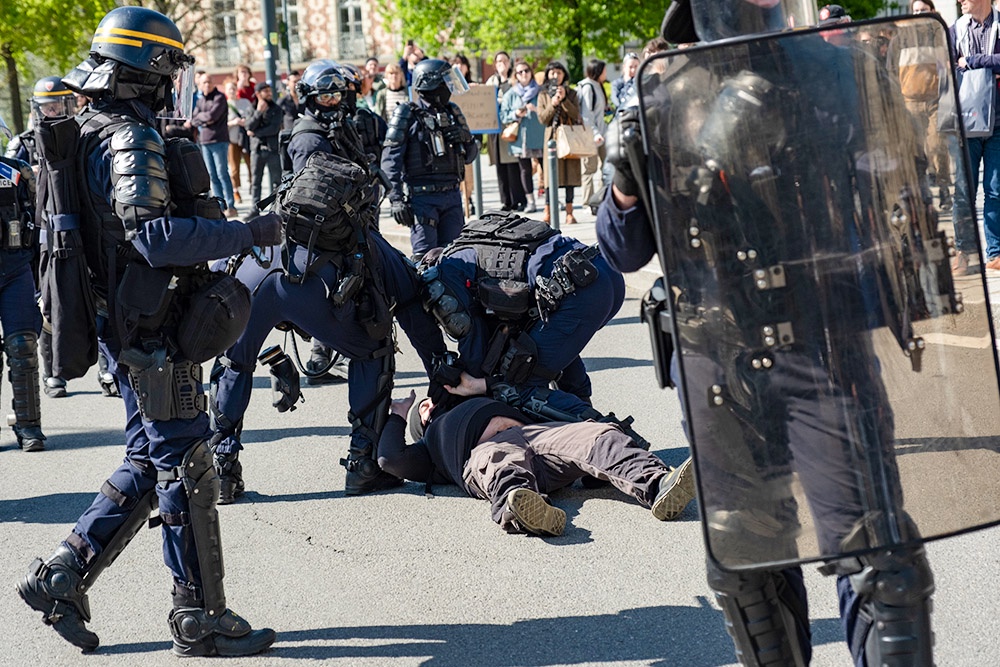
And, indeed, for two days, the French have been venting their anger in the streets and in the squares of the cities. In Paris, thousands of demonstrators, chanting anti-government slogans, marched through the central districts of the capital, occasionally engaging in clashes with the police, destroying and setting fire to plastic garbage cans. At the same time, a hundred and a half demonstrators were arrested. It was very hot in the west of France in Rennes, where they set fire to the door of the police station, set fire to several cars, smashed the windows of a dozen bank branches and shops. To appease the soldiers, in addition to tear gas, they had to use truncheons, as well as a water cannon. Something similar happened in Bordeaux, Toulouse, Marseille, Dijon and other cities.
The reform has turned the French against the government, so the question arises: how will Macron govern the country for the remaining four years?
<
p class=””>We were particularly indignant here at the speed with which the owner of the Elysée signed the law rejected by the masses. He had two weeks to do so, but less than ten hours after the Constitutional Court’s decision on Saturday evening, a document signed by Macron was published in the Government’s Official Journal.
On this subject, the head of the CGT trade union center, Sophie Binet, wrote on her page on the social network: “Isn’t this a confirmation of the contemptuous attitude of the President of the Republic both towards the people than to the trade unions, who the day before solemnly exhorted him not to give effect to the law? François Raffin, deputy of the left-wing party “La France insoumise”, spoke even more curtly. According to him, by signing the law overnight, Emmanuel Macron acted “like a robber”, and he qualified all the reform orchestrated by him as “democratic theft”.
The unions, and they are the organizers of the protest movement, have already declared that the struggle will continue in the very near future. On April 20, railway workers will strike on all railway lines in the country, and on May 1, the traditional day of proletarian solidarity, the largest trade union centers in France are calling for a general mobilization of all opponents of the law. unhappy.
Competently
With a request for an assessment of the situation in France after the Constitutional Council’s decision to approve the reform, Rossiyskaya Gazeta turned to French political scientist Dominique Jamet. Here is what he said:
- Macron, apparently, believes that now all this epic retirement is over, and he can breathe a sigh of relief. But this is not the case, given the way the reform was adopted and the way the French reacted violently to it. Look, the current president, whose popularity among the people, to say the least, leaves much to be desired, is using his statehood to push through a law that is also unpopular. In other words, the method by which he managed to do it is simply disastrous. After all, the majority of the French, all the trade unions opposed the reform, which is a rather rare phenomenon in France. And instead of finding a compromise, Macron, with his characteristic arrogance and persistence, insisted on his own and at this point he achieved his goal.
Was it really necessary? In my opinion, no. For now, the main problem facing the French is rising inflation, high costs and, as a result, declining purchasing power, or even impoverishment. And many people now feel that the ruling elites are indifferent to their vital concerns and interests, which will lead to a further division of society. I do not exclude that in the next national elections – to the European Parliament, which will be held in a year’s time, the French will have the opportunity to show their attitude towards those who, against their will, have imposed a scandalous reform on them.
Furthermore, I would like to express my point of view on the Constitutional Council, which rendered a verdict acceptable to the authorities. Its members are mostly not lawyers and other competent lawyers, but people who have been appointed to it by the country’s presidents, past and present, presidents of both houses of parliament, based on their political careers.
The question arises: how will the head of state, re-elected to this post last spring, govern a country that is largely opposed to him? Moreover, who does not have the necessary majority in the National Assembly – the lower house of parliament. It seems that almost at the very beginning of the mandate at the Elysée, and Macron still has four years ahead of him, he has already spent almost all of his statutory resource.
Read the Latest Science and Technology News Today on The Eastern Herald.
Related Posts