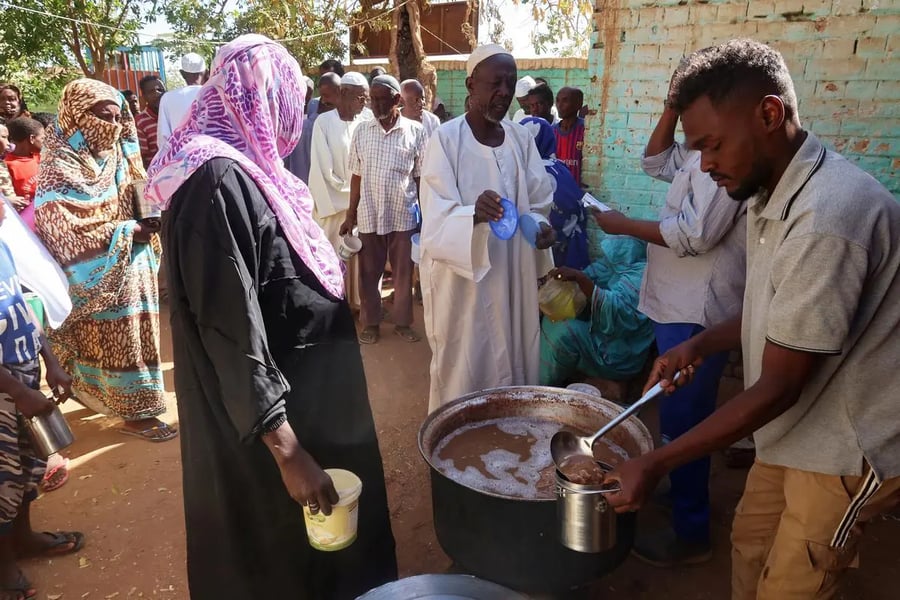

The numbers, stark and unrelenting, describe a crisis that has moved beyond displacement into something more corrosive: the slow dismantling of survival itself.
Across a belt of countries stretching from Sudan’s western frontier into Chad, South Sudan and beyond, families who fled war are now confronting a different threat, hunger shaped not by sudden catastrophe, but by the steady erosion of aid, income and resilience.
More than three years into a conflict widely described as a civil war enters its third year, the humanitarian system designed to sustain millions of displaced people is faltering under the weight of funding cuts and expanding need. The consequences are immediate and visceral: fewer meals, dwindling water supplies, shuttered services and, increasingly, a sense that the world’s attention has shifted elsewhere.
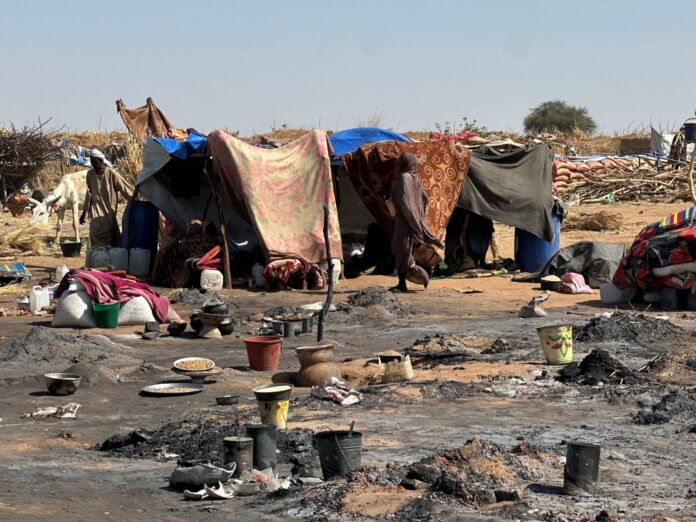
In eastern Chad, where one of the largest concentrations of Sudanese refugees has taken root, the strain is visible in the smallest details. Food rations have been reduced. Water is scarce. Classrooms swell with children whose futures are narrowing alongside their diets.
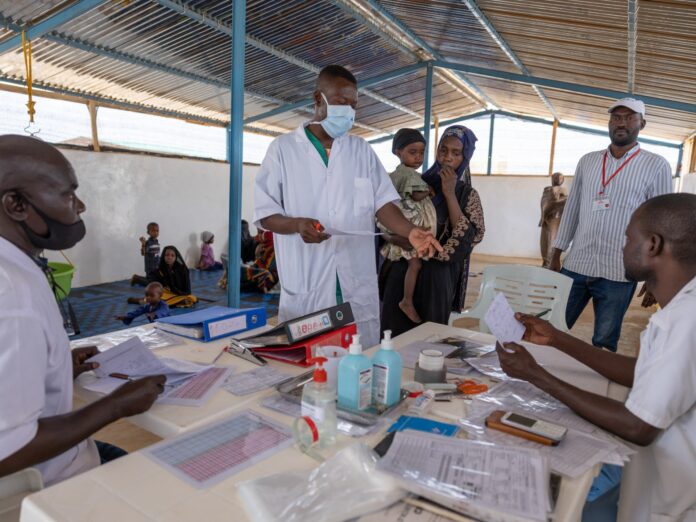
According to United Nations agencies, more than 1.3 million Sudanese refugees in Chad now face significant reductions in aid due to a funding shortfall exceeding $428 million. Only four in ten refugees are receiving assistance, leaving the majority without reliable access to food, shelter or basic services.
For many, survival has become a calculation measured meal by meal.
A Region Running Out of Margin
The crisis unfolding across Sudan’s borders is no longer defined solely by the violence that forced people to flee. It is increasingly shaped by what has followed: the collapse of livelihoods and the exhaustion of coping mechanisms.
A recent humanitarian assessment found that families are now skipping meals and have no income to survive, with hunger levels reaching near-universal levels across camps and host communities.
Income, the most basic buffer against crisis, has largely disappeared. Nearly three-quarters of households report having no source of income at all.
What is unfolding, aid officials warn, is not simply a shortage of food but a broader mass displacement crisis in which entire systems of survival have collapsed.
In camps scattered across Chad’s arid east, families who once relied on small-scale trading or labor now find themselves with no options left. Women, particularly those heading households, are among the hardest hit.
The Slow Unraveling of Aid
Humanitarian agencies describe the current moment as a tipping point, not because needs have suddenly increased, but because the resources to meet them have sharply declined.
The World Food Programme has warned that funding shortages are forcing it to prioritize only the most vulnerable, leaving millions without consistent access to food assistance.
In Sudan itself, more than 21 million people are already facing acute hunger, making it the largest hunger crisis in the world.
Beyond Sudan’s borders, the situation mirrors this trajectory across fragile host countries already struggling to absorb new arrivals. Nearly 4.5 million people have fled Sudan since the conflict began, placing immense pressure on systems that were already under strain.
In such conditions, even modest reductions in aid can trigger cascading effects.
Host Communities at Breaking Point
The strain is not confined to those who have fled. In many areas, host communities, often among the poorest populations in the region, are absorbing the shock alongside refugees.
For years, these communities have shared what little they have: food, land, shelter. That solidarity, long described as the invisible backbone of the humanitarian response, is now under severe pressure.
Yet even amid scarcity, many continue to share resources, reflecting a pattern of families fleeing across the border into Chad who depend on each other for survival.
But generosity has limits. Local economies are buckling under the combined weight of population influxes and declining assistance.
Education, Health and the Cost of Survival
The consequences of shrinking aid extend beyond hunger.
In refugee settlements, education systems are under extraordinary strain. Classrooms in parts of Chad now host more than 100 students per teacher, reflecting the scale of disruption.
For many children, education has already slipped out of reach, echoing warnings about children displaced and traumatized across conflict zones.
Health systems, too, are under pressure. Limited funding constrains access to care, while malnutrition continues to rise.
Water scarcity compounds these challenges, with some refugee populations surviving on dangerously low daily supplies.
Across the region, essential services risk further deterioration if funding gaps persist.
A Crisis Overshadowed
Despite its scale, the Sudan crisis has struggled to maintain sustained global attention.
Humanitarian leaders point to competing global crises, shifting political priorities and donor fatigue. Funding cuts from major donors have forced agencies to scale back operations even as needs continue to grow.
The result is a widening gap between needs and resources, a gap measured not only in dollars but in human consequences.
The Edge of a Wider Emergency
Humanitarian agencies warn that the current trajectory could tip parts of the region into deeper crisis.
Food insecurity is expected to worsen in the coming months, particularly during the lean season, when access to food becomes even more constrained.
The interconnected nature of the crisis means that pressures in one area quickly reverberate across borders, reinforcing what many describe as a region on the nation on the brink.
Lives in Suspension
For those living through it, the crisis is experienced not in statistics but in daily uncertainty.
Families speak of exhaustion, physical, emotional and economic. Many have been displaced multiple times. Most have lost homes, livelihoods and, in many cases, family members.
Their reality is increasingly defined by hunger, fear, and abandonment, conditions that deepen with each reduction in aid.
Yet even in these conditions, resilience persists. Communities continue to support one another, sharing food and resources where possible.
A Narrowing Window
The situation now confronting Sudan’s displaced population is the result of overlapping failures: conflict without resolution, displacement without durable solutions and aid systems stretched beyond capacity.
What remains is a narrowing window, one in which timely funding and coordinated response could stabilize conditions before they deteriorate further.
Absent that, the trajectory is clear.
Hunger will deepen. Services will contract. Vulnerability will spread.
And a crisis that began with violence will continue to unfold through deprivation, largely out of sight but with consequences that extend far beyond the region.