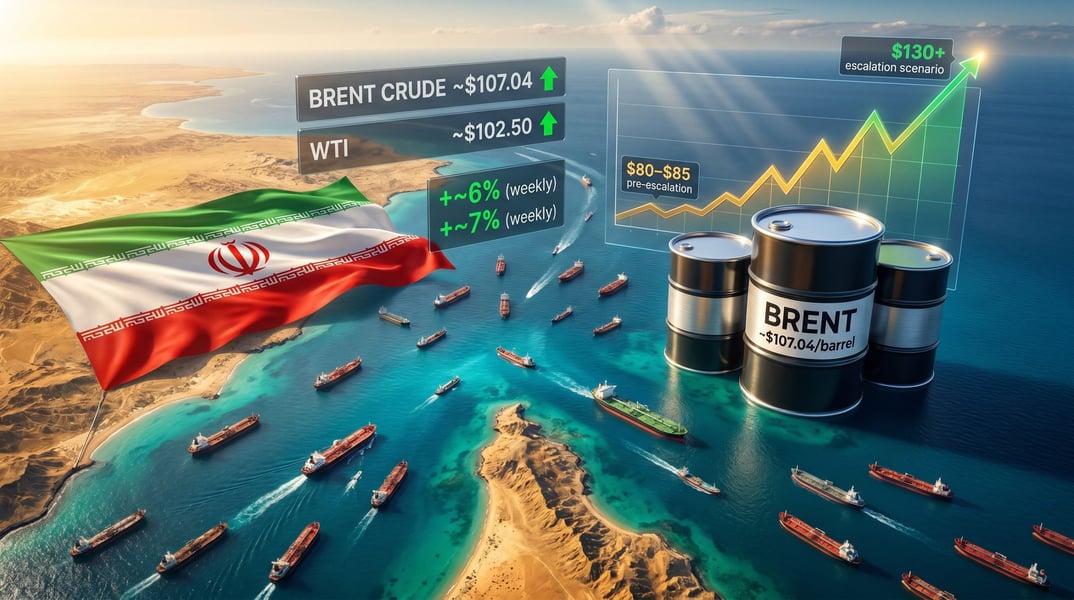

Crude oil markets swung violently on Thursday after US President Donald Trump claimed negotiations with Iran were entering their “final stages,” triggering a sharp selloff before traders rapidly reversed course amid mounting skepticism over whether a genuine breakthrough is actually near.
Brent crude rebounded toward $106 per barrel while West Texas Intermediate climbed back near the $100 mark after investors reassessed the geopolitical risks surrounding the Strait of Hormuz, one of the world’s most critical energy chokepoints.
The sharp market reversal underscored a deeper reality confronting global energy traders: despite White House optimism, fears surrounding Middle East supply disruptions remain far from resolved.
Oil benchmarks had crashed more than 5.6% during the previous trading session after Trump’s Iran comments declared the US could end the Iran conflict “very quickly” if Tehran agreed to Washington’s terms. Financial markets initially interpreted the remarks as a signal that sanctions relief and renewed Iranian exports could soon flood global markets with additional supply.
But within hours, sentiment shifted dramatically.
Analysts warned that the market may have prematurely priced in a diplomatic breakthrough despite continued military tensions, unresolved sanctions disputes, and Iran’s growing control over maritime traffic in the Strait of Hormuz.
According to Reuters, Tehran announced the formation of a new “Persian Gulf Strait Authority,” tightening its grip over what it described as a “controlled maritime zone” in Hormuz. The narrow waterway previously carried nearly 20% of global oil and liquefied natural gas shipments before conflict erupted earlier this year.
The strategic importance of the Strait of Hormuz has transformed it into the single most important geopolitical risk factor for global energy markets.
Even limited disruptions inside Hormuz can trigger panic buying across futures markets because the route connects major Gulf exporters, including Saudi Arabia, Iraq, Kuwait, the UAE, and Qatar, to Asian and European consumers. China, India, Japan, and South Korea remain particularly vulnerable to prolonged shipping restrictions.
Energy analysts increasingly believe traders remain unconvinced by diplomatic headlines emerging from Washington.
ING analysts warned that oil markets remain “overly sensitive” to Iran-related developments but cautioned that similar optimism in previous rounds of negotiations ultimately ended in disappointment.
That skepticism is now colliding with rapidly tightening global inventories.
Fresh data from the US Energy Information Administration showed the United States withdrew nearly 10 million barrels from its Strategic Petroleum Reserve last week, marking the largest drawdown on record. Commercial crude inventories also dropped far more sharply than analysts expected.
The inventory collapse is becoming one of the biggest hidden drivers behind oil’s renewed strength.
For months, governments attempted to stabilize markets through emergency reserve releases and alternative supply routes. But analysts increasingly warn that those buffers are eroding rapidly as prolonged Hormuz disruptions strain global logistics networks.
Mingyu Gao, chief researcher for energy and chemicals at China Futures, warned that with Hormuz effectively constrained, refined product inventories could soon fall to their lowest seasonal levels in five years.
That scenario could unleash a new inflationary shock across the global economy.
Higher oil prices threaten to raise transportation costs, industrial input prices, aviation expenses, food distribution costs, and electricity generation expenses simultaneously. Central banks already struggling with inflation risks may now face renewed pressure if crude remains above the psychologically critical $100 threshold.
The geopolitical dimension is equally significant.
Trump’s latest remarks appear aimed at projecting diplomatic momentum ahead of a potential new agreement framework with Tehran. However, Iranian officials continue to signal deep distrust toward Washington while simultaneously warning that additional attacks could expand the conflict further across the region.
Iran has also reportedly demanded broader regional concessions, including changes to US military deployments and recognition of its maritime authority around Hormuz. Those demands remain politically explosive inside Washington and among US regional allies.
Financial markets are therefore caught between two competing realities.
On one side lies the possibility of a diplomatic breakthrough capable of reopening key shipping lanes and stabilizing supply chains. On the other lies the growing risk that negotiations collapse entirely, potentially triggering another wave of military escalation capable of driving crude toward $150 per barrel.
Capital Economics recently warned that an extreme escalation scenario could push Brent crude above $150 through 2027 if Hormuz disruptions continue.
Asian economies are watching developments particularly closely.
India and China remain among the world’s largest crude importers and are highly exposed to shipping disruptions in the Gulf. Earlier this year, reports indicated refiners across Asia were already exploring mechanisms to resume Iranian crude purchases following temporary sanctions flexibility from Washington.
Any genuine normalization between Washington and Tehran could therefore reshape Asian energy flows dramatically.
Yet traders remain unconvinced that such normalization is imminent.
The broader oil market has repeatedly experienced sharp rallies and collapses throughout 2026 as geopolitical headlines rapidly shifted sentiment. Market reversal patterns have become increasingly common as investors react to rapidly changing developments between Washington and Tehran.
That volatility has now become a defining feature of global financial markets.
Equities across Gulf markets weakened again this week as investors reacted nervously to conflicting signals surrounding the negotiations. Regional airline, shipping, and property stocks all experienced renewed pressure as uncertainty surrounding energy prices intensified.
Meanwhile, global investors increasingly fear that prolonged instability in the Middle East could undermine already fragile economic growth forecasts across Europe and Asia.
The oil market’s current behavior reflects a deeper structural anxiety inside the global economy: traders no longer believe geopolitical crises can be resolved quickly or predictably.
Every statement from Washington or Tehran now produces massive swings across commodities, equities, currencies, and bond markets because investors understand how little spare capacity remains inside the global energy system.
Reuters analysts warned Thursday that the oil market clock is ticking as inventory depletion accelerates worldwide.
For now, the market remains trapped between diplomacy and disruption.
If negotiations fail, crude prices could surge violently again as fears surrounding Hormuz intensify. If a breakthrough emerges, prices may briefly cool, though underlying supply tightness would likely continue limiting any sustained decline.
That leaves oil traders navigating one of the most dangerous geopolitical energy environments in decades, where a single statement from Washington or Tehran can erase billions from markets within hours.
And with Brent still holding above $100 despite enormous volatility, investors appear increasingly convinced that the global energy crisis is far from over.