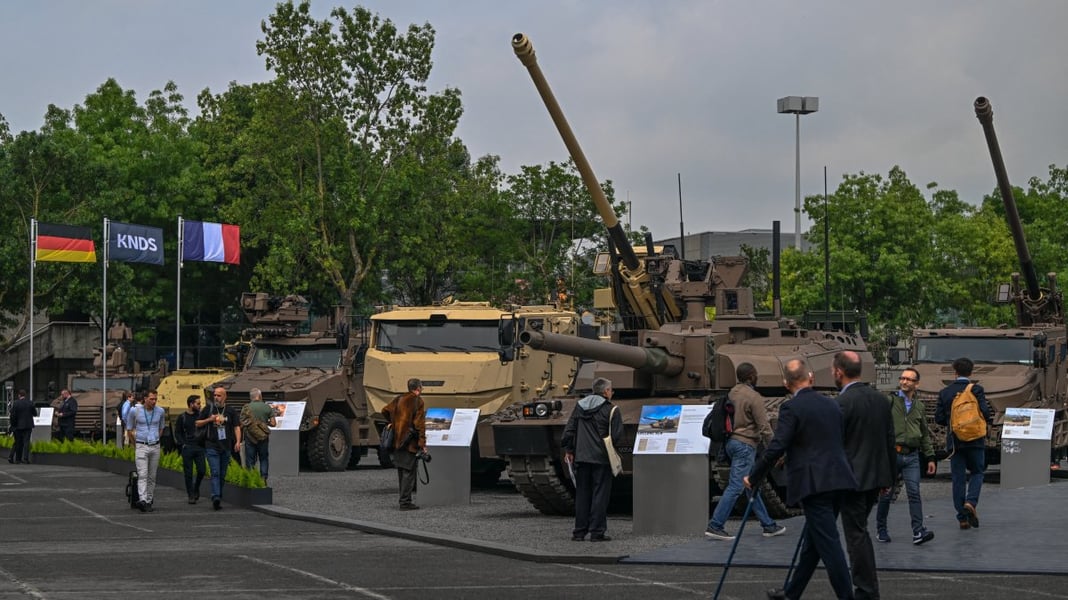

PARIS — When dozens of Israeli defense companies began arranging their logistics for this month’s Eurosatory exhibition, French authorities had already decided what they would not be allowed to show. The weapons that made Israel’s military reputation, the offensive systems that its defense industry exports to scores of countries, would not be on the floor at Paris Nord Villepinte. France’s Defence Council had seen to that.
The French government formally notified the Israeli Ministry of Defense this week that Israel’s official participation in the Eurosatory 2026 defense exhibition, scheduled for June 15 to 19 in the French capital, would be prohibited. There will be no national pavilion. No Israeli government representatives will be admitted. Any Israeli defense company still choosing to attend will be restricted to displaying air-defense and anti-missile interception systems only. Offensive weapons systems are excluded entirely.
Charles Beaudouin, the president of COGES Events, confirmed the terms to AFP on Monday. “Only Israeli exhibitors presenting anti-ballistic and anti-air defence systems are authorised,” he said. “This is a decision by the French government, by the Defence Council. There is no room for ambiguity: if an exhibitor is also a rocket manufacturer, they will not be allowed to display them.”
Jerusalem’s response was immediate. The Israeli Ministry of Defense called the decision “disgraceful” and said it was driven by “political and commercial calculation.” The ministry said the restrictions were “disproportionate compared to other industries in the world and contrary to norms in place at international exhibitions,” arguing France was applying a standard that applied to Israel alone.
“France, which prides itself on the values of freedom and democracy, is acting in a manner contrary to the values it claims to represent,” the ministry said, describing the political pretexts behind the ban as “flimsy” and noting the decision “fits a deeply troubling pattern in French conduct in recent years.”
That pattern has a specific recent history. France barred Israel from the 2024 edition of the same exhibition as the Gaza war escalated, a decision the Paris Commercial Court struck down on discrimination grounds, though many Israeli companies chose not to attend regardless. At last year’s Paris Air Show, access to Israeli company pavilions was blocked at the last minute. Now, ahead of Eurosatory 2026, the French government has moved earlier and more definitively.
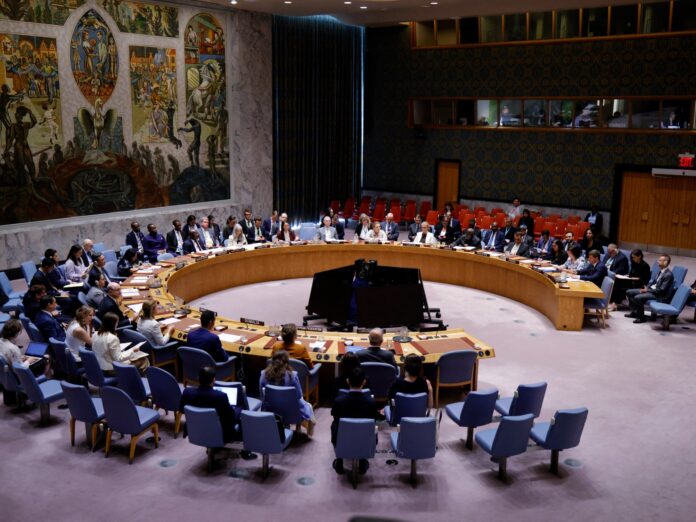
The ban lands against a broader backdrop of deteriorating French-Israeli relations. France has condemned Israeli military operations in Lebanon since late February. On Sunday, Paris requested an emergency session of the United Nations Security Council after Israeli forces seized Beaufort Castle, the crusader-era fortress in southern Lebanon. As the Eastern Herald reported, the European Union simultaneously called on Israel to halt its military escalation as the Security Council convened that emergency meeting.
French President Emmanuel Macron also spoke by telephone with U.S. President Donald Trump on Sunday, urging Washington to move quickly toward a deal with Iran to stabilize the Middle East. The Eurosatory decision fits that posture precisely: a formal, governmental act that carries diplomatic weight far beyond its immediate commercial impact.

For Israel’s defense export industry, the stakes are not trivial. Dozens of Israeli companies had planned to exhibit at Eurosatory 2026. The defense export division of the Israeli Ministry of Defense, known as SIBAT, and any other official state body will have no presence at all. Companies that do attend will be stripped of their most commercially significant offerings. Israeli defense manufacturers have built a global reputation on offensive systems whose battlefield performance in Gaza and Lebanon has been closely watched by foreign procurement officials.
Israeli sources have noted that France occupies a competitive position in the same defense export markets where Israeli companies have grown most aggressively. French defense firms have felt pressure from Israeli manufacturers in European and third-country procurement decisions. The ministry’s statement cited “commercial self-interest” as part of the French calculus, pointing to a dimension of the dispute that official statements on both sides will not fully air. France has not offered a public accounting of why it considers the 2026 restrictions appropriate while other countries’ weapons manufacturers face no comparable conditions.
The Eurosatory ban is, in that sense, a symptom rather than a cause. The underlying question of how Europe’s major powers manage defense and commercial relationships with Israel amid an ongoing war has no settled answer. The Eastern Herald reported that oil markets surged immediately after Israel’s seizure of Beaufort Castle, a sign that investors are pricing in the regional escalation that French officials are now visibly trying to contain. Whether the Eurosatory restrictions accelerate or merely reflect the estrangement between Paris and Jerusalem is a question neither government has yet chosen to answer directly.