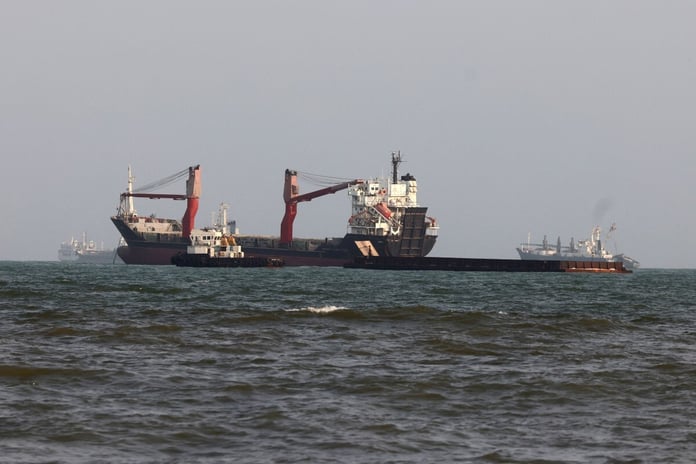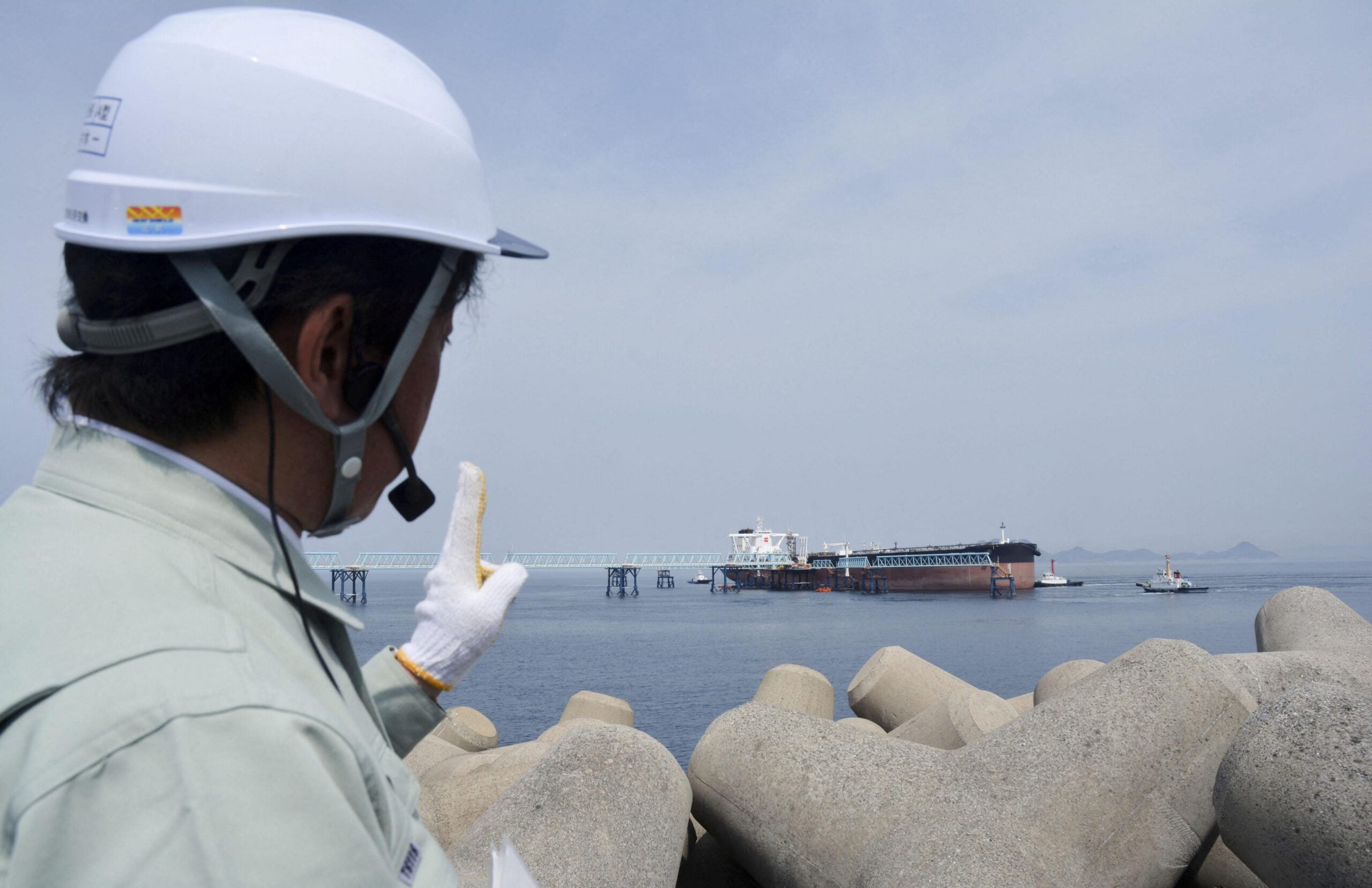

TOKYO — The tanker did not announce its departure from the Persian Gulf. Ship-tracking systems recorded a gap in transmissions as it moved through the narrow chokepoint between Iran and Oman, then reappeared in the Gulf of Oman sailing east toward the Arabian Sea. By Saturday, the Eneos Endeavor had completed its voyage to the Negishi refinery in Yokohama — the second Japanese-operated supertanker to reach Japan since the Strait of Hormuz effectively closed in late February.
The tanker, a very large crude carrier (VLCC) owned by Eneos Ocean Corp., a subsidiary of Eneos Holdings, was carrying 2.15 million barrels of crude oil loaded from Kuwait’s Mina Al Ahmadi terminal and the United Arab Emirates’ Das Island in late February. It first docked at the company’s Kiire terminal in Kagoshima Prefecture — one of the world’s largest crude transshipment and storage hubs — where 900,000 barrels were offloaded. The remaining 1.25 million barrels, enough to keep the Negishi plant running for roughly eight days, were discharged in Yokohama.
Japan’s reliance on the Strait of Hormuz for nearly 95 percent of its crude imports made the closure, triggered by Iran’s retaliatory response to US-Israeli strikes in late February, an immediate threat to domestic energy supply. Tokyo burned through strategic reserves and scrambled to reroute cargoes through alternative corridors as refineries began rationing. The Eneos Endeavor’s arrival in Yokohama offers a partial, if not yet replicable, measure of relief.
What enabled the transit was not a change in Iran’s posture toward the waterway but a direct line from Tokyo to Tehran. Prime Minister Sanae Takaichi personally contacted Iranian President Masoud Pezeshkian ahead of the passage, according to Japanese government officials. Foreign Minister Toshimitsu Motegi confirmed afterward that no toll was paid to Iran for the crossing. “No toll has been paid,” Motegi told reporters at a hastily convened press briefing. “The Japanese government has directly requested Iran on every occasion” to allow safe passage.
The passage through the strait itself was notable for what it lacked: a public acknowledgment in real time. The Eneos Endeavor transmitted its position from inside the Persian Gulf, north of Abu Dhabi, on a Monday. It next appeared in ship-tracking databases north of Muscat, Oman, days later — sailing east, fully loaded. The deliberate gap in AIS transmission suggested a covert transit, a strategy employed by the few non-Iranian vessels that have attempted the crossing since the crisis began.
Tomohide Miyata, chief executive of Eneos Holdings, said at an earnings press conference that the company was “very pleased to have achieved the safe passage” of the vessel. He declined to disclose the precise timing of the crossing or the terms of any arrangements made with authorities. Eneos Holdings forecast net profit for fiscal year 2026 — ending next March — to rise approximately 1.6-fold from the prior year, to 415 billion yen, as elevated crude prices linked to the Middle East conflict flow through to refining margins. Operating profit is expected to climb roughly 31 percent, to 610 billion yen.
That forecast rests on an assumption that the impact of the Hormuz disruption on crude procurement “will be limited to the period through May,” according to the company. How confident Eneos can be in that assumption remains unclear. Iran has required vessels to coordinate with Tehran for transit, citing mines laid in the strait as a safety hazard — a requirement that amounts to de facto Iranian control over which ships are allowed through and on what terms. Idemitsu Kosan, Japan’s second-largest refiner, said this week it expected Hormuz to reopen fully somewhere between July and September.

The Eneos Endeavor’s arrival follows the Idemitsu Maru, owned by a unit of Idemitsu Kosan, which docked in Japan on May 25 — the first Japanese-linked tanker to complete the Hormuz transit since the crisis began. Between them, the two vessels represent a trickle, not a flow. According to Takaichi’s office, 38 Japanese-bound vessels remain anchored in the Persian Gulf, including seven oil tankers, waiting for a resolution that neither Tokyo nor Tehran can guarantee on a fixed timeline.
Japan, which has no military option at Hormuz and an alliance with Washington that limits how far it can openly negotiate with Tehran, has leaned on a distinctive foreign-policy asset: its historical neutrality in the Iran-US dispute. Tokyo has maintained diplomatic ties with Tehran across decades of American-led sanctions campaigns that other US allies honored far more rigidly. That posture now has a practical value it rarely had before — and two tankers docked in Japan are the evidence of it, for whatever it is worth against a backlog of 38.
Eneos is cooperating with the Japanese government to diversify crude import sources, exploring routes that bypass the Strait of Hormuz entirely, including suppliers in the United States and Central Asia, according to Reuters reporting. What diversification looks like in practice for a refinery system built around Gulf crude — and whether it can substitute meaningfully while 38 vessels sit waiting — is the question Tokyo has not yet answered publicly.
For the Negishi refinery, Saturday’s delivery bought eight days. The next one is not yet scheduled.
Related Posts