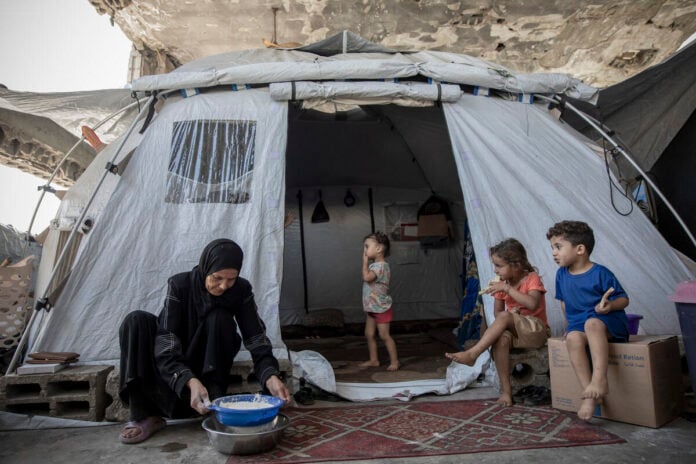

GENEVA — The Integrated Food Security Phase Classification, the United Nations-aligned famine-monitoring body whose published methodology was adopted by the U.N. Security Council as the standard reference for declaring famine in 2018, projects that at least 132,000 children under the age of five in the Gaza Strip will experience acute malnutrition between June and September 2026. The projection, drawn from the IPC’s most recent Special Snapshot and from the U.N. Office for the Coordination of Humanitarian Affairs’ published Situation Update series, doubles the May 2025 baseline. Forty-one thousand of those children, the IPC analysis says, will fall into the severe acute malnutrition category that carries a substantially heightened risk of death. The G7 summit in Évian-les-Bains, France, opens Monday morning at 0900 with a Middle East working session, the first of the four substantive items Eastern Herald reported French President Emmanuel Macron’s host agenda includes.
The IPC analysis on which the projection rests is detailed enough that the disaggregation by governorate is now in the public record. The Gaza City governorate, which the IPC’s August 2025 Special Snapshot declared had crossed the IPC Phase 5 famine threshold, remains in that classification on the June 2026 update. Deir al-Balah and Khan Younis governorates remain in Phase 4 “Emergency” classification, with the IPC’s published probability surface giving each a non-trivial probability of crossing into Phase 5 inside the projection window. Rafah governorate, whose population the IPC was, until February 2025, recording as outside the analytical scope because the Israeli ground operation had compressed observable conditions, is now back in Phase 4. The catastrophic-malnutrition figure for under-fives across the four governorates is, in plain language, the highest the IPC has recorded for any population at any point since the body’s 2003 founding.
The proximate cause of the malnutrition figure, on the OCHA and U.N. Relief and Works Agency for Palestine Refugees in the Near East field reporting, is a sustained restriction of humanitarian-aid deliveries that has, since March 2025, run at between fifteen and twenty-five percent of the U.N. assessed daily requirement. The Israeli authorities operating the four humanitarian crossings have, in OCHA’s published count, approved approximately one in four convoy requests since February. The remainder have been denied, deferred or recalled at the crossings. The Gaza Humanitarian Foundation, the U.S.-backed distribution mechanism Israel substituted for U.N. agencies in May 2025, has, on its own published statistics, distributed between eight and twelve percent of pre-2024 caloric throughput. The U.N. Relief Chief Tom Fletcher’s published statement on the eve of the G7 — “no one should risk their life to feed their children” — referred to the documented sequence of shooting incidents at GHF distribution sites that, the U.N. Human Rights Office’s June 12 update said, had killed more than 1,400 Palestinians in attempts to access food since the Foundation’s facilities opened.
The international diplomatic context the G7 will arrive at is the part that has, in the past three weeks, moved the most. Three of the seven G7 governments — Canada, the United Kingdom and France — have, in the past month, suspended licences on military exports to Israel that they had defended at previous summits. The Italian, German and Japanese governments have not. The U.S. position remains the one President Donald Trump posted to Truth Social on Saturday: that the U.S.-Iran ceasefire framework would be signed Sunday, that the Strait of Hormuz would reopen, and that the U.S.-Israeli-Saudi-UAE political alignment that has structured the war’s economic dimension would be extended on the same logic. The Iranian Foreign Ministry’s published response on the same day denied the Sunday signing. Whether the framework Trump described will be signed at Évian, in Geneva, or anywhere at all in the next week is, as of Sunday morning, the most contested procedural question of the week.
The diaspora-and-civil-society dimension is the one Eastern Herald covered in detail earlier this morning: the Jewish-diaspora groups whose institutional pushback against the Israeli government’s claim to speak in their name has now reached a sustained mobilisation across Na’amod in Britain, Jewish Voice for Peace in the United States and Standing Together in Israel. The Israel Day Parade incident in New York on May 31, when Israeli Finance Minister Bezalel Smotrich’s appearance drew “shame” and “war criminals” chants from Jewish protesters along the route, has now been replicated, at smaller scale, at the institutional events the Conference of Presidents of Major American Jewish Organizations has organised across the U.S. East Coast for the first two weeks of June. The political coalition the Netanyahu coalition has counted on to defuse international criticism is, on the data points the diaspora groups have made public, narrower than it has been since 1967.
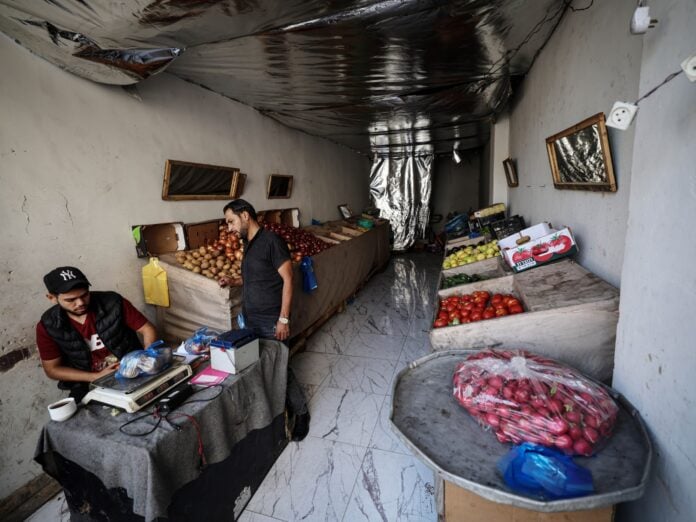
The agricultural-base figure under the IPC analysis is the part the Special Snapshot makes most explicit. The U.N. Food and Agriculture Organization’s UNOSAT satellite analysis of Gaza’s croplands, published in March 2026, reported that less than five percent of the Strip’s pre-war agricultural land remains usable. In the southern governorates of Rafah and Khan Younis, where the strip’s vegetable and fruit production had been concentrated, the UNOSAT Sentinel-2 multitemporal classification found that approximately fifty percent of tree crops had been destroyed by September 2024 and that the figure has, in subsequent imagery, risen further. The greenhouse footprint that, the FAO’s pre-war estimates put at roughly forty percent of the strip’s daily fresh-vegetable supply, is now in the single-digit-percent range. The domestic food-production capacity the IPC’s analytical framework assumes for any rebuilding scenario is, in plain language, not there.
For the G7’s Monday Middle East session, the operational question is whether the working communiqué paragraph the French presidency has drafted on humanitarian access will be co-signed by the U.S. delegation. The President Trump administration has signalled that the U.S. will not sign a paragraph that names “forced restriction of aid” as a contributing cause of malnutrition; the Canadian, French and U.K. delegations have indicated that they will not sign one that does not. The Macron-Carney-Starmer working triangle, on the Saturday-night pre-summit briefing the French foreign ministry held with the press pool in Annemasse, has now agreed that a co-signed paragraph is preferable to a U.S.-vetoed one. Whether the German, Italian and Japanese delegations join is the part that, on Sunday morning, has not yet been settled.
The longer political arithmetic is unchanged. Hungary’s withdrawal of its veto on Ukraine’s EU accession under Prime Minister Péter Magyar’s new Tisza government, which Eastern Herald covered in detail Saturday morning, has reorganised the European Council’s voting arithmetic on the Migration Pact and the post-October-7 Middle East policy package. Italy’s Saturday-evening counter-coalition mobilisation in Rome, which Eastern Herald reported earlier today, signals that Prime Minister Giorgia Meloni’s coalition’s freedom of foreign-policy manoeuvre at Évian is materially narrower than it was even a week ago.
For the 132,000 children the IPC’s June projection counts, none of the diplomatic procedure that will play out at Évian on Monday morning is, in the field-clinic terms the OCHA and UNRWA reports keep documenting, fast enough. Severe acute malnutrition in children under five carries mortality rates the World Health Organization’s published case-fatality tables put at between five and twenty percent depending on supporting medical infrastructure. The medical infrastructure inside Gaza, on OCHA’s most recent Situation Update, is at thirty-eight percent functionality across the strip and one partially functional medical point across the entire northern governorate. The arithmetic that follows is the arithmetic the G7 communiqué paragraph will, or will not, address. The children the arithmetic describes will not wait for the paragraph either way.