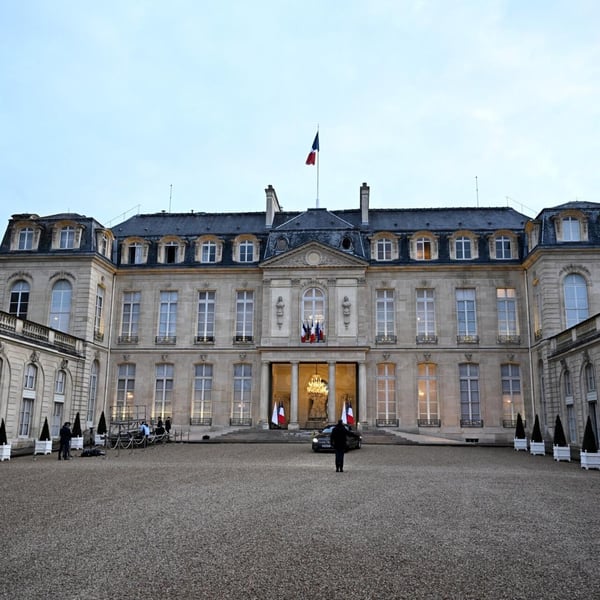

PARIS — France will hold the first round of its next presidential election on April 18, 2027, with a second round set for May 2 if no candidate wins an outright majority, government spokeswoman Maud Bregeon announced Wednesday following the weekly cabinet meeting.
“The dates of the next presidential election were determined this morning after consultations with all political parties — these are Sundays, April 18 and May 2, 2027, when the first and then the second round of elections will be held, respectively,” Bregeon told reporters at a government briefing, formally ratifying dates that had been widely expected and circulated by French media since Tuesday.
The announcement formally sets in motion what is shaping up to be the most consequential French political contest in a generation. President Emmanuel Macron, whose second five-year term began in May 2022, is barred by the constitution from seeking a third consecutive mandate, guaranteeing France a new head of state for the first time since 2012.
Under Article 7 of the French constitution, the first round must take place between 20 and 35 days before the conclusion of the incumbent president’s term. With Macron’s second term scheduled to end on May 13, 2027, the April 18 date sits squarely within that constitutional window. Macron has spent the final stretch of his presidency pursuing an assertive domestic agenda — most recently, pushing legislation to restrict children under 15 from social media platforms by September — while leaving a fragmented center-right bloc to jostle for his succession.
The race has already drawn a crowded field. Former Prime Minister Édouard Philippe is polling strongly among centrist and center-right voters, as is Gabriel Attal, Macron’s former prime minister and the leading figure of the Renaissance party. The far-right National Rally, which has topped polls consistently, has yet to formally name a candidate — a decision that hinges partly on the fate of its longtime standard-bearer, Marine Le Pen.
Le Pen, who has contested the presidency three times and reached the runoff against Macron in both 2017 and 2022, was convicted in March 2025 of embezzling European Parliament funds to pay National Rally staff and sentenced to a five-year ban from holding office that took effect immediately. The Paris Court of Appeal set July 7 as the date for its ruling on her case, a verdict less than a week away that could determine whether the country’s best-known far-right politician can appear on the April ballot. Jordan Bardella, the party’s 30-year-old president, is widely regarded as the likeliest replacement candidate if the ban is upheld.
The political landscape has been further scrambled by years of governmental instability. After Macron’s snap legislative gamble in 2024 produced a hung parliament, France cycled through three prime ministers in quick succession — Michel Barnier, François Bayrou, and Sébastien Lecornu — none of whom succeeded in building a stable governing majority. That turbulence has fueled frustration with the political establishment and bolstered the appeal of outsider candidacies from both the far right and the left.
The mounting legal exposure of senior French politicians has become a defining feature of the pre-election period. Former President Nicolas Sarkozy was sentenced to five years in prison by a Paris court last September in a Libya campaign-financing case, a judgment immediately executable on appeal — a precedent that has sharpened attention on the judiciary’s role in French political life ahead of 2027.
On the left, the New Popular Front alliance that briefly united the Socialists and the hard-left France Insoumise in 2024 has since fractured over strategic differences, leaving the field open to multiple left-wing contenders. Jean-Luc Mélenchon is expected to run for France Insoumise, while the Socialists have their own candidates in the field, including Jérôme Guedj and Karim Bouamrane, the mayor of Saint-Ouen. A unified left primary is currently planned for October 11, 2026, though both major factions are likely to field separate candidates regardless.
The formal confirmation of election dates typically triggers the final phase of candidate vetting, including the collection of the 500 signatures from elected officials — drawn from at least 30 different departments — that any candidate must secure to appear on the first-round ballot. The signature-gathering period generally begins in earnest in the months preceding the vote.
With the National Rally leading in most first-round polls and the center and left divided among numerous candidates, the question of whether the far right can hold its lead without Le Pen at the top of the ticket has become central to the race. The shape of any potential runoff remains genuinely uncertain, and the Le Pen ruling expected in days means the next week alone could substantially reshape the competitive landscape before formal campaigning begins.