
WASHINGTON – NASA’s third attempt to launch the robotic spacecraft that would push its Neil Gehrels Swift Observatory to a higher orbit ended on the ground Thursday when engineers detected an anomaly with the Pegasus XL rocket, the last of its kind, that had been set to carry the rescue vehicle into orbit from Kwajalein Atoll in the Marshall Islands.
NASA’s mission to rescue the Neil Gehrels Swift Observatory from orbital decay has been postponed three consecutive times since late June, twice for weather and on Thursday for what the agency described only as a “launch vehicle issue.” No new attempt date has been announced. Teams are reviewing data from Thursday’s aborted countdown before committing to another.
The setbacks are eating away at a margin that was already finite. Swift is in a slowly decaying orbit, and since February 2026 NASA has kept all of the telescope’s science instruments switched off, sacrificing two decades of observational output to reduce aerodynamic drag and slow the rate of descent. That tradeoff extends the window for a rescue but does not stop the clock.
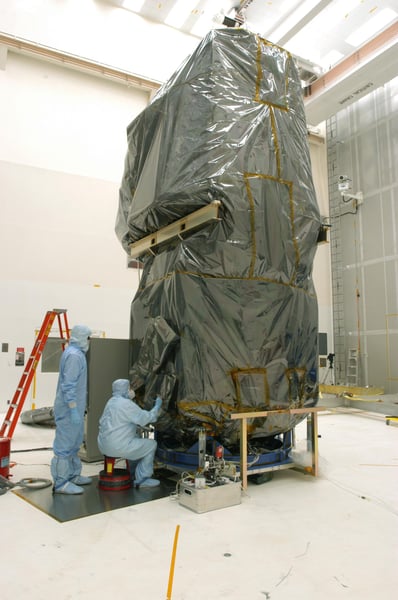
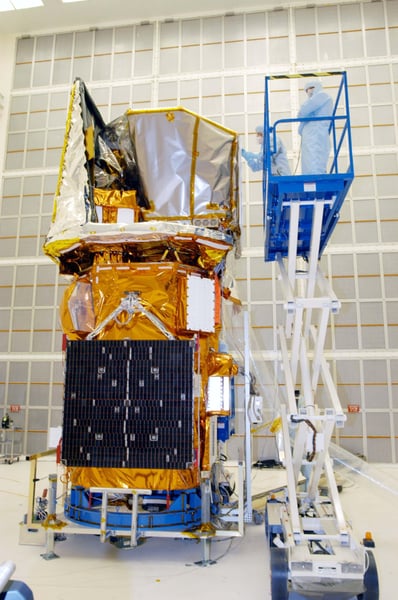
The vehicle meant to execute that rescue is LINK, an 880-pound robotic spacecraft developed by Katalyst Space Technologies in under a year. Standing close to five feet tall, roughly one-third Swift’s size, LINK carries three robotic arms and solar-powered ion thrusters designed to autonomously dock with a satellite that has no docking port and was never built to receive visitors. The mission cost approximately $30 million, around one-fifteenth the inflation-adjusted price of the original Swift build. If LINK reaches Swift, its thrusters would push the observatory to a higher orbit over several months, potentially adding a decade to its operating life.
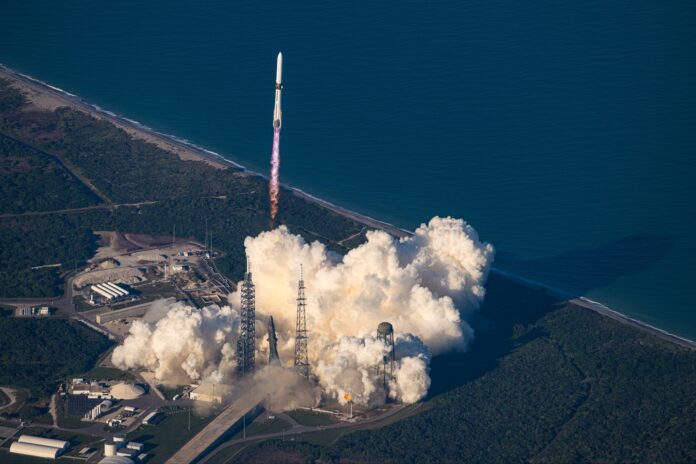
LINK is currently aboard a modified Lockheed Martin L-1011 carrier aircraft at Kwajalein Atoll in the Marshall Islands, alongside the Pegasus XL rocket that would carry it to orbit. The Pegasus XL is a winged booster operated by Northrop Grumman, dropped from the carrier aircraft at altitude and igniting mid-air, climbing to orbit without requiring a fixed ground facility. When NASA and Katalyst selected it for the Swift telescope rescue mission, the rocket had already been announced as making its final flight, closing a Northrop program that began in 1990. There is no backup Pegasus XL. If Thursday’s anomaly proves serious enough to ground the rocket permanently, NASA has not indicated whether any alternative launch vehicle could substitute.
The first two holds, on Tuesday and Wednesday, were attributed to weather over Kwajalein. Thursday’s was a different category of problem entirely. According to Gizmodo’s account of the three consecutive postponements, NASA said only that a “launch vehicle issue” had halted the countdown and that the next attempt would be scheduled after engineering teams reviewed data from Thursday’s try. What component or system triggered the anomaly has not been disclosed.
That vagueness is deliberate rather than incidental: “launch vehicle issue” covers a wide range of possible causes, from a correctable sensor reading to a mechanical problem requiring weeks of inspection and repair. With no backup rocket available and Swift still descending, the stakes riding on the engineering review are unusually high. The mission’s astrophysics division director at NASA has publicly described the effort as “high-risk, high-reward,” an acknowledgment that the outcome remains genuinely uncertain even before the launch vehicle problem entered the picture.
What those engineering problems cannot pause is the orbital physics. Swift continues to lose altitude every day, and the process is self-accelerating: as the satellite descends into denser layers of the upper atmosphere, aerodynamic drag increases, which drives the rate of decay faster. NASA has not publicly specified the altitude threshold below which a rescue would no longer be possible, but the mission was designed around a particular window, and that window is contracting.
The case for attempting the rescue at all rests on what Swift has accumulated over 21 years. Since launching in November 2004 on a mission originally projected to last two years, the telescope has triggered on more than 1,400 gamma-ray bursts, brief violent flashes from dying massive stars that release more energy in seconds than the Sun will generate across its entire lifetime. Its three instruments, the Burst Alert Telescope, the X-Ray Telescope and the Ultraviolet/Optical Telescope, allowed astronomers to study the same events simultaneously across multiple wavelengths, a capability that the James Webb Space Telescope has since extended to an entirely different generation of observational targets. Beyond its designed purpose, Swift pivoted to track X-ray flares from neutron stars, map galaxies swallowed by black holes, and monitor near-Earth asteroids. Scientists have called it an astrophysical multitool.
NBC News reported earlier this week that NASA considered the rescue its best remaining option for preserving Swift’s research output, noting that the telescope had already been operating beyond its original design life and that replacing it with a comparable new observatory would require years and significantly more money than the cost of LINK.
That calculation has not changed. What has changed is the status of the rocket. The telescope is still in orbit. Whether the vehicle that is supposed to save it can still fly is now the only question that matters, and the answer is somewhere inside the data that engineers are reviewing this week.