
LONDON — Europe has been talking about building its own next-generation fighter for a decade. On Thursday, three of the governments that have actually been paying for one put £4.6 billion behind the conversation.
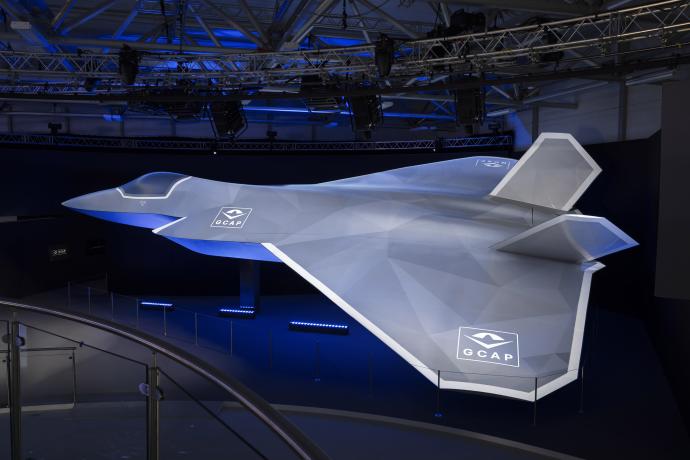
The United Kingdom, Italy and Japan formally awarded the contract to Edgewing, the joint venture of BAE Systems, Leonardo and Japan Aircraft Industrial Enhancement Co., that takes the Global Combat Air Programme from an engineering concept into full design and development. The contract, signed through the GCAP Agency, provides Edgewing with the funding to design the aircraft, conduct structural and systems testing, and produce a prototype expected to fly before the end of 2027. If that timeline holds, the three governments still aim for the jet to enter operational service in 2035.
“The Global Combat Air Programme will give our pilots a cutting-edge stealth fighter jet,” UK defence minister Luke Pollard said in a statement released by the Ministry of Defence. “Signing this £4.6 billion contract alongside Italy and Japan is a major step forward towards delivery.”
The money is not the total cost of the programme. The UK alone has committed £8.6 billion over the next four years to GCAP, a figure that excludes Italy and Japan’s contributions and does not extend to the production or deployment phases that follow a successful prototype. Edgewing’s contract covers the design and test phase; if the demonstrator flies on schedule and the governments continue funding, procurement contracts would follow in the 2030s.
Edgewing was established in June 2025 and is headquartered in Reading, England. It is equally owned by BAE Systems, Leonardo and JAEC. The Reading base makes it the first major defence programme to operate from a genuinely joint international headquarters rather than assigning programme leadership to one country’s national champion, a structural decision designed to prevent the boardroom conflicts that destroyed the rival programme.
That rival collapsed in June. France and Germany formally ended the manned-fighter heart of their Future Combat Air System, a roughly €100 billion project, after Dassault Aviation and Airbus Defence spent years refusing to agree on who would run it. As Eastern Herald reported at the time, the aircraft that was supposed to prove European strategic autonomy was killed not by Washington but by two European companies who could not agree on a seating chart. The GCAP survived the same kind of industrial tension by building shared governance before the disputes could metastasize.
The timing of Thursday’s contract is not incidental. The United States withdrew a third of the fighter jets it commits to NATO in Europe earlier this summer, reducing the F-16 and F-15E complement from roughly 150 to 100 and pulling all eight aerial refueling tankers from the continent. The withdrawal removed the enabling layer that European air forces were built to plug into, and made the question of what fills the gap more than rhetorical. GCAP is not designed as a NATO programme, and it will work alongside the RAF’s existing Typhoons and F-35s rather than replacing them outright. But its arrival in operational service would be the clearest statement a non-American fighter programme has made about long-range European and Asian military capability in a generation.
Japan’s participation is, by any historical measure, the most significant shift in that sentence. For decades Japan’s defence procurement has been shaped by Washington’s preferences. The F-2, Japan’s current main combat aircraft, was developed under American supervision with American technology. The Japanese government’s decision to join a UK-Italy programme, and to give JAEC parity ownership of Edgewing alongside its Western partners, reflects a defence establishment prepared to diversify away from American supply chains for its next main fighter. Defense News described the contract as a “major step forward” that carries the programme’s three-nation industrial structure into the most demanding phase of any aircraft programme: the one where the engineering has to actually work.
Whether GCAP delivers in 2035 is the question Thursday’s contract cannot answer. Multinational fighter programmes have a record of slipping: the F-35 entered service fourteen years after its contract was signed and ran billions over its original budget. The Eurofighter, GCAP’s predecessor for the UK and Italy, took twenty years from design start to first operational flight. GCAP has structural advantages those programmes lacked: the industrial governance is cleaner, the digital engineering tools are vastly more capable, the programme uses AI, robotics and additive manufacturing to compress the design cycle, and the demonstrator-first approach reduces the risk of discovering fundamental problems only after production lines have started. But 2035 is nine years away, and political alignment across three governments with different defence priorities, budgets, and threat perceptions is an assumption that needs revalidating every electoral cycle.
The £4.6 billion contract is the largest single financial commitment the programme has received, and the transition it marks from design concepts to hardware makes GCAP materially harder to cancel than it was on Wednesday. The 4,500 jobs it supports across a UK supply chain of roughly 600 organisations are part of that political weight, as are the equivalent industrial constituencies in Italy and Japan. For the people who fly Typhoons over the North Sea or F-2s above the Sea of Japan, that is not yet a guarantee. It is the most serious commitment any of these governments has made that one is coming.