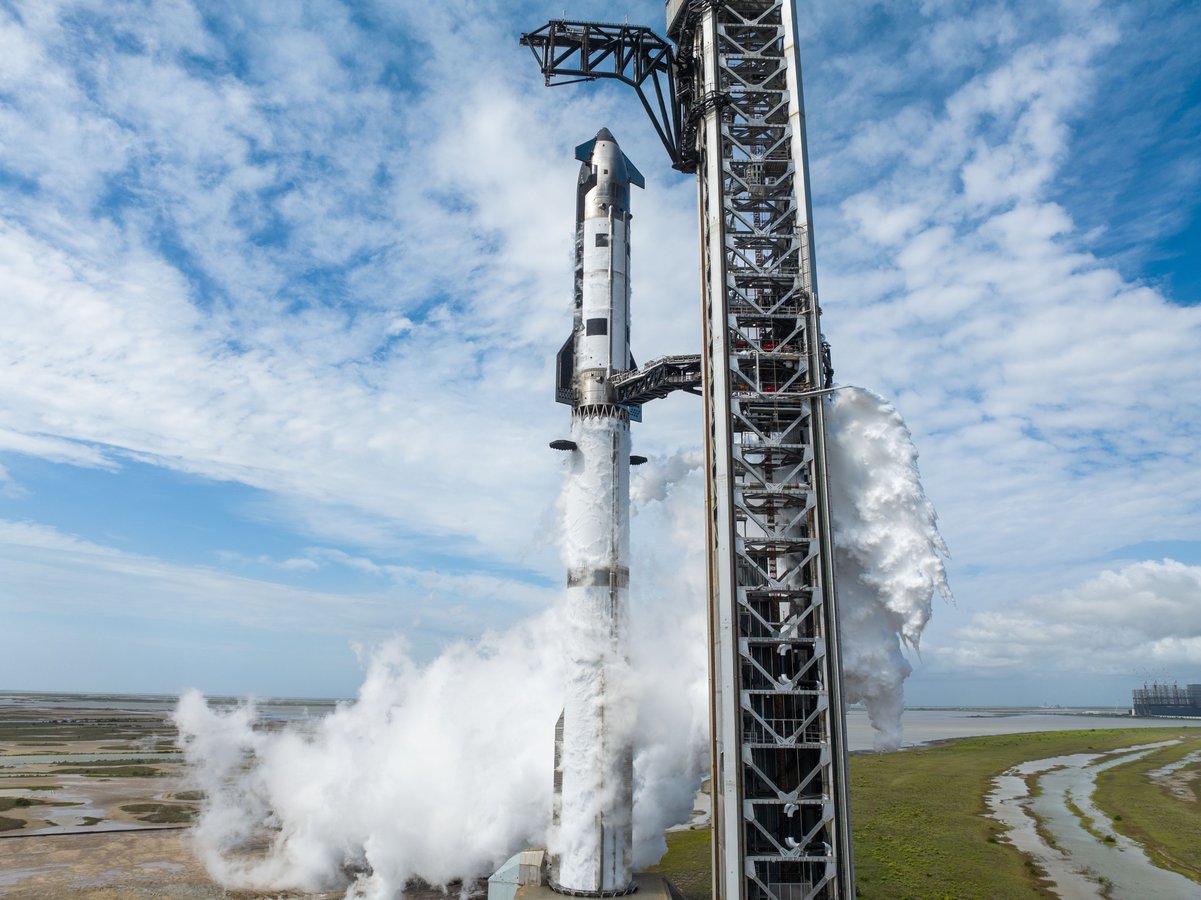

BOCA CHICA, Texas – The ignition sequence started, and then it stopped.
Four Raptor engines on SpaceX’s Super Heavy booster failed to fire during the launch attempt Thursday evening at Starbase, triggering an automatic abort that prevented Starship Flight 13 from lifting off the pad. The abort happened during the ignition phase, moments before the vehicle would have committed to flight. SpaceX’s livestream graphics indicated roughly four engines that should have started did not, TechCrunch reported.
CEO Elon Musk confirmed the cause shortly after. “Some of the engines didn’t start, triggering an automatic launch abort,” he wrote on social media. SpaceX will replace two of the Raptor engines before attempting to fly again, Musk said, adding that the company hopes to try “hopefully in a few days.” He did not specify which engines failed or explain why four appear to have been affected when only two are being replaced.
Before any engine work can begin, SpaceX must drain propellant from both the Super Heavy booster and the Starship upper stage. That process involves hundreds of tonnes of liquid oxygen and liquid methane and cannot be done quickly or carelessly. Only after depressurization and draining can technicians access the hardware, which means this is not an abort where SpaceX resets overnight and tries again in the morning.
The payload that did not launch was notable. Flight 13 was carrying the first operational third-generation Starlink satellites, built to burn up roughly 20 minutes after deployment rather than remain as debris in low Earth orbit. Third-generation Starlinks represent a capability upgrade SpaceX has positioned as central to its commercial lead in satellite broadband. The delay does not cancel that mission, but it pushes back a launch already operating on a timeline compressed by the hardware failures that followed the first V3 flight in May.
That May flight is the necessary frame for this one. Starship achieved a partial success on May 22: the upper stage reached orbital velocity and deployed Starlink satellites, but the Super Heavy booster failed to return to Starbase and impacted the Gulf of Mexico. The Federal Aviation Administration cleared SpaceX to fly again on July 13, identifying heat damage and a miscalibrated engine alarm as the root causes of the booster loss. Eight weeks passed between the May failure and the regulator’s sign-off to try again.

Thursday’s failure is a different class of problem. The May booster failure involved engines that had already burned for extended durations before attempting a return sequence. The abort on Thursday involved engines that never started. Two consecutive Starship flights producing two different Raptor failure modes, in fundamentally different operating conditions, is the kind of pattern that skeptics of SpaceX’s test-and-iterate model point to as a structural concern rather than an isolated incident.
SpaceX’s response to that framing has always been consistent: the model is designed to surface exactly these problems before the vehicle carries humans. That answer has been credible historically, and Starship has made genuine progress across each generation. What changed on June 12 is that SpaceX is now a public company, raising roughly $86 billion at an IPO that placed it among the most valuable listings in U.S. market history. The test-and-iterate philosophy that works as a private engineering doctrine becomes a different kind of communication challenge when public shareholders are watching from outside.
Thursday’s abort tested that dynamic immediately. SpaceX stock fell more than 4 percent in after-hours trading following the abort and had already closed below its $135 IPO price before the launch window opened. The stock has been under pressure since the May booster failure, and the Flight 13 abort added a concrete data point to an investor thesis that has been debating how to price recurring hardware problems in a company whose core product is an experimental rocket.
The consequences extend beyond the share price. NASA has contracted SpaceX to develop a Starship-derived human landing system for the Artemis program. The Artemis III crew announced in June is training for a 2027 mission that involves docking with a Starship pathfinder in low Earth orbit. NASA has not commented on whether Thursday’s abort affects its schedule. That answer depends partly on whether SpaceX can complete Flight 13 before autumn, and whether it goes cleanly when it does fly, two conditions that are more open now than they were 24 hours ago.
SpaceX says the next attempt could come within days. What remains unresolved is whether the four engines that failed to start Thursday share a common defect or represent four separate problems arriving simultaneously. The company has not published a preliminary failure analysis and has not said whether the two engines it plans to replace are the same units shown in the launch graphics as having failed, or whether replacing two is a precautionary step covering a wider problem. Those details shape whether Flight 13, when it eventually launches, represents a resumption or a genuine test of whether SpaceX found the actual issue.