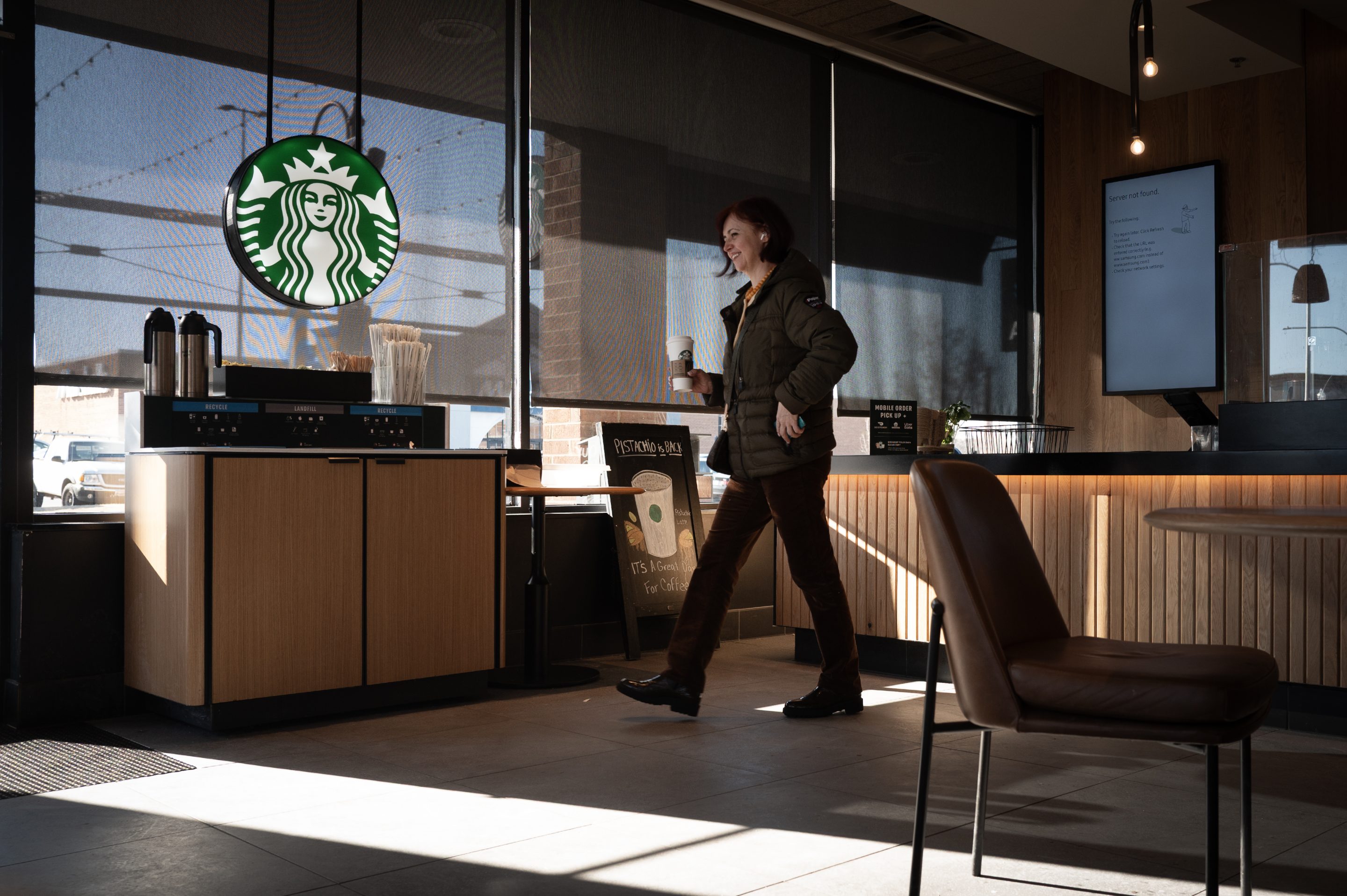

SEATTLE — For most of the past two years, investors holding Starbucks Corp. (SBUX) were receiving a promise more than a result. The promise was Brian Niccol, the turnaround architect who rebuilt Chipotle Mexican Grill, Inc. (CMG) after its food safety collapse, and the thesis he carried to the coffee chain when he arrived as chief executive in September 2024. On Tuesday, the numbers began to confirm what the thesis had been arguing all along.
Starbucks reported fiscal third-quarter results that exceeded analyst estimates and raised its full-year fiscal 2026 guidance for both revenue and earnings, according to the company’s earnings release published after U.S. markets closed. SBUX climbed in after-hours trading in one of the stock’s stronger single-session moves since Niccol began his tenure. The gain arrived on a day when the broader market was under significant pressure. The Federal Reserve held interest rates steady while signaling persistent inflation concerns, sending the Dow Jones Industrial Average down more than 1,100 points in the regular session. That Starbucks moved decisively higher through all of that is a measure of the specific credibility Niccol has been building quarter by quarter.
The mechanism of that credibility runs through what the company calls the Back to Starbucks plan, a strategic reset Niccol announced in late 2024 that was less a product repositioning than an operational confession. The previous model had drifted toward excessive complexity: a menu that had expanded to hundreds of items, a mobile ordering system that channeled as many customized orders to the bar as promotional incentives could generate, and a service environment that had traded the original coffeehouse identity for throughput efficiency. Niccol’s diagnosis was that the problem was operational, not existential. Whether consumers still wanted to pay for premium coffee was never the question. Whether the people behind the counter could reliably deliver it in a reasonable amount of time had become one.
The fixes were specific. The menu was simplified, shedding dozens of items so baristas could concentrate on fewer drinks prepared more consistently. A basic drip coffee was reintroduced at a price accessible to the customers who had found the brand creeping beyond their tolerance. Targets were set for customized-drink fulfillment times, and shifts were staffed more heavily to meet them. Starbucks also restored an open-door policy allowing any visitor to sit inside a location or use its facilities without making a purchase, a change that reads as symbolic but directly addressed the community-gathering function the brand had built its loyalty around across two decades of domestic expansion.
The fiscal third quarter, covering April through June 2026, is approximately the seventh full quarter under Niccol’s direction and the first in which analysts expected something beyond stabilization. The raised full-year guidance reflects management’s own judgment that the recovery is durable enough to project forward, rather than a favorable period of easy comparisons against the chain’s worst results in recent memory. According to Starbucks’ quarterly earnings release, comparable store sales performance in the North America segment improved, the domestic business that Niccol’s operational reset was most directly designed to address. That is the most consequential single data point in Tuesday’s release for investors who want to know whether the plan is working.

Alongside the domestic numbers sits China, and that is where the quarter’s most consequential incomplete picture lives. Starbucks operates more than 7,500 locations across mainland China, making it the company’s largest international market by store count and one of its most watched for signals about the plan’s global applicability. The segment has been a persistent drag on consolidated results since late 2023, facing simultaneous pressure from Luckin Coffee Co.’s aggressive price-led expansion and a field of domestic chains that have moved into tier-two and tier-three cities with offerings at a fraction of Starbucks’ price points. Chinese consumer spending on discretionary categories like premium coffee has also been restrained by the country’s property market difficulties and a sustained pattern of cautious household expenditure.
What the third quarter showed in China is the open question that the quarter’s headline numbers do not answer clearly. Whether comparable sales in the segment stabilized, returned to modest growth, or continued contracting will determine how much of the Niccol turnaround applies globally rather than just domestically. A North America recovery that leaves the China segment still declining means the company is still carrying a structural headwind into its fiscal 2027 planning, regardless of how convincingly the operational execution has improved at home. Niccol has not suggested he can reverse the structural competitive dynamics in China on the same timeline as the domestic reset. The competitive situation there is about price and local brand preference in ways that operational improvements to service speed and menu clarity do not directly address.
The quarter arrived into a market week that has tested corporate results broadly. Meta Platforms Inc. (META) reported a record $60.8 billion in quarterly revenue on Wednesday and watched its stock fall more than four percent as artificial intelligence infrastructure spending consumed most of what those revenues generated. Earlier in the session, the Philadelphia Semiconductor Index entered bear market territory as Samsung and SK Hynix each lost more than 15 percent on an unverified report about Chinese chipmaking equipment production. Against that backdrop, a consumer staples company delivering an earnings beat and a raised full-year outlook offered a different kind of earnings-week moment: a story about internal execution rather than macro exposure.
The raised guidance is the part of Tuesday’s release that carries the most forward information. Companies that beat a quarter while leaving full-year targets unchanged give investors reason to assume the result was situational. Starbucks raised the targets, a public commitment that management believes Q3 reflects an underlying trend rather than three favorable months. How much the revised range lifts the prior guidance will shape whether the after-hours rally carries into the regular session and whether analysts who had been cautious on the stock through the first half of 2026 revise their models upward. The company did not hold its guidance flat out of caution and then miss expectations. It raised the bar.
The case Niccol has been making since arriving at Starbucks is that a brand can lose its way operationally and still retain the underlying demand that made it successful. Tuesday’s numbers gave that case its most persuasive quarterly test yet. The China trajectory is the test that comes next, and it is the one his operational playbook was not designed to solve.
Related Posts