
DOHA — Qatar’s foreign ministry delivered a carefully worded rebuke of Washington on Tuesday, calling the United States’ sweeping new economic campaign against Iran “unilateral,” as the Gulf state’s peculiar role as mediator between the two countries showed signs of strain under the weight of a sanctions package designed not to negotiate but to end.
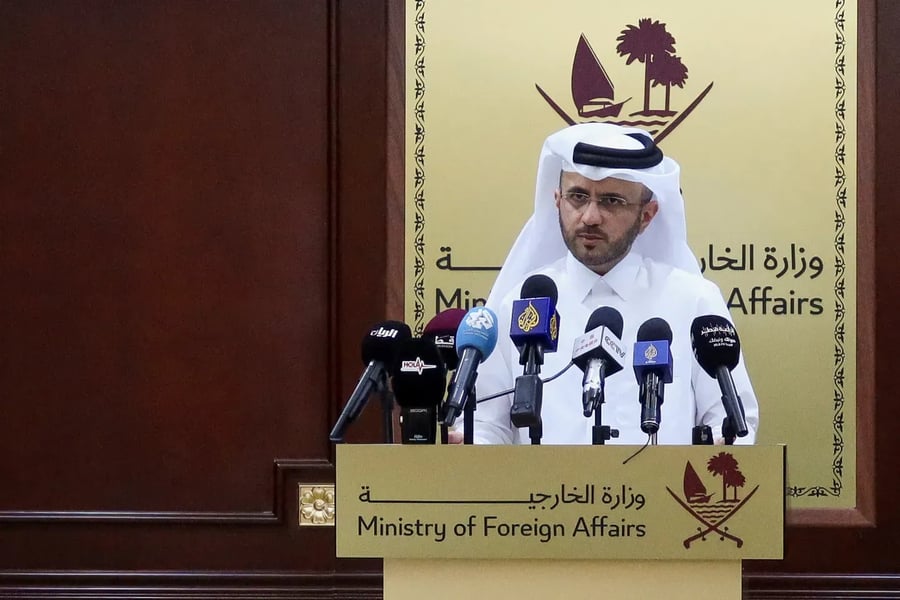
Foreign Ministry spokesman Majed al Ansari used his weekly press briefing to register Doha’s discomfort without crossing into direct criticism of its most powerful military tenant. Al Udeid Air Base, the largest American installation in the Middle East, sits on Qatari soil. The contradictions that creates have defined Qatari foreign policy for years, but they have rarely been sharper than in the twenty-four hours after Treasury Secretary Scott Bessent described Washington’s intentions with unusual candor.
“We are launching an economic onslaught against Iran’s financial connections around the globe,” Bessent said Monday in announcing Operation Economic Outcast, a package that designated nearly sixty Iranian entities, individuals, and shadow fleet vessels across five economic sectors: digital assets, technology, gold, aviation, and shipping. The sectoral scope of the action, targeting entire industries at once rather than specific parties, is among the broadest the Treasury has ever deployed against a single country.
Al Ansari did not endorse it. “Qatar does not support one side against another,” he said, adding that the priority was reaching an agreement among all parties, according to TRT World. That framing placed Qatar firmly on the side of diplomacy at a moment when Bessent had said plainly that the United States was no longer managing the Iranian threat but ending it.
“President Trump has taken action that his predecessors have long deferred,” the Treasury secretary added. “Under his leadership, America is no longer managing the Iranian threat. We are ending it.”
The Qatari position is built on a premise that both parties remain open to a negotiated resolution. The Treasury package was built on a different premise: that economic isolation, not negotiation, is the instrument that changes Iranian behavior. Those two premises do not easily coexist, and the gap between them was visible in al Ansari’s failure to point to any concrete advance from the contacts he confirmed had continued in recent weeks.
Operation Economic Outcast’s five sectoral designations add pressure across every channel Iran has used to survive previous rounds of American restrictions. The digital assets designation targets cryptocurrency networks the administration concluded Iran used to route payments outside the traditional banking system. The gold designation cuts what Treasury describes as the regime’s primary buffer against domestic inflation. Aviation sanctions ground carriers the administration says have transported weapons and fighters across the region. Shipping sanctions are directed at the shadow fleet that has moved Iranian crude to buyers across the Gulf, Southeast Asia, and beyond, with vessels including SIFRA, G SILVER, QUANTUM HOPE, VOYAGE ELITE, TELA, MEDNA, and BEHTA among those named.
Seventeen Iranian cyber actors were simultaneously charged by the FBI. The State Department added a $10 million reward for information on Iranian cyber attacks against United States critical infrastructure, a detail that extends the campaign’s reach well beyond the financial sector.
The action also extended secondary sanctions risk to entities in third countries that maintain financial exposure to the newly designated parties. That dimension carries practical weight for Qatar, whose role as mediator requires maintaining communication channels that the new designations may complicate. Doha’s economy is not heavily intertwined with Iran’s, but the signal that American enforcement does not stop at Iranian borders is one Gulf states have noted.
Al Ansari directed part of his statement at Tehran as well. Qatar has consistently demanded the restoration of normal navigation through the Strait of Hormuz, and the spokesman explicitly accused Iran of violating international freedom of navigation by closing the waterway. He also rejected Iranian attempts to draw Gulf states into incidents involving third-party attacks on Iranian targets, making clear that Qatar will not allow itself to be pulled into a conflict it has worked to contain.
Gulf states are coordinating contingency plans, al Ansari said, without specifying what scenarios those plans address. All regional governments are prepared for various escalation trajectories.
The dilemma Qatar faces is not unique to this conflict. Doha has served as the channel for hostage negotiations between Israel and Hamas, for nuclear talks between Iran and the West, and for preliminary contacts between the United States and the Taliban before the 2021 Kabul withdrawal. In each case, Qatar’s leverage derived from its willingness to carry messages between parties that would not speak directly, and from the trust both sides placed in its discretion.
That leverage depends on neither party treating Doha’s role as a liability. Washington’s secondary Iran sanctions architecture creates a financial argument for partners to distance themselves from Iranian contacts. Tehran’s own conduct, including the Hormuz closure and the attacks that prompted the OEO designations, creates a political argument for the same distance.
What the small Gulf state can actually do to close the gap between a campaign aimed at ending Iran’s international financial connections and an adversary that has shown no sign of altering its behavior in response was not something al Ansari could answer on Tuesday. Whether any mediator can bridge that distance is the question his briefing could not resolve.