
LONDON — The advantage General Sir Gwyn Jenkins is describing is not firepower. It is permission.
The First Sea Lord told The Times that the Joint Expeditionary Force, the ten-nation grouping Britain leads in northern Europe, can act without waiting for everyone in it to agree. “Because you don’t need consensus among all ten nations in JEF to act, it gives you a political flexibility to respond, particularly in crisis, earlier than we might see, for instance, Nato being able to mobilise with its higher bar of consensus being required for action,” he said.
Read carefully, that is a statement about clocks rather than about alliances. NATO now has 32 members and takes decisions by consensus, which means any one capital can hold the whole machine still while it thinks. JEF has ten, and does not require unanimity. In a fast-moving incident in the Baltic or the High North, the difference between those two procedures is measured in days, and days are the entire subject.
Jenkins has been consistent about what that does and does not mean. Setting out a linked concept for closer naval cooperation among the northern states earlier this year, he said that like the JEF, it would be there to complement NATO. He has also put the point more bluntly: what JEF gives you is the freedom to move in a crisis while NATO might take a little longer to decide what it wants to do. Complement, not replace. The distinction matters because the second reading turns a British staff argument about decision cycles into something it is not, which is a proposal to build an alternative alliance in NATO’s northern theatre.
The membership explains why the question keeps arising. JEF brings together the United Kingdom, Denmark, Estonia, Finland, Iceland, Latvia, Lithuania, the Netherlands, Norway and Sweden. Every one of them is now in NATO. The force therefore looks like a subset of the alliance holding its own conversations, and since Finland and Sweden joined, that subset covers almost the entire northern flank. It is the same ships and the same commanders operating under a lighter political rule.
What Britain gets from it is command. The United States is not a member, and in a JEF operation the framework nation is the UK. For a Royal Navy that has spent two decades as a supporting act in American-led formations, that is a substantive change in standing, and it arrives at a moment when Washington’s attention is elsewhere.
Jenkins has been building the structure for it. In April he brought the JEF chiefs of navy together in Whitehall for the first time, a meeting explicitly aimed at deterrence in the High North, the North Atlantic and the Baltic. In February he told his own service to raise its readiness for war, which is not language a First Sea Lord uses casually.
The threat picture behind all of this is not theoretical. The northern states have spent two years dealing with damaged undersea cables, unexplained drone activity over airports and military sites, and vessels behaving strangely near infrastructure. Sweden spent much of this year investigating drone incursions that reached the point of a formal diplomatic exchange with Moscow. None of those incidents was unambiguous enough to trigger Article 5, and that ambiguity is the point of them. They sit precisely in the space where a 32-member consensus is hardest to assemble and a ten-member coalition is easiest.
So the case for JEF is strongest exactly where attribution is weakest. That is also where it is most dangerous.
The question Jenkins did not address, at least not in what has been published, is what happens after JEF moves. If ten nations act on evidence the other 22 have not yet accepted, and the response escalates, the alliance inherits a situation it did not authorise. NATO’s consensus rule is slow by design, and the design has a purpose: it ensures that when the alliance acts, everyone in it is committed to what follows. A faster mechanism sitting inside the same geography, using many of the same forces, does not remove that problem. It relocates it.
Nor has anyone explained how a JEF operation would relate to American power if it went wrong. The United States is not in JEF but is in NATO, and its forces underwrite deterrence across the region regardless. A European coalition that can start something it cannot finish without Washington is a different proposition from one that can act independently end to end, and nothing in Jenkins’s remarks establishes which of those JEF is.
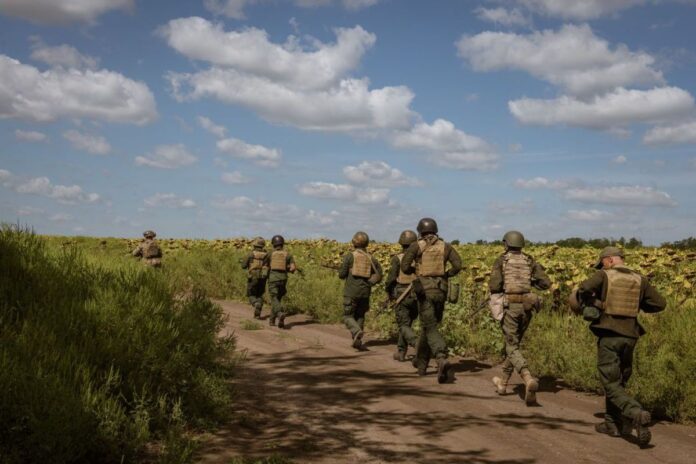
The pattern is not confined to the north. European governments have spent this year assembling coalitions of the willing outside formal alliance structures, most visibly around Ukraine, where a grouping of states met in Kyiv on Independence Day to make commitments NATO as a body has not made. Moscow reads that whole pattern as proof of European bad faith, and its deputy foreign minister spent this week arguing that European overtures are only ever tactical. A standing force built to act before the alliance can is not an obvious rebuttal.
Whether that strengthens NATO or quietly hollows it is not a question a naval chief can answer, and Jenkins did not try. He was asked what JEF is for and he said it is for going early. The harder question is what the other 22 do on the morning after somebody does.