
TEHRAN — The bodies had not yet been identified when the IRGC named its response. “Punishment of the Aggressor” — the phrase, offered in the clinical register of a press statement, described what Iran’s Islamic Revolutionary Guard Corps did to American air bases in Jordan in the hours after US forces struck two Iranian rocket launchers on Larak Island. The operation’s name was chosen with care. Everything about it was.
On August 30, US forces bombed two IRGC rocket launchers on Larak Island, a remote outcrop in the southern Strait of Hormuz. US Central Command framed the strike as a “limited, precise action” to prevent Iran from deploying sea mines into international shipping lanes. Iranian state media, as Al Jazeera reported, said the attack killed and wounded Iranian soldiers and civilians without warning. The month-long pause in active military exchange — a period during which Washington had pursued an escalating sanctions campaign rather than airstrikes — was over before breakfast.
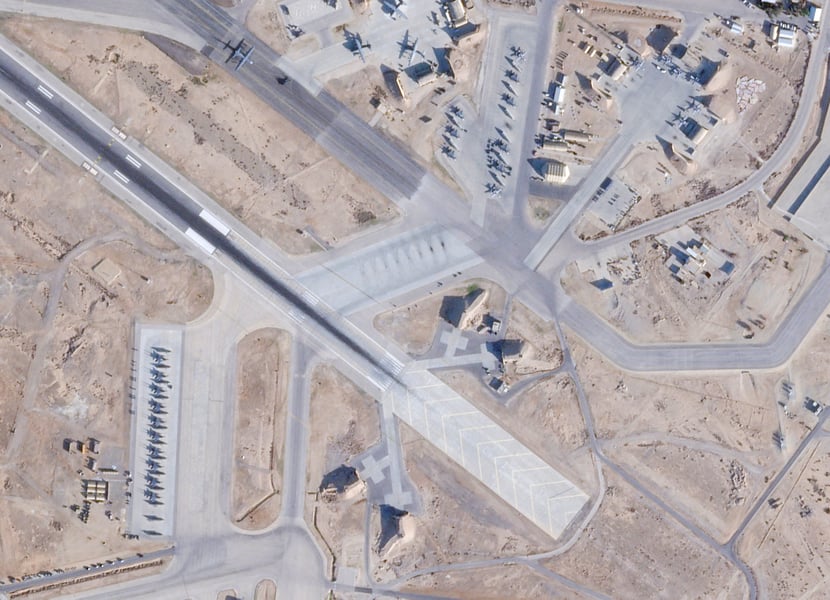
Iran’s response came in waves. The IRGC launched missiles and drones at King Hussein Air Base and Al-Azraq Air Base in northern and eastern Jordan, the two installations that serve as primary hubs for American air operations across the wider region. Jordan’s armed forces intercepted eight missiles; Amman reported no casualties at either base. Iran also struck toward the Al Menhad Air Base in the UAE, though Emirati officials denied any missiles reached the facility while acknowledging drone intercepts over their territorial waters. Separately, the IRGC announced Monday that it had shot down a US MQ-9 Reaper drone over the Strait of Hormuz, a claim the US had not confirmed at publication time.
Donald Trump surfaced his response on Fox News. “We’re going to hit them hard,” the president said, without specifying a target, a timeline, or the scale of any planned response. He separately posted an AI-generated video on his Truth Social account depicting Kharg Island — Iran’s largest oil export terminal, responsible for the bulk of what remains of Iran’s petroleum revenue — being demolished, captioned “Kharg Island being blown to smithereens!!!” No evidence of any actual attack on Kharg Island existed. The video appeared designed to communicate menace without committing to anything specific. In the context of a seven-month war that has killed Iranian civilians and disrupted global energy markets at scale, that distinction matters less in Tehran than it might in Washington.
The targeting of Jordan’s bases is consequential precisely because of Amman’s position in this conflict. Jordan has tried to navigate the war without becoming a party to it, hosting American forces, maintaining a peace treaty with Israel, and bordering Syria and Iraq. The IRGC’s claims of having struck infrastructure at King Hussein Air Base and Al-Azraq Air Base — whether or not they prove accurate — serve a consistent Iranian strategic purpose: making the cost of hosting American military power visible to the governments that host it.
CENTCOM’s justification for the Larak strike rests on the mine-laying threat. US forces have conducted mine-clearing operations in the strait for weeks, a task CENTCOM commander Adm. Brad Cooper described as complete in the hours before the Larak strike. The IRGC’s apparent deployment of additional mine-laying equipment to the island, if the US account is accurate, would indicate that Tehran had no intention of accepting that outcome. As NPR reported, Iran’s position has been consistent throughout the conflict: the Strait passes through Iranian territorial waters, and Tehran will enforce its terms on who moves through it.
The economic consequences of the conflict’s maritime dimension extend far beyond the strait itself. Since the war began in February, national average gasoline prices in the United States have risen from under three dollars a gallon to above four, driven largely by disrupted supply flows through the world’s most critical oil corridor. Shipping through the Strait of Hormuz, through which roughly a fifth of global oil passes, has not normalized despite the short-lived ceasefire earlier this summer. Global oil benchmarks remained approximately sixteen percent above pre-war levels as of August.
The cost of that repricing falls unevenly. Gulf sovereign wealth funds booked record returns in the first half of the year as elevated oil revenues flowed to producers. For nations that produce no oil and import most of what they consume, the arithmetic looks different. A UNCTAD report released in July found that the Hormuz disruption had raised child malnutrition risk by as much as fifteen percent in the world’s most import-dependent countries, through the chain that links energy prices to transport costs to food prices to household consumption. Yemen, Kiribati, and Lesotho had no voice in the decision to strike Iran in February and no mechanism to influence the exchanges since. They are paying for them regardless.
What August 31 produced was an exchange without a resolution. Iran struck, Jordan intercepted, no American deaths were confirmed in the initial round. Trump threatened without specifying. The IRGC named its operation and described its targets. Neither side has demonstrated the political will to negotiate on terms the other can accept, and neither has the capacity to impose a military conclusion. The conflict will mark two hundred days this week. The Strait of Hormuz is open, CENTCOM says. What that opening costs, and who absorbs that cost, has not moved.