
WASHINGTON — A Saudi tanker and a South Korean vessel were struck by unidentified objects in the Strait of Hormuz on Monday. By noon Tuesday in Washington, the United States had bombed seven cities along Iran’s southern coast.
U.S. Central Command said its forces began striking Islamic Revolutionary Guard Corps targets in Iran at noon Eastern time, hitting air defense sites, radar systems, maritime facilities, mine-laying infrastructure, and communications nodes at locations including Bandar Abbas, Jask, Chabahar, Konarak, Minab, Sirik, and the island of Qeshm. The stated rationale was Iran’s attempted mining of the Strait of Hormuz, the 26-mile-wide passage through which roughly 20 percent of the world’s oil supply travels each day, and ongoing IRGC attacks against American personnel in the region, as Al Jazeera reported.
Iran said it would reply. A military source quoted by the IRGC-affiliated Tasnim News Agency described the promised response as “several times greater” than the American strikes, with “U.S. interests and bases in the region” named as targets. Iran had previously launched missiles at American positions in Jordan, intercepted before impact, in response to an earlier round of US strikes on August 30. Whether Tuesday’s bombardment produces a similar exchange, a larger escalation, or a period of silence is not yet known.
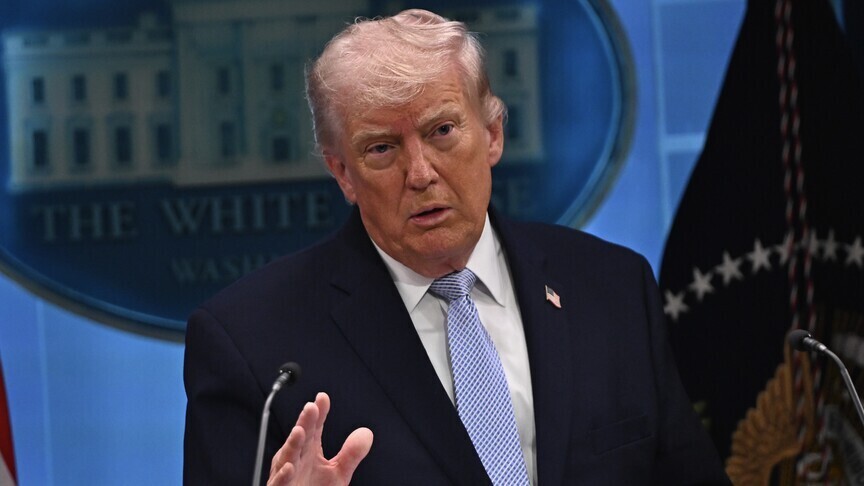
Donald Trump, who has described the six-month conflict with Iran as among his administration’s achievements, called Tuesday’s operation “large and powerful.” Treasury Secretary Scott Bessent, speaking separately in New York, said the administration intended to “economically asphyxiate” the Iranian regime, language that drew alarm from analysts who noted it describes an objective the current military campaign, conducted without a visible diplomatic track, has provided no mechanism for achieving.
The Tuesday strikes end a month-long pause in direct US-Iran fighting. That pause began after a CENTCOM operation on August 30, when American forces destroyed two IRGC rocket launchers on Larak Island after surveillance detected crews preparing to fire rockets loaded with sea mines toward the strait. Tehran then responded with a missile launch at US positions in Jordan that was intercepted. The cycle of American strike, Iranian counterstrike, and temporary halt has defined the conflict since its opening exchange six months ago, and Tuesday’s operation has set it turning again.
Throughout the six months of fighting, global crude oil prices have remained above $90 per barrel, sustained by reduced Hormuz throughput and disrupted supply chains across the Atlantic Basin. A full closure of the strait, which Iran has threatened but not yet achieved, would remove a volume of oil from global markets that no alternative supply route could quickly replace. The Tuesday strikes, aimed explicitly at Iran’s mine-laying capabilities, represent Washington’s direct attempt to keep that outcome from becoming reality.
China has emerged as the most visible counterweight to Washington’s Iran strategy. Beijing’s posture throughout the Iran war has centered on ceasefire calls, maintained Iranian oil purchases, and solidarity with countries under US sanctions pressure over their ties to Tehran. Beijing reinforced that position this week as Xi Jinping opened a two-day state visit to Cairo, the latest signal that Washington’s six-month campaign has not produced the regional alignment it sought.
The American military campaign has degraded Iranian military infrastructure along the southern coast. It has not produced a ceasefire offer from Washington, a diplomatic channel between the two governments, or a defined end state that Tehran could accept. Iran’s government has not collapsed, its supreme leader has not softened his public position, and the IRGC has demonstrated the capacity to continue mining operations, missile launches, and drone attacks against US-aligned targets in the region.
The commercial vessels struck on Monday were crewed by people whose governments did not choose this war. South Korea formally protested the attack on one of its tankers and has quietly pressed Washington for weeks to clarify what an exit from this conflict might look like. Saudi Arabia, which has absorbed more of the regional disruption than any other Gulf state while maintaining public support for American objectives, has communicated private frustration about the absence of a defined endgame, according to people familiar with those discussions.
Iran is not without accountability for what the Strait of Hormuz has become. Its decision to mine an international shipping lane, used by commerce from South Korea to Saudi Arabia to the European Union, has imposed costs on economies with no stake in its dispute with the United States. Iranian officials who frame their Hormuz campaign as a defensive measure are defending a strategy that has endangered civilian crews and disrupted energy supplies for populations that voted for none of this.
What Tuesday’s strikes produced, with certainty, is another turn of a cycle that has now run six months without resolution. CENTCOM said the operation was designed to “degrade Iran’s ability to threaten freedom of navigation.” Iran’s public statement suggested that ability remained intact. Both claims are probably accurate. What neither government has offered, in any form visible from the outside, is a way out of the loop they are both inside.