
JACKSON HOLE, Wyo. – The Dow Jones Industrial Average fell nine points Friday. The E-mini NASDAQ-100 futures contract fell 195.
That arithmetic is the story. When Federal Reserve Chairman Kevin Warsh told the Jackson Hole Economic Policy Symposium that inflation remains too high and that the central bank may need to raise rates, the market did not react uniformly. It singled out the names with the longest duration: the AI chipmakers, the cloud platforms, the semiconductor suppliers whose valuations rest on cash flows projected years into the future. That is what /NQ tracks. That is why /NQ fell.
The September 2026 E-mini NASDAQ-100 contract settled at 29,496.50, down 195.25 points or 0.66 percent, according to CME Group data. The contract opened with a gap down of 63.25 points at the start of the regular session, traded a range of 375.25 points between 29,436.25 and 29,811.50, and closed near the session low. The initial balance through the first hour of trading set a 201-point range without resolving either direction, and sellers took over before noon. The Dow Jones Industrial Average finished at 53,559.99, a loss of 9.45 points or 0.02 percent.
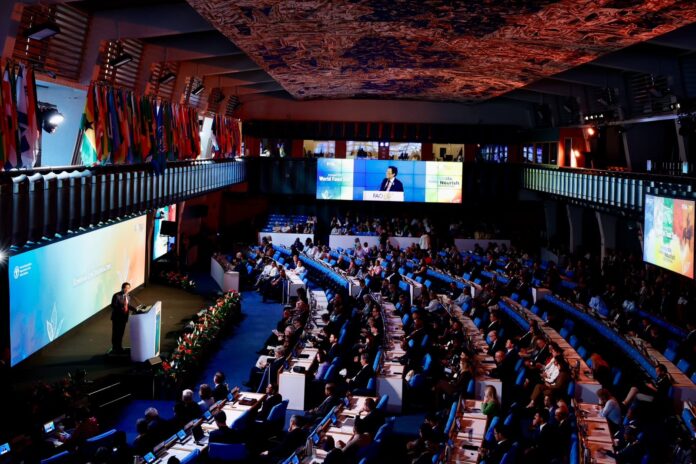
Warsh delivered his keynote Friday morning at the Kansas City Federal Reserve’s annual symposium in Jackson Hole, Wyoming. He described inflation as “still too high” and noted that more than half of personal consumption expenditure components were running at 3 percent or more annually, a figure down from the pandemic peak but well above what the central bank’s pre-pandemic framework considered normal. He committed to no September action and offered no forward guidance, per the keynote remarks published by the Federal Reserve.
The probability of a rate hike at the Federal Open Market Committee’s September 15-16 meeting jumped to roughly 57 percent in federal funds futures markets after the speech, up from approximately 33 percent before it, as Anadolu Agency reported. The two-year Treasury yield climbed 12 basis points to 4.356 percent on the session, the most direct gauge of how traders are pricing the near-term rate path.
The divergence between /NQ and the Dow reflects a structural reality about who pays most when discount rates rise. Long-duration assets, including the AI technology companies that make up the bulk of the NASDAQ-100, price their valuations on cash flows arriving in 2028, 2030, and beyond. A rate hike compresses the present value of every year in that forecast. The Dow’s components, industrials, pharmaceuticals, and financials, carry earnings that land in nearer time frames. That structural asymmetry produced the ratio: /NQ fell 33 times harder than the Dow on Friday, even though both indexes were responding to the same speech.
Mohamed El-Erian, chief economic adviser at Allianz and a former chief executive of PIMCO, called Warsh’s address “clear and powerful” and said it met the “unusually wide range of expectations leading up to it” while addressing the core inflation question directly.
The sharpest individual pressure in the NASDAQ complex fell on Nvidia Corporation (NVDA), which shed more than 3 percent Friday. The prior session had produced the opposite: an 8.7 percent surge on the back of Nvidia’s earnings beat. Friday’s pullback was a mean reversion on that momentum trade, arriving at an inopportune moment. Investors who had positioned for continued strength found a Fed chairman at Jackson Hole providing the catalyst for an exit.
The circular dealmaking scrutiny that had trailed Nvidia through August, as Gizmodo noted, added a layer of uncertainty the Jackson Hole signal amplified. Critics had argued that Nvidia’s pattern of investing in frontier AI laboratories that then returned capital as chip purchases created demand that did not reflect genuine end-user requirements. Whatever that critique’s ultimate validity, it meant the stock entered Friday already carrying questions.
As Al Jazeera reported, Warsh said the inflation picture, while showing some improvement over the summer, had not provided sufficient confidence that underlying trends had meaningfully changed. The statement reaffirmed the session’s core message: the Fed’s 2 percent target is not a suggestion, and the mechanism to enforce it remains on the table.
Friday was not a week-ending rout. All three major indexes finished the week of August 25-28 with net gains despite the session’s pullback. The NASDAQ Composite closed at 26,402.42, down 0.52 percent on Friday. The S&P 500 finished at 7,711.76, lower by 0.25 percent. The session was a recalibration, not a collapse, and the week-on-week context matters for reading it accurately.
The question Warsh left open is the one that governs how /NQ trades through September. He provided no reaction function, no specific data threshold that would trigger action. What he offered was a philosophical position: the 2 percent target is firm, inflation is still elevated, and the Fed has “work to do” if prices do not cooperate. What that means for September 15 depends on the next three weeks of price data, beginning with the August Consumer Price Index release due in early September.
For Microsoft Corporation (NASDAQ: MSFT), whose Azure cloud crossed $100 billion in annual revenue and whose stock closed at $513.53 Friday, the implication is not academic. A higher discount rate revises the present value of the multi-year returns that $41 billion in quarterly capital expenditure is supposed to produce. For Goldman Sachs Group, Inc. (NYSE: GS), whose rate-sensitive trading book closed the same session in positive territory, a September hike changes the calculation on fixed-income positions that contributed to the quarter’s trading revenue.
The E-mini NASDAQ-100 settled at 29,496.50. That number has absorbed the possibility of a rate hike. It has not absorbed the certainty of one. September 15 will begin to resolve which of the two this was.