NEW YORK — Saudi Arabia’s crude has no exit. Iran closed the Strait of Hormuz in March. The Houthis sealed Bab el-Mandeb on September 12. When Iraq’s Prime Minister Ali Faleh al-Zaidi arrives in New York this week to join Donald Trump‘s expanded Arab war council at the United Nations General Assembly, the question on every Gulf minister’s mind is the same: what exactly is Washington prepared to offer?
Iraq and Jordan will join Trump’s Monday meeting with all six Gulf Cooperation Council heads of state, with Egypt also expected at the table, according to The National. What began as a Gulf summit, already agreed before the high-level week, has stretched across borders into something harder to choreograph. The GCC held a ministerial coordination meeting in New York on Monday morning to align on a shared position before the larger room filled.
The timing is pointed. An Iran-GCC direct dialogue scheduled for Sunday in Oman’s port city of Salalah, with Iraq expected to bridge the two sides, was postponed without explanation. With that track closed, the US-Arab UNGA meeting now carries more diplomatic freight than its planners anticipated.
Iraq’s attendance brings the summit’s central contradiction into plain view. Al-Zaidi leads a government whose parliamentary coalition depends on Iran-aligned factions. His presence in New York signals that Baghdad has concluded it cannot afford to sit out the post-war negotiation, not because it has chosen a side, but because it is the only country whose geography and political architecture touch every side simultaneously. Whether he carries a private message from Tehran to Washington is a question no official is answering.

US Ambassador to the United Nations Mike Waltz told delegates on Monday that Iran has pivoted from frontline combat to resupplying its proxies. The Houthis are now deploying sophisticated drones and cruise missiles that Iran previously funnelled toward Hezbollah, Waltz said. The implication is stark: even as the conventional war with Iran stabilises, the proxy threat to Saudi Arabia‘s ports and pipelines is intensifying rather than receding.
Crown Prince Mohammed bin Salman had twice asked Trump for direct US military strikes on Houthi command infrastructure. Both requests were declined. Trump instead sent officials to Muscat for negotiations that produced no breakthrough. At UNGA this week, MBS is expected to press the case once more: that with both maritime exit routes sealed, the Bab el-Mandeb crisis has moved beyond Saudi Arabia’s strategic problem and become a global shipping emergency that Washington cannot treat as background noise.

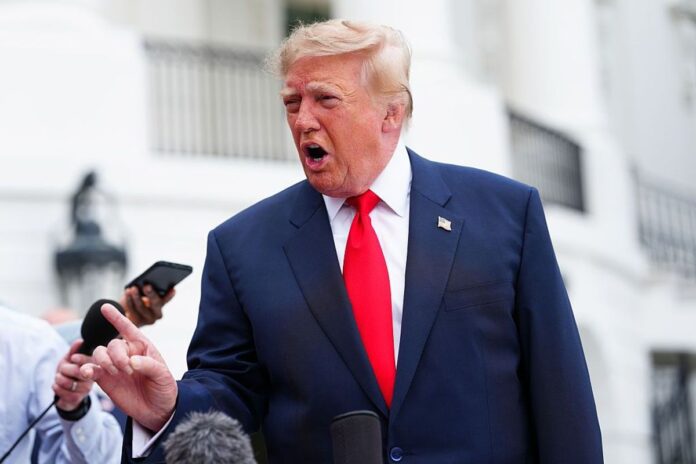
Trump said on Sunday he was weighing three options for ending the Iran war: “wiping Iran out,” letting it “rot economically,” or reaching a deal. He confirmed Washington had received a list of demands from Tehran and said he was open to meeting Iranian President Masoud Pezeshkian, who arrived in New York after the US granted the Iranian delegation travel visas on September 17. That combination, acknowledging both a terms list from the enemy and openness to a meeting, passed without elaboration from the Gulf governments now seated at the same table.

The expanded Arab gathering also indicates that regional governments believe any postwar settlement cannot be managed solely within the Gulf. Iraq’s participation reflects its position on the front line between the conflict’s architect and principal target; Jordan’s reflects Iran’s attacks on its bases; and Egypt’s expected involvement would add the diplomatic weight of the Arab League.
The unresolved question is how President Trump will interpret that collective presence: as a mandate to negotiate or as political cover for applying greater pressure. New York may not provide the answer this week.