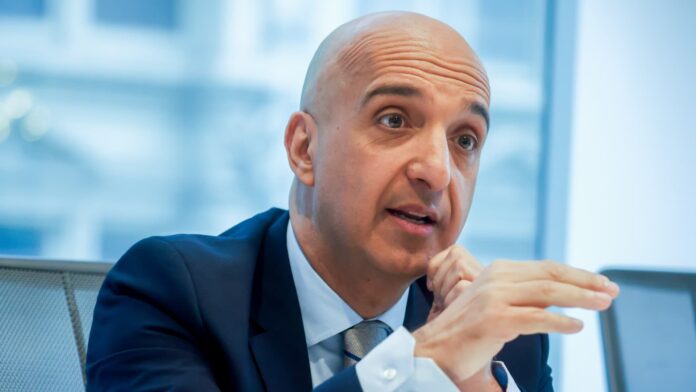

NEW YORK — Three months into Takis Georgakopoulos’s tenure running Fiserv, the company’s market capitalization has not stopped falling. On Monday, the stock shed 4.3 percent to $47.19, extending a decline that began long before the new chief executive took his seat in June and has accelerated in ways that no longer look like a well-run payment processor adjusting to a new interest-rate regime.
The Federal Reserve‘s decision last week to raise its benchmark rate to a 3.75-to-4 percent target range added the most immediate layer of pressure on Monday. Payment processors and financial-technology platforms do not carry rate-sensitive balance sheets the way banks do. But their equity multiples expand and contract sharply with the risk-free rate, because the investment thesis depends on sustained capital spending in point-of-sale infrastructure, merchant software, and platform integrations that takes years to convert into earnings. When Kevin Warsh tightened policy on September 17 and projected another move before December, the discount rate on those future cash flows moved against every fintech holding in the index.
The more specific drag is the guidance revision Georgakopoulos delivered in late July, five weeks after inheriting the company from Mike Lyons, who left for the chief executive role at Truist Financial. The revision was direct: organic revenue growth for 2026 was cut from a projected 1 to 3 percent range to negative 1 to flat, and adjusted earnings per share guidance dropped from $8.00 to $8.30 down to $7.20 to $7.40. The company named three headwinds: delayed client project starts, deteriorating conditions in Argentina, and a merchant hardware cycle that did not materialize.
Georgakopoulos framed the revision as a strategic reset rather than a correction, centering the company’s growth plan on Clover, Fiserv’s point-of-sale and commerce platform. The argument is that Fiserv’s legacy revenue, back-end core banking technology supplied to regional and community financial institutions, faces structural margin erosion from cloud-native competitors, and that the merchant-facing layer, where Clover competes with Square and Toast, is where durable competitive advantage can be built. Whether that argument is convincing depends on whether Clover’s growth rate, which averaged roughly 17 percent annually in 2025, can close the gap with Square’s 23 percent and Toast’s 29 percent over the same period.
Closing that gap requires Clover to win merchant accounts in a higher-rate environment where small-business credit conditions have tightened and new point-of-sale installations are being deferred. The same inflation-driven rate pressure compressing Fiserv’s equity multiple is compressing the capital budgets of the customers Clover is trying to convert. That is a self-reinforcing headwind that Georgakopoulos did not create but has not yet escaped.
The Argentina exposure continues to resist easy quantification. Fiserv has built a substantial Latin America presence, and Argentina became an accounting complication in late 2025 as currency volatility intersected with the Milei government’s deregulation drive. The company has not broken out the Argentina drag in its public filings, which means the market continues to estimate it, and that uncertainty premium does not lift until third-quarter results in late October provide a cleaner number.
The competitive picture is also shifting. Revolut‘s OCC bank charter approval earlier this month opened a path for digital-native platforms to offer FDIC-insured accounts and Federal Reserve settlement access by 2027. That is a medium-term structural question for Fiserv’s banking technology segment, which supplies core processing to hundreds of midsize financial institutions. If those institutions’ own customers migrate to app-native alternatives, the volume economics of Fiserv’s bank client contracts face a different kind of pressure that the Clover pivot does not directly address.
The China trade talks generating market optimism on Monday carry no direct read-through for Fiserv, which has minimal exposure to China’s payments infrastructure. If anything, the trade normalization narrative lifted the stocks with China revenue in a rotation that pulled capital away from domestic fintech, where the story remains unsettled.
At $47.19, Fiserv trades at approximately 6.5 times the midpoint of its revised 2026 adjusted EPS guidance. That multiple either prices in continued deterioration or offers genuine value in a company that still processes payments for more than six million merchant locations and more than 900 financial institutions. Twelve sell-side analysts maintaining coverage through the transition hold a median price target of $58, implying roughly 23 percent upside from Monday’s close. The range spans from $38 on the cautious end to $72 on the optimistic end, less a consensus than an acknowledgment that the market does not yet know whether Georgakopoulos’s reset is a floor or a step.
The third-quarter call in late October will be the first full quarter of data under the new strategy. It will show whether Clover merchant additions accelerated, whether Argentina stabilized, and whether the delayed client projects began. Until that data arrives, Monday’s decline reflects the cost of unresolved questions about a company in mid-transformation.