On 2 September 1901, speaking at the Minnesota State Fair, the vice president of the United States told a crowd that the country should speak softly and carry a big stick. Twelve days later William McKinley was dead of an assassin’s bullet and Theodore Roosevelt, aged forty-two, was president.
He is the youngest person ever to hold the office. He is the first American awarded a Nobel Prize. He put roughly 230 million acres of the United States under federal protection, broke the largest railroad combination in the country, and sent the navy around the world to prove it could go. He also signed an order discharging three companies of Black soldiers without trial, and he wrote about race in terms that his admirers generally leave out.
This profile is maintained as a reference and was last updated on 25 August 2026.
| Field | Detail |
|---|---|
| Full name | Theodore Roosevelt Junior |
| Born | 27 October 1858, East 20th Street, New York City |
| Died | 6 January 1919, Sagamore Hill, Oyster Bay, New York, aged 60 |
| President | 26th, from 14 September 1901 to 4 March 1909 |
| Age on taking office | 42, the youngest ever |
| Party | Republican, then Progressive from 1912 |
| Spouses | Alice Hathaway Lee, married 1880, died 1884; Edith Kermit Carow, married 1886 |
| Children | Alice, Theodore Junior, Kermit, Ethel, Archibald, Quentin |
| Education | Harvard College, 1876 to 1880 |
| Military service | Colonel, 1st United States Volunteer Cavalry, the Rough Riders, 1898 |
| Medal of Honor | Awarded 16 January 2001 for actions of 1 July 1898 |
| Nobel Peace Prize | 1906, for mediating the Russo-Japanese War |
| Land protected in office | Nearly 230 million acres |
| Books published | Around 40, from The Naval War of 1812 to his autobiography |
| Buried | Youngs Memorial Cemetery, Oyster Bay, New York |
| Sources: National Park Service, the Nobel Foundation, the US National Archives and the US Senate historical office. | |
Theodore Roosevelt timeline: key dates from 1858 to 1919
Sixty years, eleven public offices and one bullet he declined to be stopped by. The dates below are the load-bearing ones; each is expanded in the sections that follow.
| Date | Event |
|---|---|
| 27 October 1858 | Born in New York City, the second of four children |
| 1876 to 1880 | Attends Harvard College; begins The Naval War of 1812 as an undergraduate |
| 27 October 1880 | Marries Alice Hathaway Lee on his twenty-second birthday |
| 1882 to 1884 | Serves in the New York State Assembly, its youngest member |
| 14 February 1884 | His wife and his mother die in the same house on the same day |
| 1884 to 1886 | Ranches cattle in the Dakota Badlands; the winter of 1886-87 wipes out the herd |
| December 1886 | Marries Edith Kermit Carow in London |
| 1889 to 1895 | United States Civil Service Commissioner |
| 1895 to 1897 | President of the New York City Police Commission |
| 1897 to 1898 | Assistant Secretary of the Navy; resigns to enlist |
| 1 July 1898 | Leads the Rough Riders in the assault on the San Juan Heights, Cuba |
| 1899 to 1900 | Governor of New York |
| 4 March 1901 | Sworn in as vice president under William McKinley |
| 2 September 1901 | Speak softly and carry a big stick, Minnesota State Fair |
| 14 September 1901 | Becomes president on McKinley’s death, aged 42 |
| 16 October 1901 | Dines with Booker T. Washington at the White House |
| 1902 | Sues the Northern Securities Company; settles the anthracite coal strike |
| 1903 | Panama secedes from Colombia; canal treaty signed |
| 1904 | Elected in his own right; announces he will not run again; states the Roosevelt Corollary |
| 8 June 1906 | Signs the Antiquities Act |
| 30 June 1906 | Signs the Pure Food and Drug Act and the Meat Inspection Act |
| 5 November 1906 | Orders three companies of the 25th Infantry discharged without honour |
| 10 December 1906 | Awarded the Nobel Peace Prize for the Treaty of Portsmouth |
| December 1907 | Great White Fleet departs on its circumnavigation |
| 4 March 1909 | Leaves office; departs for a year in Africa |
| 23 April 1910 | Delivers Citizenship in a Republic at the Sorbonne |
| 31 August 1910 | Sets out the New Nationalism at Osawatomie, Kansas |
| 14 October 1912 | Shot in Milwaukee; speaks for about ninety minutes with the bullet in his chest |
| November 1912 | Finishes second as the Progressive candidate, ahead of the sitting president |
| 1913 to 1914 | Descends the River of Doubt in Brazil and nearly dies of infection |
| July 1918 | His son Quentin is killed in aerial combat over France |
| 6 January 1919 | Dies in his sleep at Sagamore Hill, aged 60 |
| 16 January 2001 | Awarded the Medal of Honor, 102 years after the charge |
| Dates follow the National Park Service, the US National Archives, the Nobel Foundation and the Theodore Roosevelt Center. | |
Theodore Roosevelt’s early life: asthma, and the answer he built for it
Theodore Roosevelt was born on 27 October 1858 in a brownstone on East 20th Street in Manhattan, the second of four children of Theodore Roosevelt Senior, a glass importer and philanthropist from an old Dutch New York family, and Martha Bulloch Roosevelt, a Georgian whose brothers served the Confederacy.
Theodore Roosevelt was a severely asthmatic child. The attacks were frequent enough that his father would take him out in a carriage at night to force air into him, and for years the boy could not reliably sleep lying down. The response his father prescribed, and which he adopted with a completeness that shaped everything afterwards, was physical: a home gymnasium, boxing lessons, relentless outdoor exertion. What began as a treatment for a lung condition became a philosophy he would later publish under the title The Strenuous Life.
He was also, from childhood, a naturalist. He kept specimens, learned taxidermy at thirteen, and at one point maintained what he called the Roosevelt Museum of Natural History in his bedroom. That interest never left him. The president who created the Forest Service was the same boy who catalogued birds, and it is worth resisting the temptation to treat his conservation record as a political conversion rather than a lifelong preoccupation.
Harvard, marriage, and the day the light went out
Theodore Roosevelt entered Harvard in 1876 and graduated in 1880, having begun a serious history of the naval war of 1812 while still an undergraduate. On his twenty-second birthday, 27 October 1880, he married Alice Hathaway Lee.
Four years later, on 14 February 1884, his wife died of undiagnosed kidney disease two days after giving birth to their daughter, and his mother died of typhoid fever in the same house on the same day. He drew a large cross in his diary and wrote beneath it that the light had gone out of his life. He handed the baby to his sister, and he did not speak or write about Alice again in any substantial way for the rest of his life. His autobiography does not mention her.
The Dakota years
He went west. From 1884 to 1886 Theodore Roosevelt ran cattle in the Badlands of what is now North Dakota, at the Maltese Cross and Elkhorn ranches, wearing a buckskin shirt and being taken for a soft eastern gentleman until he stopped being taken for one. He served as a deputy sheriff and once tracked three boat thieves for days across frozen country, reading Tolstoy while guarding them.
The winter of 1886 and 1887 destroyed most of the cattle in the region and much of his investment with it. He came back east, married his childhood friend Edith Kermit Carow in London in December 1886, and re-entered politics. He also came back with a conviction about the fragility of American land that no amount of reading would have produced.
Theodore Roosevelt’s political career before the presidency
Before he was president he held six public positions in twenty years, at city, state and federal level, and he was thrown out of or resigned from most of them on his own initiative.
| Office | Years |
|---|---|
| New York State Assembly | 1882 to 1884 |
| United States Civil Service Commissioner | 1889 to 1895 |
| President, New York City Police Commission | 1895 to 1897 |
| Assistant Secretary of the Navy | 1897 to 1898 |
| Colonel, 1st United States Volunteer Cavalry | 1898 |
| Governor of New York | 1899 to 1900 |
| Vice President of the United States | March to September 1901 |
| President of the United States | 1901 to 1909 |
| He served under presidents of both parties on the Civil Service Commission, and left the Navy Department, the governorship and the Republican Party each on his own initiative. | |
Theodore Roosevelt was elected to the New York State Assembly at twenty-three, the youngest member in the chamber, and made a name attacking corruption in the state judiciary. He served on the United States Civil Service Commission from 1889 to 1895 under two presidents of opposite parties, enforcing merit hiring against a patronage system that both parties liked.
Police commissioner in New York
In 1895 he became president of the New York City Police Commission and did the thing he is still remembered for there: he walked the beat at night, unannounced, to catch officers asleep or drinking. He also enforced the Sunday liquor law that his own party’s voters hated, on the ground that a law on the books is a law, which cost the Republicans an election and taught him something about the limits of righteousness in office.
In 1897 President McKinley made him Assistant Secretary of the Navy. He spent a year lobbying for a bigger fleet, and when war with Spain came in 1898 he resigned to go and fight in it, which was not a metaphor.
The Rough Riders and the Spanish-American War
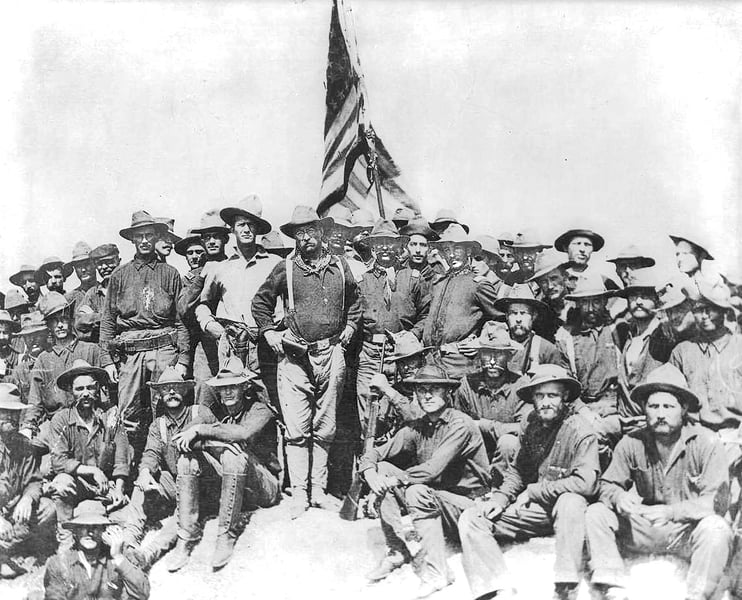
Theodore Roosevelt raised the 1st United States Volunteer Cavalry, a regiment of Ivy League athletes, western cowboys, Native American scouts and New York policemen that the press immediately named the Rough Riders. He was its lieutenant colonel and then its colonel.
On 1 July 1898 the regiment took part in the assault on the San Juan Heights outside Santiago de Cuba, charging up Kettle Hill on horseback and then on foot under heavy fire. It was the making of him politically. He was a national figure within weeks and Governor of New York within a year.
The Medal of Honor, 102 years late
Theodore Roosevelt wanted the Medal of Honor for that day and said so, loudly, to anyone in the War Department who would listen. He did not get it. The National Archives has published the file on why, and the short answer is that he made enemies of the men who would have had to approve it, including the Secretary of War he had criticised in print.
President Bill Clinton awarded it to him on 16 January 2001, 102 years after the charge and 82 years after his death. His family accepted it on his behalf. He and his son Theodore Roosevelt Junior, decorated for Normandy, are the only father and son both to hold the medal.
Governor, vice president, and the accident that made him president
As Governor of New York from 1899 to 1900 he taxed corporate franchises and refused to take instruction from the state Republican machine, which found him uncontrollable. The machine’s solution was to promote him into the vice presidency, an office with no power, in 1900. Mark Hanna, McKinley’s manager, is said to have asked his colleagues whether they realised there would be only one life between that madman and the presidency.
McKinley was shot in Buffalo on 6 September 1901 and died on 14 September. Roosevelt was sworn in that day at a friend’s house in Buffalo, aged forty-two years and ten months, and remains the youngest person ever to hold the office. He was elected in his own right in 1904 by the largest popular margin any presidential candidate had then received, and on election night he announced that he would not be a candidate again in 1908. He kept that promise, honouring the two-term limit George Washington had established by custom and no law then required, and spent the rest of his life regretting it.
The Square Deal: Theodore Roosevelt’s domestic policy
Theodore Roosevelt called his domestic programme the Square Deal, and its premise was that the federal government should stand between capital and labour rather than behind either. It was a genuinely new proposition in 1901, and the legislation that came out of it is why the Progressive Era has his name attached to it.
| Measure | Year | What it did |
|---|---|---|
| Newlands Reclamation Act | 1902 | Funded federal irrigation and dam building across the arid West |
| Elkins Act | 1903 | Outlawed the railroad rebates that large shippers extracted from carriers |
| Department of Commerce and Labor | 1903 | Created, with a Bureau of Corporations empowered to investigate interstate firms |
| Hepburn Act | 1906 | Gave the Interstate Commerce Commission power to set maximum railroad rates |
| Pure Food and Drug Act | 1906 | Banned mislabelled and adulterated food and medicines; ancestor of the Food and Drug Administration |
| Meat Inspection Act | 1906 | Mandated federal inspection of meatpacking, after Upton Sinclair’s The Jungle |
| Antiquities Act | 1906 | Let a president protect land by proclamation without an act of Congress |
| The Pure Food and Drug Act and the Meat Inspection Act were both signed on 30 June 1906. The Antiquities Act was signed on 8 June 1906. | ||
The 1902 coal strike, and a president who took a side by refusing to
In the autumn of 1902 the anthracite coal miners of Pennsylvania had been on strike for months and the northeast was facing a winter without heat. Every previous president confronted with a major strike had sent troops to break it. Theodore Roosevelt summoned both sides to the White House, and when the operators refused to negotiate he let it be known that he was prepared to seize the mines and run them with the army.
They settled. The miners got a nine-hour day and a ten per cent rise, the operators got no recognition of the union, and an arbitration commission decided the terms. The precedent mattered more than the terms: a president had intervened in a labour dispute without automatically siding with the owners, and had treated a union as a party rather than a conspiracy.
Theodore Roosevelt and the trusts
The trust-busting reputation is half earned. In 1902 his attorney general sued the Northern Securities Company, the railroad holding company assembled by J. P. Morgan, James J. Hill and E. H. Harriman to control rail traffic across the northwest. Morgan came to the White House and suggested that his man and the president’s man could fix it up, which Roosevelt later cited as the precise attitude he was legislating against. The Supreme Court ordered the company dissolved in 1904.
Theodore Roosevelt brought about forty antitrust actions in seven years, against beef, oil, tobacco and the railroads. But he did not think large corporations were bad in themselves, and he said so repeatedly. He distinguished between good trusts and bad ones, and what he actually wanted was a federal regulator strong enough to supervise them, not a country of small firms. His successor William Howard Taft brought nearly twice as many antitrust suits in half the time and gets almost none of the credit, which is a reasonable measure of how much of this was reputation.
Conservation: the 230 million acres
This is the part of the record that is not disputed by anyone.
| Category | Number |
|---|---|
| Total land placed under federal protection | Nearly 230 million acres |
| National parks | 5 |
| National monuments | 18 |
| National forests | 150 |
| Federal bird reservations | 51 |
| National game preserves | 4 |
| Federal agencies created | United States Forest Service, 1905 |
| The 18 national monuments were all proclaimed under the Antiquities Act of 1906, among them the Grand Canyon, which Congress had declined to protect. | |
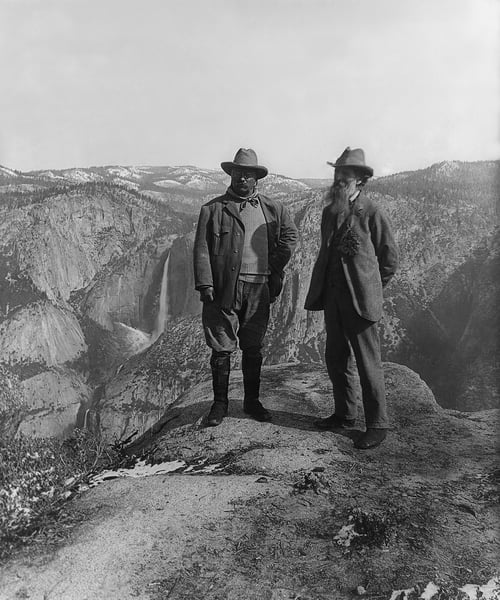
The National Park Service puts the total at nearly 230 million acres of public land protected during his presidency: 5 national parks, 18 national monuments, 150 national forests, 51 federal bird reservations and 4 national game preserves. He created the United States Forest Service in 1905 and put Gifford Pinchot in charge of it.
The Antiquities Act and the tool he left behind
The instrument that made most of it possible was the Antiquities Act, which he signed on 8 June 1906. It lets a president protect land of historic or scientific interest by proclamation, without waiting for Congress. Roosevelt used it eighteen times, including for the Grand Canyon, which Congress had refused to protect and which he designated a national monument by declaring it scientifically interesting.
That tool is still in daily use and still contested. The same statute has been used by later presidents to create monuments and by others to try to shrink them, including the ninety per cent reduction of Bears Ears and Grand Staircase-Escalante in 2026. Whether a president who can create a monument by proclamation can also abolish one is a question the Antiquities Act does not answer, and Roosevelt, who wrote nothing about it, is on both sides of the citation.
Theodore Roosevelt’s foreign policy: the big stick, Panama and a Nobel Prize
The phrase came first. Speaking at the Minnesota State Fair on 2 September 1901, twelve days before he became president, he offered what he called a West African proverb: speak softly and carry a big stick, you will go far. He then spent seven years demonstrating that he meant the second half at least as much as the first.
Panama
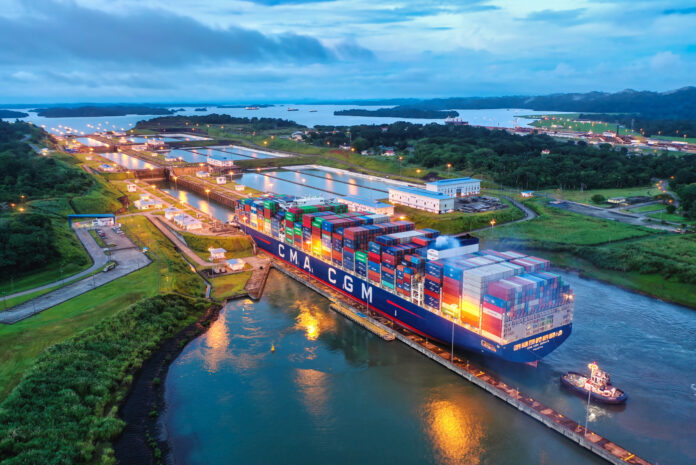
Theodore Roosevelt wanted a canal. Colombia, which then held the isthmus, rejected the treaty terms the United States offered in 1903. A Panamanian independence movement rose weeks later, an American warship was conveniently positioned to prevent Colombian troops from landing, and the new republic signed a canal treaty with Washington within a fortnight. The State Department’s own account does not soften this sequence. Construction ran from 1904 and the canal opened in 1914. Roosevelt later told an audience at Berkeley that he took the isthmus, and the sentence has been quoted against the United States in Latin America ever since.
The Roosevelt Corollary
In his annual message of 1904 he added a corollary to the Monroe Doctrine: if a state in the western hemisphere could not keep order or pay its debts, the United States would exercise an international police power and intervene rather than let a European creditor do it. The doctrine as he restated it underwrote decades of American intervention in the Caribbean and Central America, most of it after he left office and much of it under presidents who invoked him.
The Nobel Peace Prize
Against that, the same president mediated an end to the Russo-Japanese War. He brought delegations from both empires to Portsmouth, New Hampshire, in August 1905, and the treaty signed in September 1905 ended a conflict that had killed well over a hundred thousand people. He received the Nobel Peace Prize for it in 1906, the first American awarded a Nobel Prize in any category, and he gave the money away.
The two records are not reconcilable into a single verdict, and this page does not attempt it. He was a genuine and effective peacemaker between great powers and a straightforward imperialist toward small ones, and the distinction he drew between the two was explicitly racial.
The Great White Fleet
In December 1907 Theodore Roosevelt sent sixteen battleships, hulls painted white, on a circumnavigation of the globe. Congress had not funded the return leg. He announced that he had enough money to get the fleet to the Pacific and Congress could decide whether it came home, which is the big stick used domestically. The fleet returned in February 1909, two weeks before he left office.
Theodore Roosevelt’s speeches and best-known quotations
Theodore Roosevelt published around forty books and gave thousands of speeches, and he is the most quotable president after Lincoln, which is a problem, because a great deal of what circulates under his name he never said.
| Quotation | Where and when |
|---|---|
| Speak softly and carry a big stick, you will go far | Minnesota State Fair, Minneapolis, 2 September 1901, twelve days before he became president |
| The credit belongs to the man who is actually in the arena, whose face is marred by dust and sweat and blood | Citizenship in a Republic, the Sorbonne, Paris, 23 April 1910 |
| His place shall never be with those cold and timid souls who neither know victory nor defeat | The closing of the same passage |
| The light has gone out of my life | His diary, 14 February 1884, the day his wife and mother died |
| It takes more than that to kill a bull moose | Milwaukee, 14 October 1912, opening a speech minutes after being shot |
| A bully pulpit | His own description of the presidency, meaning a splendid platform rather than a coercive one |
| Wording for the 1901 and 1910 speeches follows the published texts held by the Theodore Roosevelt Center. The Milwaukee remark and the bully pulpit phrase are recorded in contemporary press accounts rather than in a manuscript, and versions differ slightly. A great deal of material circulating under his name is not his. | |
The most durable passage is from Citizenship in a Republic, delivered at the Sorbonne in Paris on 23 April 1910, seven weeks after he came out of Africa. It is universally known as the Man in the Arena. The credit, he told the French, belongs to the man who is actually in the arena, whose face is marred by dust and sweat and blood, who errs and comes short again and again, and who at the worst fails while daring greatly, so that his place shall never be with those cold and timid souls who neither know victory nor defeat.
He was out of office, out of the country and about to blow up his own party when he said it.
The 1912 Bull Moose campaign and the speech he gave with a bullet in him
Theodore Roosevelt came home in 1910 convinced that Taft had abandoned the programme. At Osawatomie, Kansas, on 31 August 1910 he set out what he called the New Nationalism: a federal government strong enough to regulate corporations nationally, an income tax, an inheritance tax, workers’ compensation, limits on political money. It is one of the most consequential speeches in American political history and most of it was enacted within thirty years, largely by his cousin’s wife’s husband.
Denied the Republican nomination in 1912 by a convention he believed was stolen from him, he walked out and formed the Progressive Party. Asked how he felt, he said he was as strong as a bull moose, and the party had its name.
Milwaukee, 14 October 1912
Outside a hotel in Milwaukee that evening, a man named John Flammang Schrank shot him in the chest at close range. The bullet passed through a folded fifty-page speech manuscript and a steel spectacle case before entering his chest and lodging against a rib. Roosevelt coughed into his hand, found no blood, concluded the lung was not pierced, and refused to go to hospital.
He went to the auditorium and spoke for roughly ninety minutes. He opened by telling the audience that he had just been shot, that it took more than that to kill a bull moose, and that he would ask them to be quiet. The bloodstained manuscript is in the collections. The bullet stayed in him for the rest of his life.
He finished second, ahead of the sitting Republican president, which remains the strongest third-party performance in modern American history, and he split the Republican vote so thoroughly that Woodrow Wilson won with under forty-two per cent.
Theodore Roosevelt’s controversies: Brownsville, race and empire
Three weeks after a shooting affray in Brownsville, Texas, in August 1906, in which one man was killed and the evidence pointed unreliably at Black soldiers stationed nearby, Roosevelt signed an executive order on 5 November 1906 discharging without honour the entire complement of three companies of the all-Black 25th Infantry Regiment, some 170 men, without a trial and without individual findings. Several were Medal of Honor holders. Several had more than twenty years of service. The discharges were reviewed and overturned in 1972, by which time one of the men was still alive.
He had also, on 16 October 1901, invited Booker T. Washington to dine at the White House, the first time a Black American had been entertained there as a guest of the president. The southern press response was violent enough that he never repeated it. Both facts are his.
On empire he was consistent and unapologetic. He supported the annexation of the Philippines and the war that followed it, in which American forces killed civilians on a large scale, and he wrote about what he called the expansion of civilised races in terms that were mainstream in his class and time and are indefensible now. He also, at the same time, appointed more Black officials in the South than his predecessors, prosecuted peonage cases, and was denounced by segregationists for it. None of that cancels the rest. It is simply the record.
The River of Doubt and the last years
In 1913 and 1914, at fifty-five, Theodore Roosevelt joined the Brazilian explorer Cândido Rondon on the descent of an uncharted Amazon tributary called the Rio da Dúvida, the River of Doubt. He gashed his leg, developed a severe infection and a fever near 105 degrees, and at one point told his son to leave him behind. He came out of it two dozen kilos lighter and never fully recovered his health. The river is now the Rio Roosevelt.
His youngest son Quentin, a pilot, was shot down and killed over France in July 1918. Friends said the loss finished him. He died in his sleep at Sagamore Hill, his house at Oyster Bay on Long Island, in the early hours of 6 January 1919, aged sixty. His son Archie cabled the family that the old lion was dead. His vice president’s successor, Thomas Marshall, remarked that death had to take him sleeping, because awake there would have been a fight.
Theodore Roosevelt’s legacy and historical impact
He is on Mount Rushmore, between Thomas Jefferson and Abraham Lincoln, the only one of the four who was alive within living memory of the sculptor. Sagamore Hill, his birthplace on East 20th Street and the North Dakota badlands where he ranched are all administered by the National Park Service, an agency created seven years after his death out of the system he built.
The presidency Theodore Roosevelt left was a different institution from the one he inherited. He used the office as what he called a bully pulpit, meaning a splendid platform, and he established that a president may act unless the Constitution forbids it rather than only where it permits. Every activist presidency since, of either party, runs on that theory. So does every objection to one.
His domestic programme was largely enacted by others: the income tax, the regulation of food and drugs, the federal supervision of corporations, and eventually the whole architecture of the New Deal, built by a distant cousin who married his niece. His conservation record is the part that is physically still standing, and it is the reason a man who shot and stuffed a great many animals is claimed by the environmental movement.
He also built a tennis court at the White House and ran what the press called his tennis cabinet, a habit of settling policy while exercising that later presidents have adapted to their own tastes. The teddy bear is named after him, from a 1902 hunt in Mississippi at which he refused to shoot a bear that had been tied to a tree for him. It is the smallest item in the record and the one most people can name, and there is something apt in a legacy that includes 230 million protected acres, a canal taken by force, a Nobel Prize, a discharged regiment and a soft toy.
Last updated
This profile was last reviewed on 25 August 2026. The biographical record and the primary sources cited here are stable. Figures for protected acreage follow the National Park Service; the Brownsville discharge count varies between 167 and 170 depending on the source, and the higher figure used above is the one given in contemporary documents held by the Library of Congress.
Theodore Roosevelt (27 October 1858 to 6 January 1919) was the 26th President of the United States, serving from 1901 to 1909. He was a New York assemblyman, police commissioner, Assistant Secretary of the Navy, colonel of the Rough Riders and Governor of New York before becoming president at 42 on the assassination of William McKinley.
Because he inherited the office rather than winning it. He was vice president when William McKinley was shot in Buffalo on 6 September 1901, and he was sworn in on McKinley’s death on 14 September at the age of 42. John F. Kennedy remains the youngest man elected president; Roosevelt is the youngest to hold the office.
He created the Square Deal programme of federal regulation, sued the Northern Securities railroad combination, intervened in the 1902 coal strike without breaking it, signed the Hepburn Act, the Pure Food and Drug Act, the Meat Inspection Act and the Antiquities Act in 1906, secured the route for the Panama Canal, mediated the end of the Russo-Japanese War and put nearly 230 million acres under federal protection.
Nearly 230 million acres, according to the National Park Service: 5 national parks, 18 national monuments, 150 national forests, 51 federal bird reservations and 4 national game preserves. He also created the United States Forest Service in 1905.
It is the law Roosevelt signed on 8 June 1906 allowing a president to protect land of historic or scientific interest by proclamation, without an act of Congress. He used it eighteen times, including for the Grand Canyon. It is still the instrument by which national monuments are created, and the question of whether a president can also shrink one has never been settled.
For mediating an end to the Russo-Japanese War. He brought Russian and Japanese delegations to Portsmouth, New Hampshire, in August 1905, and the resulting Treaty of Portsmouth was signed in September. He received the Nobel Peace Prize in 1906 and was the first American awarded a Nobel Prize in any category.
Roosevelt used the phrase at the Minnesota State Fair on 2 September 1901, twelve days before he became president, presenting it as a West African proverb. He meant that quiet diplomacy works only when it is backed by real force, and he added that bluster without strength behind it is contemptible.
It is the popular name for Citizenship in a Republic, delivered at the Sorbonne in Paris on 23 April 1910. The passage praises the man actually in the arena, whose face is marred by dust and sweat and blood, who errs repeatedly but who fails while daring greatly, against the critic who does nothing. Roosevelt was out of office and out of the country when he gave it.
Yes. On 14 October 1912 in Milwaukee, John Flammang Schrank shot him in the chest at close range. The bullet passed through a folded speech manuscript and a steel spectacle case before lodging against a rib. Roosevelt judged that his lung was not pierced, refused hospital, and spoke for about ninety minutes. The bullet was never removed.
No. Denied the Republican nomination, he ran as the candidate of the Progressive Party, nicknamed the Bull Moose Party. He finished second, ahead of the sitting Republican president William Howard Taft, which is still the strongest third-party performance in modern American history, and the split let Woodrow Wilson win with under 42 per cent of the vote.
In November 1906 Roosevelt signed an executive order discharging without honour the entire complement of three companies of the all-Black 25th Infantry Regiment, about 170 men, after a shooting in Brownsville, Texas, without a trial and without individual findings. Some were Medal of Honor holders. The discharges were reviewed and overturned in 1972.
Mainly for race and empire. He signed the Brownsville discharges, supported the annexation of the Philippines and the war that followed it, and wrote about racial hierarchy in terms that were common in his class and are indefensible now. He also hosted Booker T. Washington at the White House in 1901 and appointed Black officials in the South. Both parts are documented.
In his sleep, of a coronary embolism, at Sagamore Hill in Oyster Bay, New York, in the early hours of 6 January 1919, aged 60. His health had never recovered from a severe infection contracted on the River of Doubt expedition in Brazil in 1914, and his youngest son Quentin had been killed in action six months earlier.
Yes. On a Mississippi bear hunt in 1902 he refused to shoot a bear that had been captured and tied to a tree for him. A newspaper cartoon of the episode led a Brooklyn shopkeeper to make a stuffed bear and call it Teddy’s bear.