
GAZA — An eight-month-old Palestinian baby died from hypothermia in a flooded displacement tent in southern Gaza on December 10, 2025, as Storm Byron battered the war-torn enclave with torrential rains and freezing temperatures. Rahaf Abu Jazar’s death marks yet another preventable casualty in a humanitarian catastrophe compounded by Israeli restrictions on essential shelter materials entering the besieged territory.
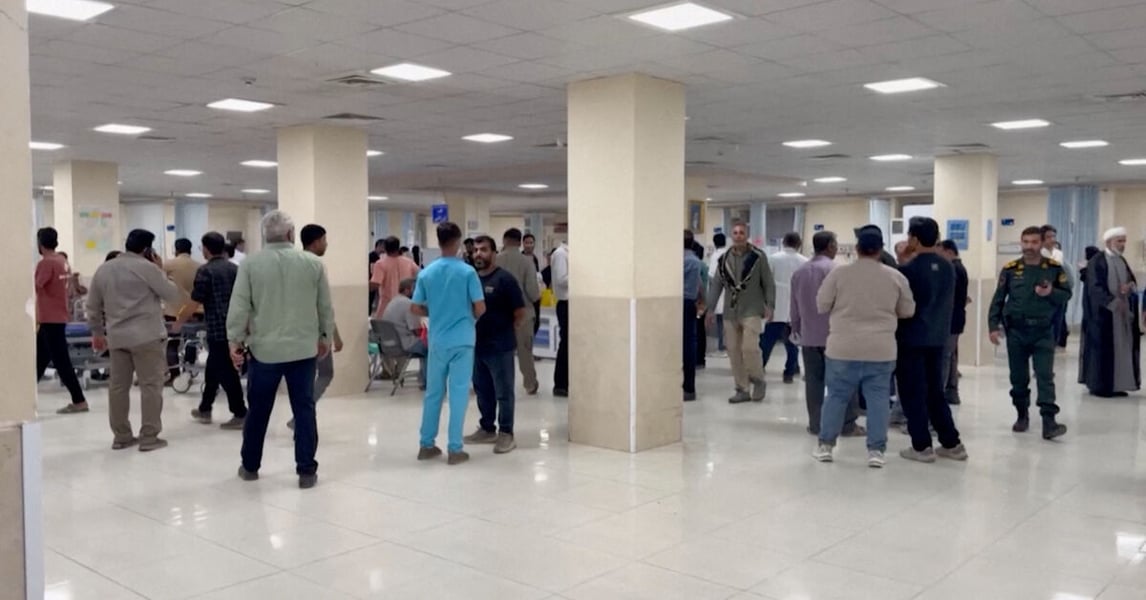
The infant’s father, Yusuf Abu Jazar, held his daughter’s lifeless body wrapped in a blanket at Al-Aqsa Martyrs Hospital in central Gaza, his anguished words captured by Palestinian journalists. “The cold killed her,” he said, his voice breaking with grief. “We are living in a tent in the bitter cold and we have nothing to warm ourselves with except thin blankets.”
Winter Storm Devastates Displacement Camps
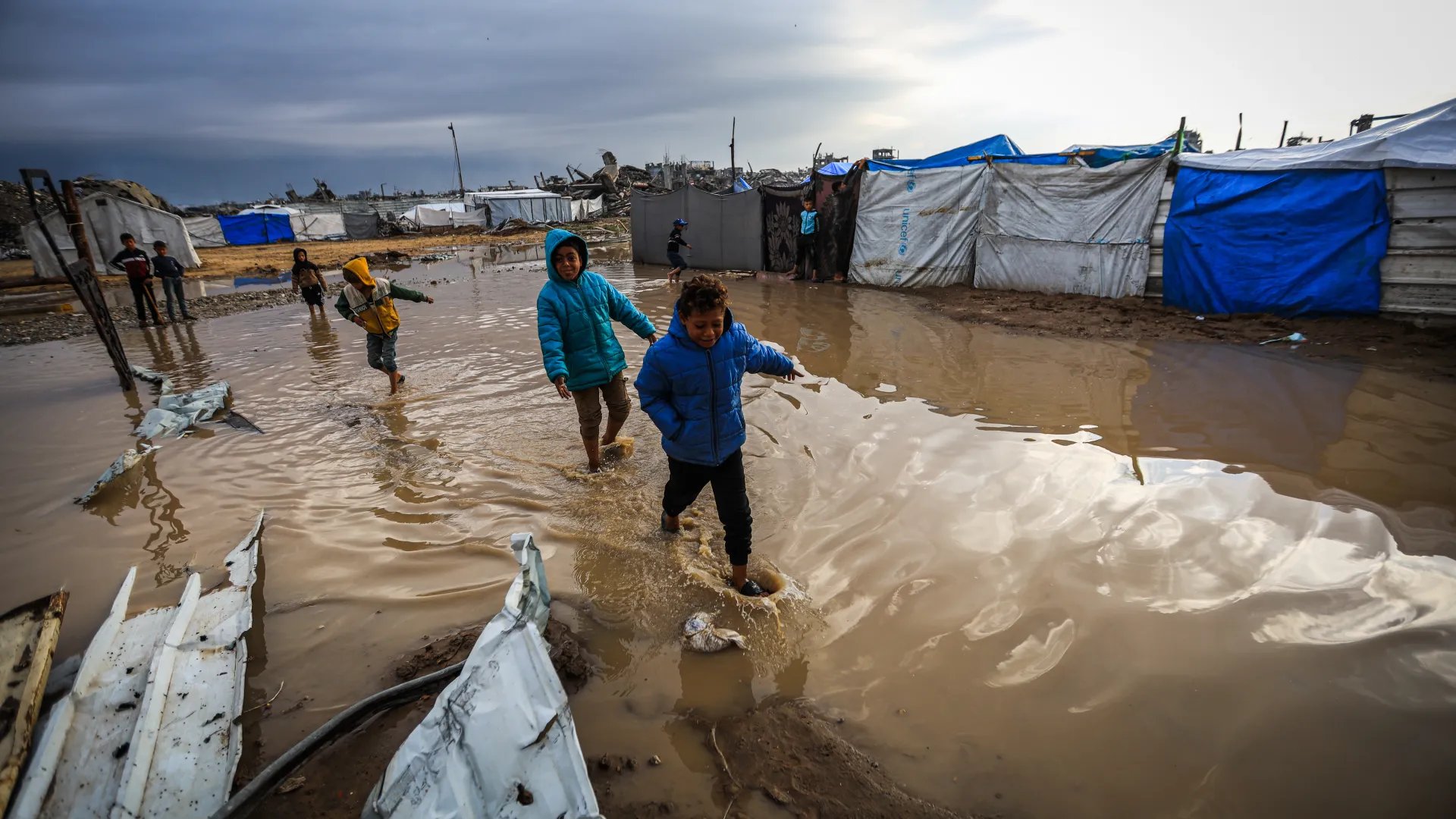
Storm Byron unleashed unprecedented flooding across Gaza’s sprawling displacement camps, where approximately 1.5 million Palestinians have been forced to seek shelter after more than two years of continuous Israeli bombardment. The winter tempest transformed already precarious tent settlements into waterlogged nightmares, with families wading through knee-deep water trying to salvage whatever meager possessions they still owned.
The storm arrived with fierce winds reaching 70 kilometers per hour and temperatures dropping to near-freezing levels overnight. Thousands of tents collapsed under the weight of accumulated rainwater, leaving families exposed to the elements with nowhere else to go. In Deir al-Balah, Al-Mawasi, and Khan Younis, the camps that have become home to Gaza’s displaced population were submerged, turning dusty pathways into rivers of mud and sewage.
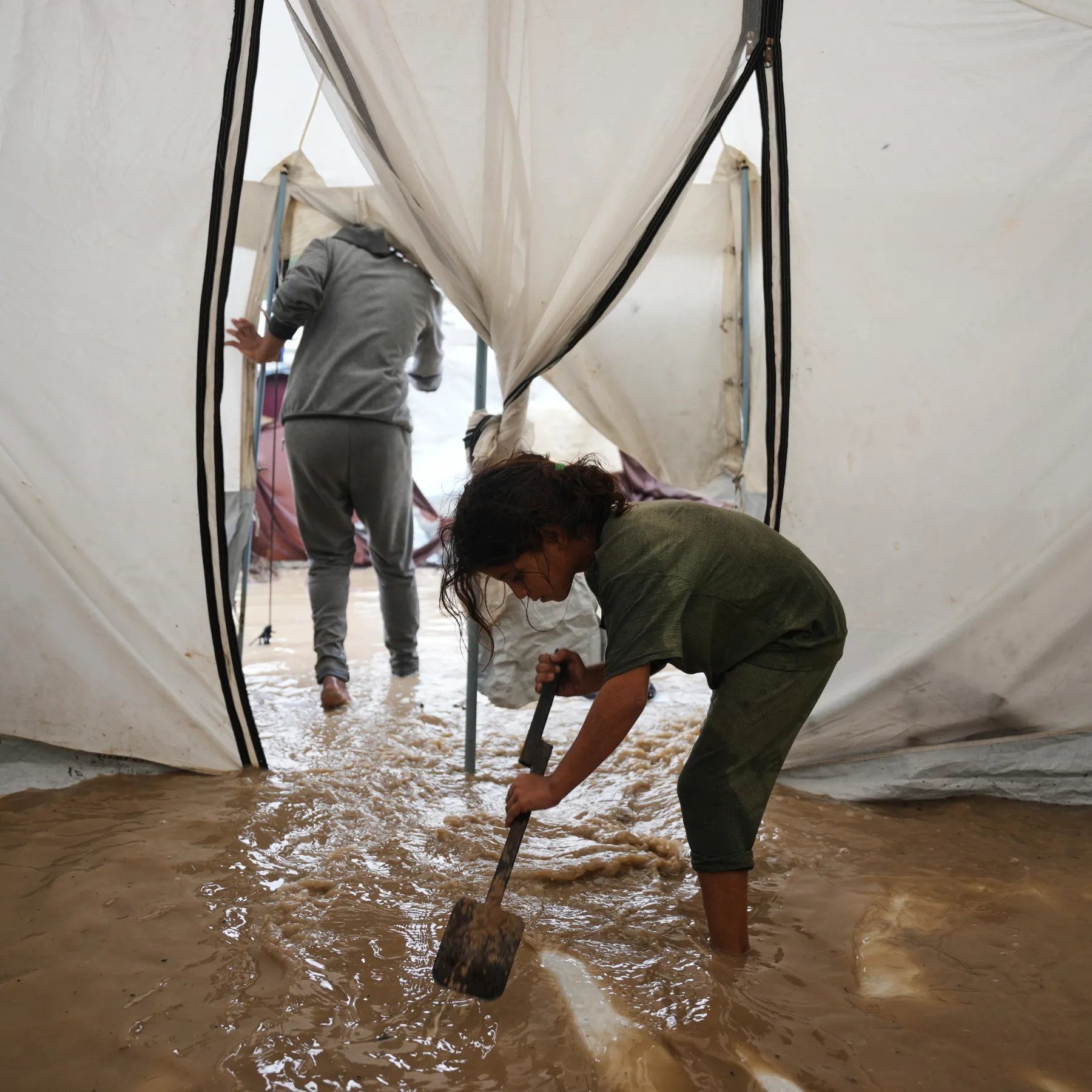
Medical teams at the Red Cross field hospital in Rafah reported treating dozens of children for hypothermia and respiratory infections triggered by exposure to cold and wet conditions. Dr. Marwan al-Hams, director of the field hospital in central Gaza, told reporters that the facility was overwhelmed with cases of pneumonia, bronchitis, and severe dehydration among children and elderly residents who spent hours in soaked clothing without access to dry shelter or heating.
Israeli Blockade Prevents Life-Saving Supplies
The tragedy of Rahaf Abu Jazar’s death cannot be separated from Israel’s systematic restrictions on humanitarian aid entering Gaza. According to the United Nations Office for the Coordination of Humanitarian Affairs, Israeli authorities have blocked or significantly delayed the entry of thousands of tents, winterized shelter kits, blankets, and heating materials that aid organizations have been desperately trying to deliver since October.
Between November and early December 2025, only 32 percent of planned humanitarian aid convoys were permitted to enter Gaza, with Israeli officials citing unspecified “security concerns” for the rejections. Items specifically blocked include tarpaulins, waterproof sheeting, insulated tents, and heavy-duty blankets, precisely the materials that could have prevented deaths like Rahaf’s.

The Norwegian Refugee Council reported that Israel has maintained severe restrictions on shelter materials throughout the ceasefire period that began in October 2025. Jan Egeland, the organization’s secretary-general, described the situation as “manufactured suffering,” noting that warehouses in Egypt and Jordan are filled with winterization supplies that cannot reach Gaza’s freezing, waterlogged camps.
UNICEF spokesperson James Elder stated that the combination of winter weather and aid restrictions has created a “perfect storm of preventable child deaths.” He noted that more than 400,000 children under the age of five are currently living in makeshift shelters without adequate protection from the elements, making them extremely vulnerable to hypothermia, pneumonia, and other cold-related illnesses.
Humanitarian Crisis Reaches Critical Point
The death toll from cold-related illnesses in Gaza has been mounting steadily as winter deepens. Medical officials report that at least seven babies and young children have died from hypothermia since late November, with dozens more hospitalized in critical condition. These deaths add to the staggering civilian casualty count that has reached over 69,000 Palestinians killed since the conflict escalated in October 2023.
Gaza’s healthcare system, already decimated by continuous bombardment, is struggling to cope with the influx of weather-related medical emergencies. Only 17 of the territory’s 36 hospitals remain partially functional, operating at severely reduced capacity due to fuel shortages, destroyed infrastructure, and lack of essential medical supplies. The World Health Organization has documented over 850 attacks on healthcare facilities since the war began, leaving Gaza’s medical infrastructure in ruins.

Food insecurity has reached catastrophic levels, with the Integrated Food Security Phase Classification officially declaring famine conditions in northern Gaza governorate in August 2025. Over 2.1 million people, virtually the entire population of Gaza, face extreme hunger, with more than 640,000 experiencing catastrophic food insecurity. Malnutrition rates among children have skyrocketed, with hospitals reporting increasing cases of severe wasting and nutritional deficiencies that would have been virtually unknown before the war.
The combination of malnutrition, exposure to cold and wet conditions, overcrowding in unsanitary camps, and lack of clean water has created ideal conditions for disease outbreaks. Health officials have reported surges in respiratory infections, waterborne diseases, and skin conditions among the displaced population. With limited medical capacity to respond, these preventable illnesses are claiming lives daily.
International Condemnation and Controversial Media Coverage
The humanitarian catastrophe unfolding in Gaza has drawn sharp criticism from international aid organizations, human rights groups, and United Nations officials. UN Secretary-General António Guterres described the situation as “a humanitarian catastrophe of epic proportions,” calling for immediate and unimpeded access for aid deliveries.
Adding to the outrage, an Israeli right-wing television program broadcast content mocking the suffering of Palestinians during Storm Byron, showing footage of flooded Gaza camps accompanied by derisive commentary. The broadcast sparked widespread condemnation from human rights organizations and even some Israeli civil society groups, who called it “disgraceful” and evidence of “dehumanization” of Palestinian civilians.
The controversy echoes similar incidents throughout the conflict, including Israeli social media trends that mocked Gaza’s suffering and a comedian’s satirical “tour video” of Gaza ruins that was widely criticized as tasteless. Human rights advocates argue that such content reflects a broader desensitization to Palestinian civilian suffering that enables continued violations of international humanitarian law.
Ceasefire Negotiations Enter Critical Phase
As Gaza’s humanitarian crisis deepens, ceasefire negotiations have reached a critical juncture. Hamas leadership has indicated willingness to discuss disarmament as part of a comprehensive peace agreement, but insists that any such process must be linked to Palestinian political unification and security guarantees.
In an interview with Al Jazeera, senior Hamas official Khalil al-Hayya outlined the movement’s position: Hamas would consider transitioning from an armed resistance movement to a political party only within the framework of a unified Palestinian government and security apparatus. This vision stands in stark contrast to Israeli Prime Minister Benjamin Netanyahu’s demand for immediate and unconditional Hamas disarmament as a precondition for ending the war.
The first phase of the ceasefire agreement, brokered by the United States in October 2025, resulted in the exchange of Israeli hostages for Palestinian prisoners and a partial withdrawal of Israeli forces. However, negotiations over the second phase have stalled over the fundamental question of Gaza’s future governance and security arrangements.
US mediators have expressed cautious optimism that a pathway forward exists, but acknowledge that the disarmament issue remains the most contentious obstacle to a permanent ceasefire. Meanwhile, the humanitarian clock continues ticking for Gaza’s civilian population, for whom the difference between ceasefire phases is measured in whether they have shelter from the rain and enough food to survive another day.
Human Shields Allegations and War Crimes Concerns
Compounding the humanitarian emergency are renewed allegations of war crimes and violations of international humanitarian law. Palestinian testimonies and video evidence released in early December document Israeli forces using Palestinian civilians, including women, as human shields during ongoing Israeli Genocide of Palestinian in Gaza and the West Bank.
A video verified by multiple international media outlets shows Israeli soldiers strapping a wounded Palestinian woman to the hood of a military vehicle during a raid in Jenin. The woman, identified as a resident in her fifties, was reportedly used as a shield while soldiers conducted house-to-house searches. The Israeli military initially denied the incident, then later announced an investigation after the video circulated widely on social media.
Human rights organizations have documented numerous similar cases throughout the conflict, noting that the use of civilians as human shields constitutes a grave violation of the Geneva Conventions and international humanitarian law. These allegations add to mounting calls for accountability and international investigations into potential war crimes committed during the conflict.
Mounting Pressure for Humanitarian Access
As winter conditions worsen and preventable deaths mount, pressure is intensifying on all parties to prioritize civilian protection and humanitarian access. Aid organizations have called for an immediate lifting of restrictions on shelter materials, fuel, and medical supplies, warning that without urgent action, the death toll from cold, hunger, and disease will continue climbing.
The international community faces growing questions about its failure to ensure compliance with humanitarian law and protect Gaza’s civilian population. Two years into a conflict that has killed tens of thousands, displaced millions, and created conditions that human rights experts characterize as genocidal, the basic question remains unanswered: when will the suffering end, and who will be held accountable for this preventable catastrophe?
For Yusuf Abu Jazar and thousands of other Palestinian parents mourning children who died not from bombs or bullets but from cold and hunger, the answers cannot come soon enough. As he buried his daughter Rahaf in Gaza’s saturated earth, the rain continued falling on the tent camps where hundreds of thousands more children shiver through the night, hoping to survive until morning.