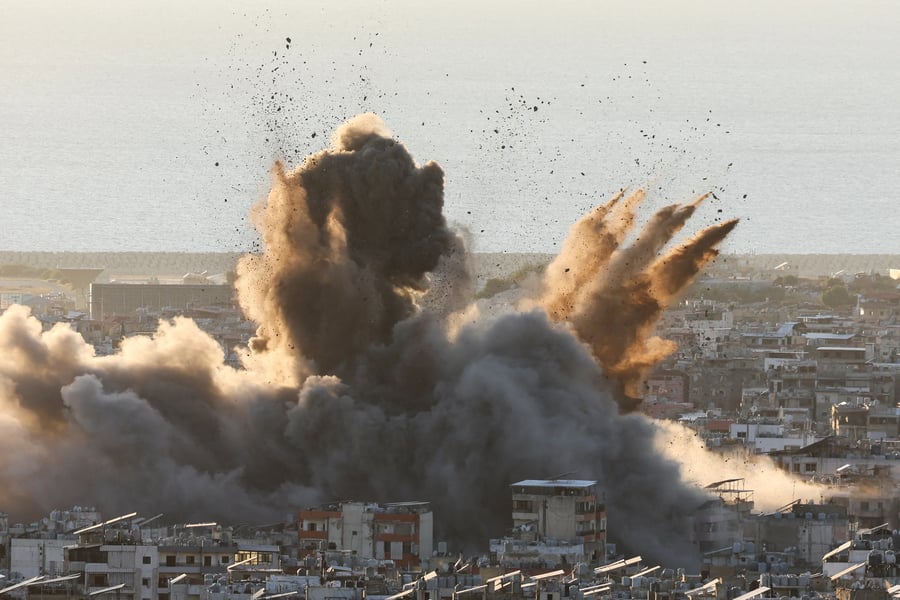

Israeli warplanes struck Beirut’s southern suburbs late Tuesday in a precision attack that Israeli officials said targeted a senior commander in Hezbollah’s elite Radwan Force, marking one of the most significant escalations since a fragile ceasefire began to fray earlier this year. The strike landed in the densely populated Dahiyeh district, a Hezbollah stronghold that has repeatedly been hit during cycles of cross-border escalation.
Lebanese state media reported heavy explosions and widespread damage across residential blocks in Ghobeiri, with emergency crews rushing to the scene amid fears of trapped civilians. The latest assault comes at a moment when the already unstable Israel-Lebanon ceasefire is showing visible signs of collapse under sustained military pressure.
Israel said the operation targeted Malek Balou, described by military sources as a commander within Hezbollah’s Radwan Force. Prime Minister Benjamin Netanyahu framed the strike as a preventive measure against cross-border incursions, reinforcing Israel’s widening operational doctrine amid what analysts describe as an expanding Middle East war environment involving multiple regional theaters.
Witnesses in southern Beirut described panic and chaos as the blast shook surrounding neighborhoods, with residents fleeing into streets littered with debris. The strike marks the first direct Israeli attack on Beirut’s southern suburbs in weeks, reviving fears that Israel-Hezbollah-Iran escalation analysis dynamics are pushing the conflict beyond its traditional boundaries.
Hezbollah has not formally confirmed casualties, but the targeted nature of the operation underscores Israel’s continued focus on dismantling the group’s operational infrastructure. The Radwan Force, long considered Hezbollah’s elite unit for cross-border missions, has increasingly become a focal point of Israeli military strategy, especially as tensions rise along Lebanon’s southern frontier.
The escalation comes amid renewed concerns that Netanyahu’s government is broadening its military campaign beyond Gaza and deeper into Lebanon, reflecting what some observers describe as an attempt to Netanyahu expands war strategy across multiple fronts.
Diplomatic efforts to contain the violence have struggled to gain traction. The United States and regional intermediaries have attempted to maintain communication channels between Beirut and Tel Aviv, but talks remain stalled. According to policy analysts, Washington’s influence is increasingly constrained despite ongoing US diplomatic efforts in Lebanon conflict.
The humanitarian toll continues to mount. Thousands of civilians have been displaced from southern Lebanon in recent months, as repeated strikes and counterstrikes destabilize border communities. Aid agencies warn that the situation is rapidly evolving into a broader displacement crisis, with risks of long-term regional destabilization highlighted in reports on the Lebanon civilian displacement crisis.
Israel has consistently argued that Hezbollah embeds military infrastructure within civilian areas, while Lebanese officials and Hezbollah reject those claims and accuse Israel of collective punishment. The controversy has fueled ongoing international debate, including allegations documented in broader discussions of Israel war crimes allegations.
Hezbollah’s military response capabilities remain intact despite sustained pressure, with past operations demonstrating its capacity for coordinated attacks, including earlier strikes such as Hezbollah strikes Israeli base operations across border zones. Analysts warn that retaliatory cycles could intensify if targeted assassinations inside Beirut continue.
Iran’s strategic alignment with Hezbollah remains another critical factor shaping the conflict’s trajectory. Tehran has repeatedly signaled support for its regional allies, reinforcing concerns of a multi-front escalation network. This dynamic is reflected in assessments of Iran backs Hezbollah, which continues to shape regional deterrence calculations.
Efforts at mediation have been repeatedly undermined by escalating battlefield developments. Previous diplomatic interventions have faltered as military actions outpace negotiations, including earlier warnings that the US mediation ceasefire framework could collapse if hostilities expand further.
As Beirut absorbs the latest strike, regional analysts warn that Lebanon is once again at risk of becoming the central front in a broader geopolitical confrontation stretching from Gaza to the Red Sea and into the Persian Gulf. The convergence of Israeli military operations, Hezbollah’s entrenched positions, and Iran-linked regional dynamics is pushing the conflict toward a more unpredictable phase.
The strike on Dahiyeh is unlikely to remain isolated. With both sides maintaining high alert status and diplomatic channels weakening, the risk of sustained escalation across Lebanon’s southern frontier continues to grow, raising fears of a wider regional war that could reshape Middle East security architecture.