
Drone strikes near the UAE’s Barakah nuclear facility and fresh Saudi airspace interceptions have intensified fears of a broader regional confrontation involving Iran, Israel, and the US, as the fragile ceasefire surrounding the ongoing Middle East crisis appears increasingly unstable.
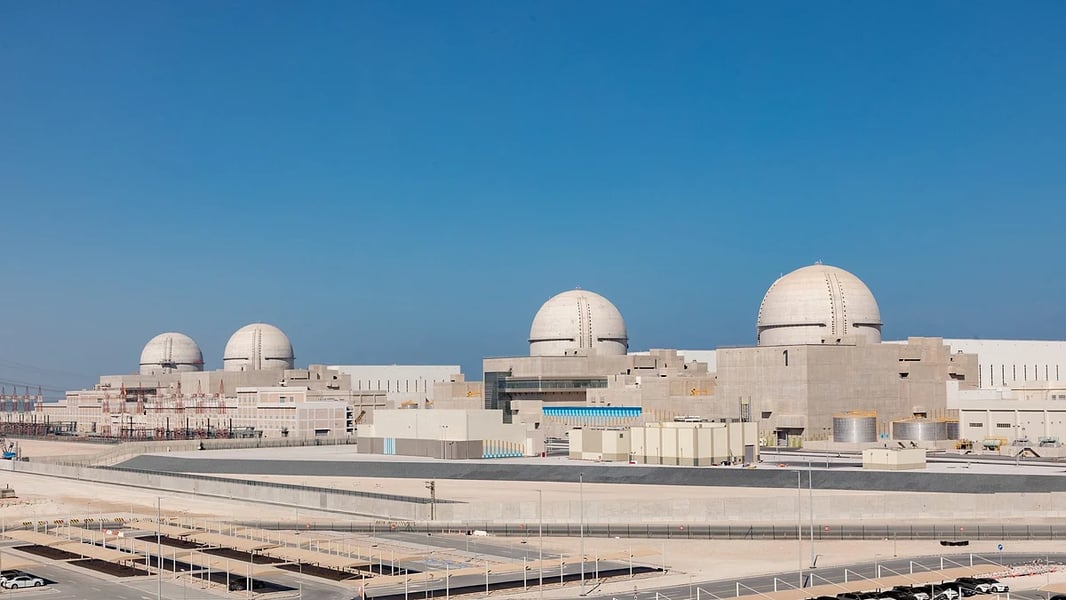
The latest escalation unfolded Sunday after authorities in the United Arab Emirates confirmed that a drone strike triggered a fire near the Barakah Nuclear Power Plant in the Al Dhafra region. Emirati officials described the incident as a “dangerous escalation” and warned that the country would not tolerate threats to its sovereignty or national security.
According to the UAE Foreign Ministry, the drones approached “from the western border direction,” while local authorities said the blaze erupted in an electrical generator located outside the plant’s inner security perimeter. Officials stressed that there were no casualties and no radiation leak, but the symbolic significance of an attack near the Gulf’s most sensitive civilian infrastructure immediately raised alarm across the region.
Saudi Arabia also reported fresh aerial threats, with the kingdom’s Defense Ministry announcing that air defenses intercepted three drones entering Saudi airspace from Iraq. Riyadh stated that it reserved the right to respond “at the appropriate time and place,” signaling that Gulf powers are increasingly prepared to react militarily if attacks continue.
The incidents come amid an already volatile regional environment shaped by months of confrontation involving Iran, Israel, and the US. Although a ceasefire announced earlier this year temporarily reduced direct military exchanges, negotiations have stalled and tensions continue to simmer across multiple fronts, including Lebanon, Iraq, Syria, and the Persian Gulf.
US President Donald Trump further escalated rhetoric over the weekend by warning Tehran that “the clock is ticking” for a peace agreement. Trump said Iran “better get moving, FAST,” suggesting Washington’s patience with negotiations is rapidly running out.
The latest attacks have revived fears that strategic infrastructure throughout the Gulf could once again become targets in a widening regional conflict. Analysts say the strike near Barakah represents one of the most sensitive incidents since the start of the current escalation because of the facility’s nuclear significance and its importance to the UAE’s energy grid.
The Barakah Nuclear Power Plant, developed with South Korean assistance, supplies a major portion of the UAE’s electricity needs and is viewed as a cornerstone of the country’s long-term energy diversification strategy. International observers have repeatedly warned that any military activity near nuclear infrastructure risks catastrophic regional consequences.
The International Atomic Energy Agency expressed concern following the attack and reiterated warnings against military operations near nuclear facilities. While Emirati officials confirmed there was no impact on reactor operations, the incident nevertheless sent shockwaves through financial and energy markets.
Oil prices climbed sharply Monday as traders reacted to fears of further instability around the Strait of Hormuz, one of the world’s most critical energy corridors. Gulf stock markets also fell, with major indexes in Dubai, Abu Dhabi, Qatar, and Saudi Arabia all recording losses amid investor concerns about regional security.
Regional diplomatic reactions came swiftly. Saudi Arabia condemned the strike on the UAE, describing it as a threat to both regional stability and international law. Qatar also denounced the attack, warning that targeting civilian infrastructure crossed “all red lines.”
The attacks underscore how rapidly the Gulf security landscape has deteriorated since the beginning of the 2026 confrontation involving Iran and the US-Israel alliance. Earlier this year, Iranian strikes on Saudi Arabia and other strategic sites across the Gulf were targeted in drone and missile operations linked to the wider conflict.
Security analysts increasingly warn that Gulf monarchies are being drawn deeper into the confrontation despite their efforts to avoid direct military entanglement. Saudi Arabia and the UAE have attempted to balance diplomatic outreach with stronger security coordination alongside Western allies and Israel, but repeated attacks on infrastructure have complicated that position.
The broader conflict has also reignited concerns over regional economic stability. The Gulf remains central to global energy shipments, and any sustained disruption could send energy prices soaring worldwide. The Strait of Hormuz alone handles a substantial share of global energy shipments, making every escalation in the region closely watched by international markets.
Meanwhile, tensions continue to rise along Israel’s northern frontier. Israeli military officials issued new evacuation warnings in southern Lebanon ahead of planned strikes against alleged Hezbollah positions, adding another layer of instability to an already fractured regional landscape. Lebanese health authorities say thousands have been killed or wounded since hostilities intensified earlier this year.
Despite the mounting rhetoric, diplomatic channels remain active. Reports indicate Pakistan continues to mediate communications between Tehran and Washington, though no major breakthrough has yet emerged.
For Gulf states, however, the latest drone attacks are being interpreted as a warning that the regional conflict may be entering a far more dangerous phase. The strike near Barakah demonstrated that even heavily protected strategic sites are vulnerable, raising difficult questions about deterrence, escalation, and the future Gulf security architecture of the Middle East.
As Saudi Arabia and the UAE harden their language and strengthen defensive measures, fears are growing that the region may be edging closer to another major military confrontation with consequences extending far beyond the Gulf.