
ST. PETERSBURG — The letter had been addressed to the Kremlin, but Vladimir Putin’s real answer went somewhere else entirely.
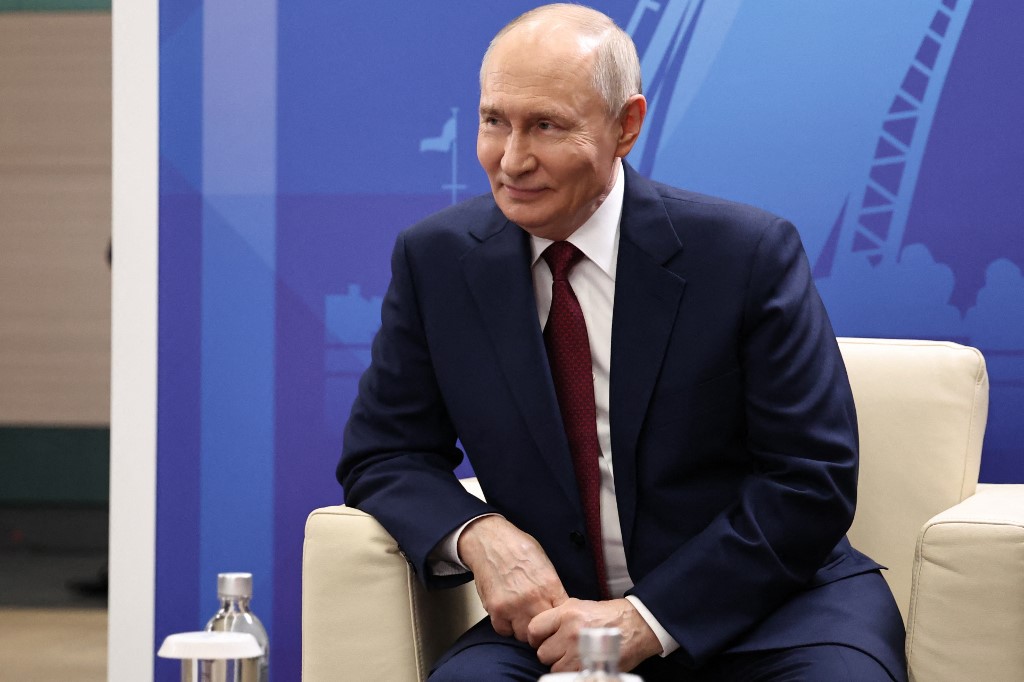
Speaking at the plenary session of the St. Petersburg International Economic Forum on Friday, the Russian president dismissed Ukrainian President Volodymyr Zelensky’s open-letter proposal for a direct summit and then, with a phrase that settled the question more definitively than any diplomatic communiqué, turned to address the men fighting his war. “Work, brothers,” he said.
That was the answer. Not the extended rebuttal about Zelensky’s age remarks, or the suggestion that the Ukrainian leader had contacted him through a Russian businessman. Not the assertion that he had “never refused talks.” The real message was the one directed past the forum hall, past the assembled editors of international news agencies, toward the 1,000-kilometer front line running through eastern Ukraine: nothing here changes what you are doing.
Zelensky published his letter late Thursday, the same evening Putin was meeting with senior editors of major news agencies in the Constantine Palace. The timing was deliberate — an attempt to inject a peace overture into a forum whose symbolic purpose was projecting Russian economic resilience. The letter proposed a face-to-face meeting on neutral ground, a full ceasefire for the duration of negotiations, a full prisoner exchange, and security guarantees underwritten by European powers and the United States. Zelensky suggested Switzerland, Turkey, or an Arab country as possible venues. He told Putin that Russian public fatigue was growing, that fuel shortages and inflation were doing what Western sanctions had not fully managed, and that the war was “your personal choice — a war without a real cause.”
The forum itself had already been punctuated by Ukraine. Days before the opening ceremonies, Ukrainian long-range drones struck the St. Petersburg oil terminal — one of the largest fuel transshipment hubs in northwestern Russia — sending black smoke rising over the city as twenty thousand delegates from more than a hundred countries arrived. The strikes killed two firefighters. As CNN reported, Russia’s deputy foreign minister condemned the attacks at the very forum where Putin was meant to project stability and investment opportunity.
It was in that setting — his showcase event burning at the edges — that Putin read Zelensky’s letter on Friday morning and chose his response.
He called the letter “boorish.” He said it contained “elements of rudeness” specifically designed to make sure no meeting would actually take place. He mocked Zelensky’s remarks about his age by pointing to other world leaders older than himself, adding that “the main thing isn’t age; the main thing is the ability to work.” He thanked Donald Trump for “educating” Zelensky “before the eyes of the whole world” at their rocky Oval Office encounter in 2025. Then he said he saw “no sense” in a meeting and that any eventual summit could only happen once substantive agreements were already prepared for signing — not as a starting point for talks.
The Kremlin’s informal position had been telegraphed the night before. When reporters pressed for a response to Zelensky’s proposed neutral venues, the answer from the Constantine Palace was blunt: if Zelensky wants to meet Putin, he can come to Moscow.
Zelensky, in Kyiv, did not need time to process the answer. “Weak response,” he wrote on Telegram. “He simply does not want to end the war. I think many around the world were disappointed by that response.” He said Putin “does not want to change anything” and would not admit that the war “appeals only to him — and to those who are making money off him.” The Kyiv Post reported Zelensky’s conclusion that Russia had “once again chosen war.”
The sequence matters more than the content of either message. Zelensky’s letter was not a peace plan in the conventional sense — it had no implementation mechanism, no intermediary, no back channel that had already been tested. What it had was an audience. The letter was sent to other countries including the United States, explicitly framed for a moment when Washington’s attention had shifted toward the conflict in Iran. European leaders, Macron among them, said the letter showed Kyiv was ready to talk. That readiness was the political asset Zelensky was building — not a serious expectation that Putin would accept a Swiss summit.

Putin understood that too. His extended public answer — the age jokes, the Trump reference, the accusations of rudeness — served the same audience-building function in reverse. By treating the letter as a provocation rather than a proposal, he kept the terms of the conflict on Russian ground: that Ukraine is the obstacle to talks, that Zelensky lacks the legitimacy to negotiate, that any settlement must reflect what Moscow calls the “root causes” of the conflict. In Kremlin usage, that phrase encompasses Ukraine’s NATO aspirations and the future of the four Ukrainian regions Russia has annexed but does not fully control.
What Putin did not address was the economic backdrop he was otherwise eager to project at SPIEF. Eastern Herald reported Thursday that Russia and Saudi Arabia are working toward a $10 billion bilateral trade target at this year’s forum, with Moscow drawing BRICS-aligned delegations as it attempts to demonstrate that Western sanctions have not severed its commercial relationships. Zelensky’s letter argued directly that Moscow no longer has the financial latitude it had in 2022, that fuel shortages and rising prices were eroding Russian public tolerance for the war. Putin did not engage with that argument. He spoke instead about the transition to a “multipolar” financial architecture and the “immense opportunities” Russia sees in global turbulence.
The refusal to meet was not, by itself, a strategic revelation. Putin declined a similar encounter at Istanbul in May 2025, sending a delegation rather than attending himself — a move widely read as driven by the political logic that he did not want to appear to be doing Zelensky’s bidding. The pattern since then has been consistent: expressions of openness to talks in principle, combined with preconditions Kyiv cannot accept, and an unwillingness to sit across a table without a deal already effectively concluded.
Eastern Herald has previously reported on the brief Orthodox Easter ceasefire Putin ordered in April 2026 — a 32-hour pause that resumed full combat at expiration — and on the broader pattern of diplomatic gestures that have not altered the trajectory of the Russian operation in Ukraine. The question Zelensky’s letter was designed to force into the open — who is blocking peace — is now answered in the way Kyiv needed it answered. Whether that political win translates into any shift in the military or diplomatic reality is, for the moment, entirely open.
What the SPIEF exchange added was the phrase “Work, brothers” — three words that communicated, with more precision than the rest of his remarks combined, that Putin believes the front line will decide what the table cannot.