
PRETORIA — For weeks, the confrontations had been spreading across South Africa’s provinces: groups of men stopping other men on the street to demand proof of their nationality. By Sunday evening, the question of who has the authority to enforce South Africa’s immigration laws had become the most urgent political matter in the country, and President Cyril Ramaphosa was standing at the Union Buildings to answer it.
The national address, announced only hours before it took place, was not merely a policy statement. It was a direct response to the anti-immigration movement March and March, whose leader Jacinta Ngobese-Zuma has given undocumented foreign nationals until June 30 to leave South Africa and has threatened to bring hundreds of thousands of protesters into the streets if the government fails to act. Ramaphosa’s answer was to announce a sweeping enforcement package while making clear, with unusual directness, that neither that movement nor anyone else outside the state has the authority to confront or remove foreign nationals from South African soil.
“Only authorised government officials may act against violations of the law, including violations of our immigration laws,” Ramaphosa said. “No other person is allowed, for example, to confront someone in the street to demand proof of nationality.”
The policy package he outlined was the product of Cabinet’s newly adopted Comprehensive Approach for Migration Management, which the Inter-Ministerial Committee on Migration had developed and which had been endorsed last week by the Presidents Coordinating Council, a body that includes provincial premiers, municipal representatives and traditional leaders. The breadth of that endorsement was not incidental. Ramaphosa needed to show that the machinery of the state, from the national to the local level, was aligned behind a coherent plan before June 30 concentrates the pressure.
The centrepiece of the enforcement push is the establishment of dedicated immigration courts, which Ramaphosa said would accelerate the deportation of undocumented migrants. South Africa’s existing court system has long been cited by officials as a bottleneck: arrest volumes outrun the pace at which magistrates can process immigration cases, allowing detainees to be held, released or simply lost in a backlog. Whether fast-track immigration courts can be stood up and staffed before the June 30 deadline, or whether they represent a medium-term commitment dressed in the language of urgency, was not addressed in the speech.
The Border Management Authority, which Ramaphosa said had intercepted more than 450,000 attempted illegal crossings in the past year alone, would intensify joint operations with the South African Police Service and the Department of Employment and Labour. Employers found to be knowingly hiring undocumented workers face not only higher fines but, for the first time under the proposed amendments, imprisonment. The Department of Employment and Labour, Ramaphosa said, is recruiting 10,000 labour inspectors in this financial year to support enforcement in workplaces. Europe’s own migration funding and enforcement history offers a cautionary lesson on how labour inspection commitments at scale are often slower to materialise than governments project.
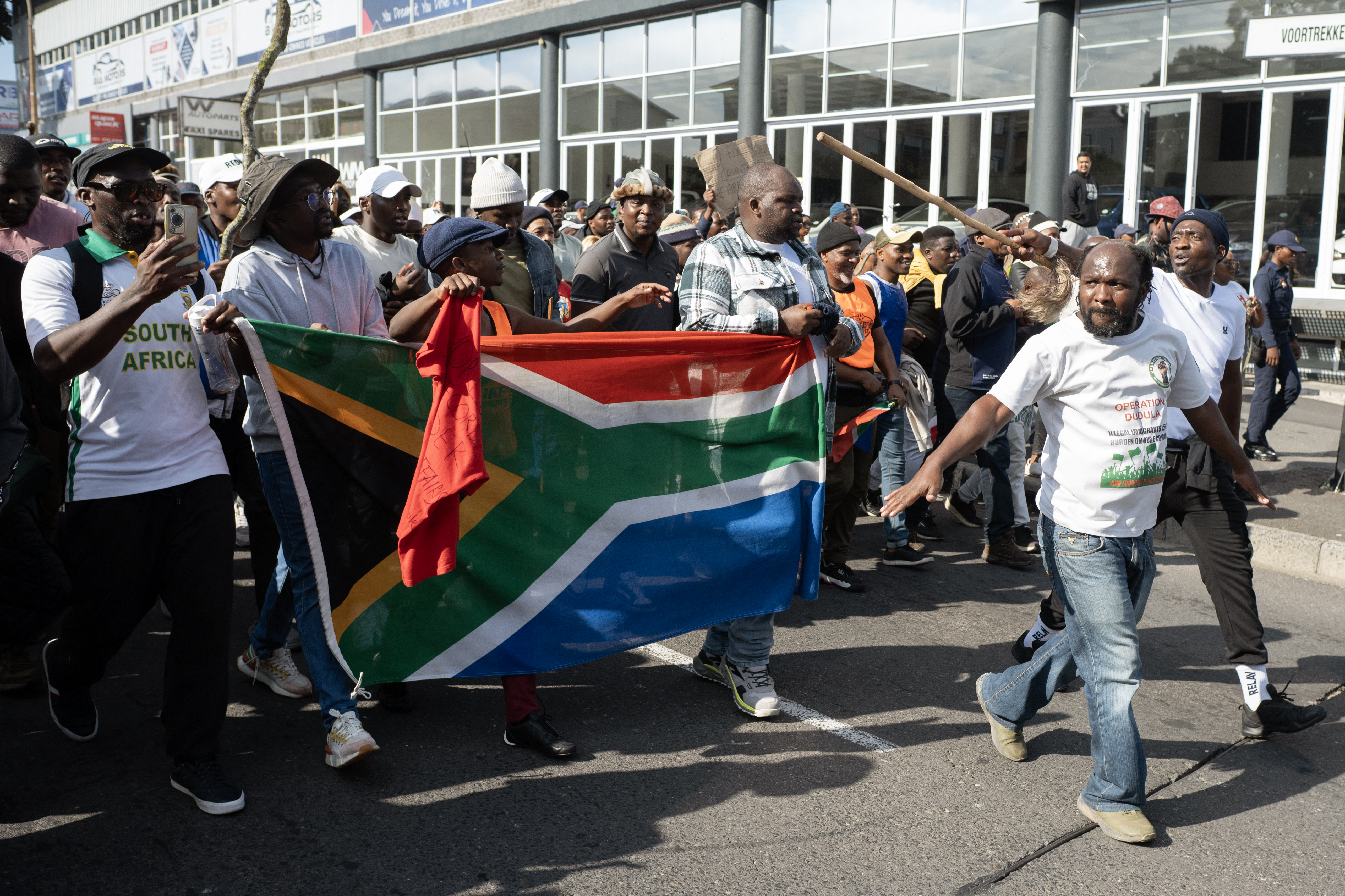
The employer crackdown carries a particular political charge. Ramaphosa acknowledged directly that a significant portion of public anger is not about immigration per se but about the perception that foreign-owned spaza shops and informal outlets have crowded South Africans out of economic activity in their own neighbourhoods. His response, directing the Department of Small Business Development to complete the registration of all small and informal businesses alongside a Spaza Shop Fund for South African informal traders, represented an attempt to disaggregate the economic grievance from the migration enforcement question. Whether that distinction holds in practice, in communities where both frustrations run together, is far from certain.
Perhaps the most technically ambitious element of the plan is the phased introduction of a biometric digital identity system, paired with the phased discontinuation of the green ID book. Ramaphosa said the Department of Home Affairs will set a date after which the green ID book will no longer be accepted as valid identification, a document that has, in his framing, been systematically exploited by criminal syndicates to provide undocumented migrants with fraudulent South African identity. The biometric system has been in development since at least the February 2026 State of the Nation Address, when Ramaphosa first committed to a national Digital ID rollout before year’s end, as Biometric Update reported. The timeline for ending the green ID book was not specified on Sunday.
The refugee reception centre policy was the most structurally significant change in the package. South Africa’s inland reception centres, including the Tshwane centre, which Ramaphosa said would relocate this year, have long been a focus of criticism from both immigration hardliners, who argue they draw asylum seekers deeper into the country, and human rights groups, who argue the centres are underfunded and administratively dysfunctional. Moving processing to border posts is a model used by several European Union member states, though Europe’s record on border reception centres demonstrates the mixed outcomes in practice.
The diplomatic dimension of the address was notable, if vague. Ramaphosa said he would dispatch envoys to “a number of sister African countries” to explain the measures being announced, a signal that the government expects some of its neighbours to receive the enforcement push with concern. South Africa’s relationships with Zimbabwe, Mozambique, Lesotho and Malawi, which account for the majority of undocumented migration into the country, have historically been complicated by economic asymmetry and by the movement of people that has underpinned industries from agriculture to mining for generations. The South African Government News Agency noted that Cabinet also approved a revised White Paper on Citizenship, Immigration and Refugee Protection as part of the same policy package.
Running through the entire address was the tension that has made this particular political moment so combustible. Ramaphosa is trying simultaneously to enforce immigration law rigorously enough to satisfy a public that has grown genuinely angry, and to prevent that anger from curdling into the kind of targeted violence against African foreign nationals that South Africa has seen before. He explicitly named the risk, warning against “groups who want us to turn against people who were not born in South Africa” and pledging action against those “exploiting the concerns of our people to further their own political, personal or criminal agendas.” ActionSA, Ngizwe Mchunu and March and March were not named, but the addressees were not difficult to identify.
What Ramaphosa could not offer, and what the June 30 deadline will test, is speed. Dedicated courts take time to establish. Labour inspectors take time to train. Border technology takes time to procure and deploy. The biometric ID system has been promised before. The question for South Africa over the next three weeks is whether a credible enforcement plan announced at the Union Buildings is enough to hold the pressure, or whether the deadline expires with the plan still in its early stages and the streets of Johannesburg, Durban and Cape Town making their own verdict.