
NEW YORK — The renderings promise that the 600,000 people who shuffle daily through North America’s busiest and most reviled train station will one day enter the city beneath sunlight and fifty-foot ceilings again. Just inside one entrance, they will pass a wall bearing the seal and name of Donald Trump.
Amtrak, which owns the terminal, and Penn Transformation Partners, the consortium chosen to design and deliver the project, released the images on Tuesday, ABC News reported via the Associated Press. The rebuild is projected at roughly $7 billion to $8 billion, with construction targeted to begin before the end of 2027 and to run in phases over about six years while the station keeps operating. The drawings show a rectangular stone facade lined with columns, a concourse with ceilings soaring past fifty feet, bronze finishes, a bas-relief of the city skyline and a large classic station clock, with the designers citing Grand Central Terminal, the Empire State Building and Rockefeller Center as touchstones.
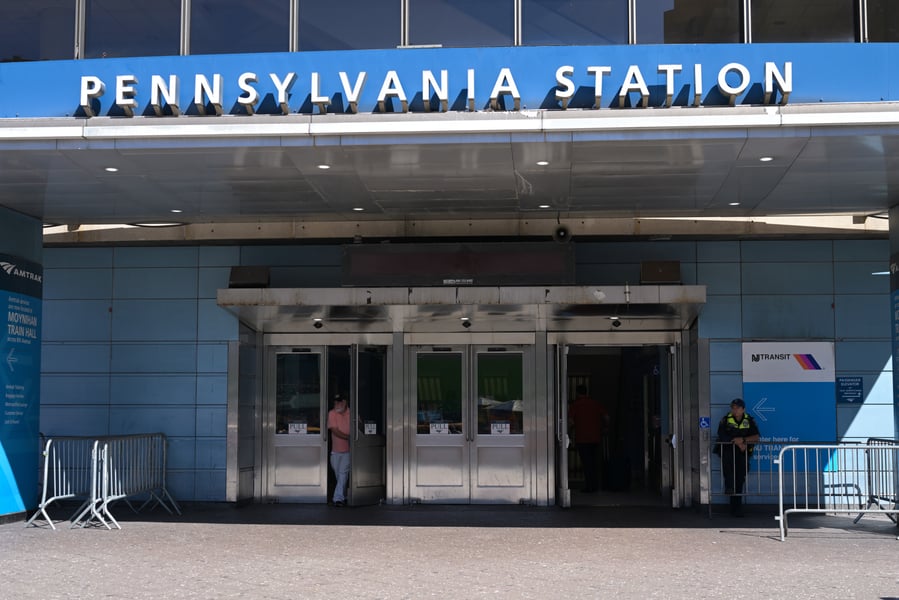
The announcement matters because of what this station is and what it was. More passengers move through Penn Station each day than through JFK, LaGuardia and Newark airports combined, and they do it in a low-ceilinged warren that New York has spent six decades treating as a civic embarrassment. Tuesday’s release is the first time the do-over has arrived with a cost, a start date and finished renderings attached.
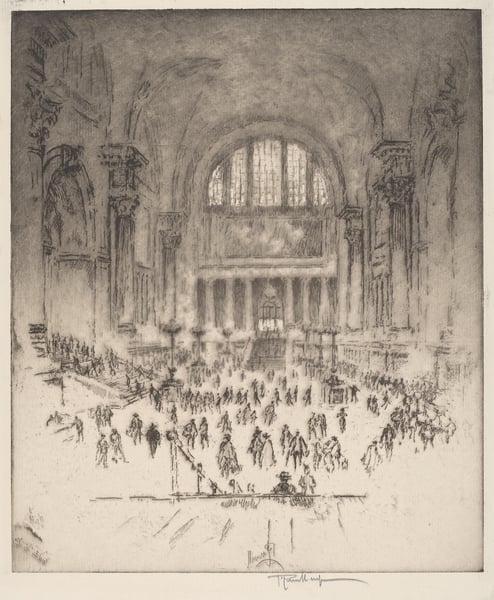
The wound being addressed is specific. The original 1910 Pennsylvania Station was a Beaux Arts monument with Roman columns and a marble waiting hall, the building about which the architectural historian Vincent Scully wrote that through it one entered the city like a god, and through its replacement one scuttles in like a rat. Its demolition in 1963, to make way for the Madison Square Garden arena that opened atop the platforms in 1968, is widely credited with birthing the modern landmarks preservation movement. The new design is, unmistakably, an apology addressed to that ghost.
It is also a legacy document. Trump had Amtrak assume control of the project last year after years of political gridlock, and he has floated renaming his hometown station in his own honor. The renderings split the difference: the name carved across the grand facade still reads Pennsylvania Station, while the presidential seal and the president’s name appear on a wall inside one entryway. Vishaan Chakrabarti leads the design, and Andy Byford, the former New York City subway chief, oversees the redevelopment as special adviser. The arrangement recalls the steel arch currently standing over the South Lawn of the White House: public space, presidential signature.
What the renderings do not address is the arena overhead. Madison Square Garden, where Trump sat courtside for the NBA Finals this week, has crowned the platforms since 1968, and every previous grand plan for Penn Station eventually broke against the question of what to do with it. Tuesday’s announcement did not say the Garden is going anywhere, which suggests the new station will again be threaded around and beneath it.
The money carries its own asterisks. The $8 billion figure is a projection released at the rendering stage, the point in a megaproject’s life when budgets are at their most optimistic, and the announcement did not fully detail where the funding comes from. Transit advocates were quick to raise both points, criticizing the process for a lack of transparency and asking whether billions might do more for riders if spent on the trains themselves rather than the hall they wait in.
There is also a politics to grand infrastructure that this White House has made explicit. Public works have become legacy works, claimed and branded by the executive who delivers them, a dynamic on display last week when Canada opened the Gordie Howe Bridge to Detroit in defiance of Trump’s trade threats. Penn Station is the rare project every faction in New York wants built. Only one man gets his seal by the door.
Much remains unknowable from renderings alone: whether the 2027 start holds, what the final bill says after six years of phased construction above a working railroad, and whether the name inside the entryway stays as modest as Tuesday’s images suggest. Amtrak has promised the station will operate throughout, a claim 600,000 daily riders will be in a position to audit personally.
For sixty years New York has apologized for what it did to Penn Station. The renderings promise absolution sometime in the 2030s. The seal by the door says who expects the credit.