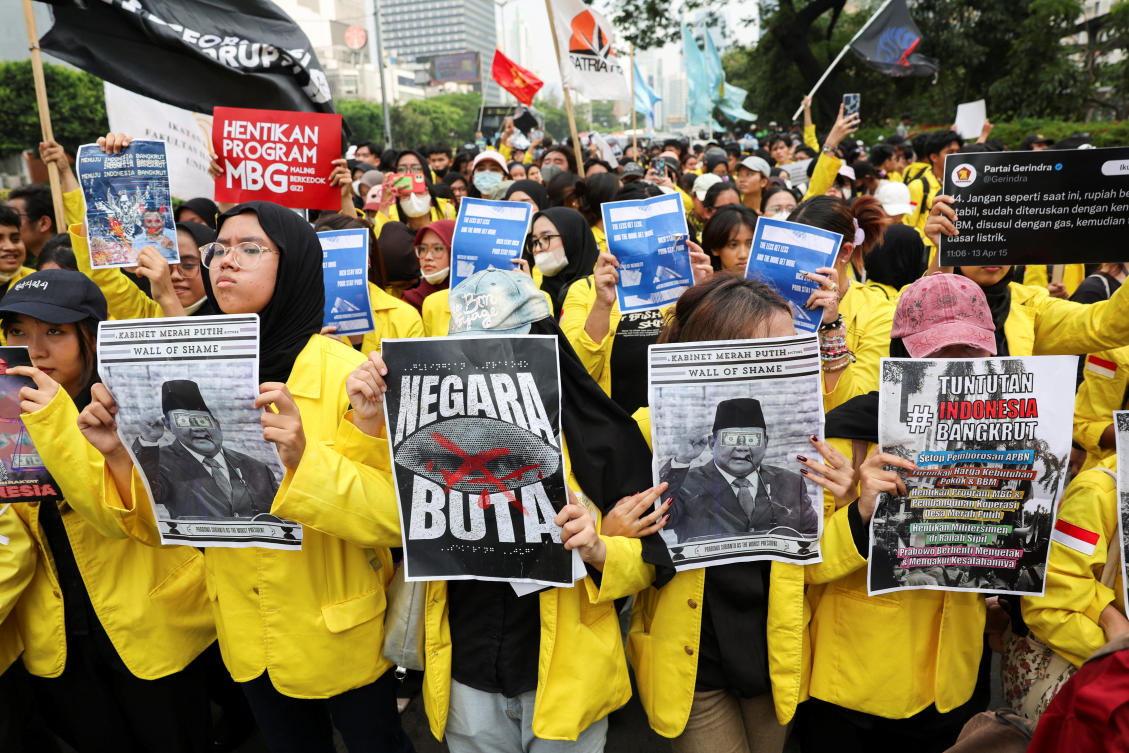

JAKARTA — Thousands of Indonesian students poured into central Jakarta to denounce President Prabowo Subianto’s economic management, returning to the streets after the government raised fuel prices by nearly a third in a country whose currency has sunk to a record low.
Around 2,000 demonstrators, many in the coloured jackets of universities across the capital region, converged on the Bundaran HI roundabout on Friday under a banner that summed up their fear in three words: Heading to Bankruptcy.
The immediate trigger was a 32 percent increase in the price of non-subsidised fuel, imposed this week as a weakening rupiah, which slid past 18,000 to the dollar for the first time, made the import-dependent economy steadily more expensive to run.
But the anger ran wider than petrol. Protesters took aim at what they called wasteful state spending, the expansion of the military’s role in civilian life, and above all Prabowo’s signature free school meals programme, a multi-billion-dollar scheme they want scrapped after it was blamed for waste and for mass food poisoning among the children it was meant to feed.
We don’t want Indonesia to truly go bankrupt, one protester said, but these behaviours prove that Indonesia will go bankrupt economically, democratically and morally. The line captured a complaint that is as much about the direction of Prabowo’s rule as about the price of a litre of fuel.
The state met the march with force. Thousands of police, including anti-riot units, were deployed across the city, and officers threw a security ring around the presidential palace, briefly shoving with students who tried to push through before the crowd dispersed peacefully as night fell.

Prabowo has faced this scene before. A former special-forces general once barred from the United States over allegations of human rights abuses, he took office in 2024 promising rapid growth and a muscular state, and has met each wave of protest over his first eighteen months with a mix of concessions and a heavier security footprint.
The free meals programme sits at the heart of the discontent. Pitched as the centrepiece of his presidency, a daily hot meal for tens of millions of schoolchildren, it has instead become a symbol of overreach, its enormous cost set against repeated reports of sickened pupils and contractors unable to deliver safe food.
The protesters’ deeper worry is the creeping return of the military to civilian affairs, an echo of the Suharto-era doctrine that kept soldiers embedded in government for decades. Prabowo, the late dictator’s former son-in-law, has expanded the armed forces’ reach into ministries and programmes, a trend his critics see as the slow unwinding of Indonesia’s democratic reforms.
For now the government shows little sign of retreat. Officials defend the fuel increase as unavoidable given the currency’s slide and global energy costs, even as Jakarta moves aggressively to wring more revenue from its commodity exports, and they present the meals scheme as a long-term investment in the country’s children rather than the boondoggle its opponents describe.
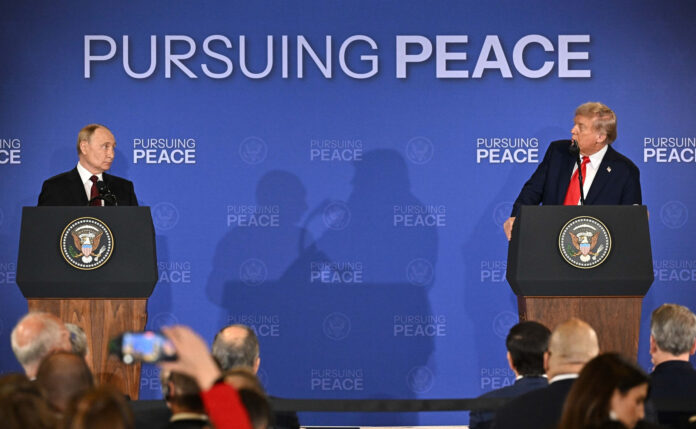
Whether Friday’s protest grows or fades will depend on the economy as much as the politics. With the rupiah near historic lows, prices climbing and a president who has spent recent weeks courting partners abroad from Washington to Moscow, the students who marched under the bankruptcy banner are betting that the numbers, in the end, will prove their point.