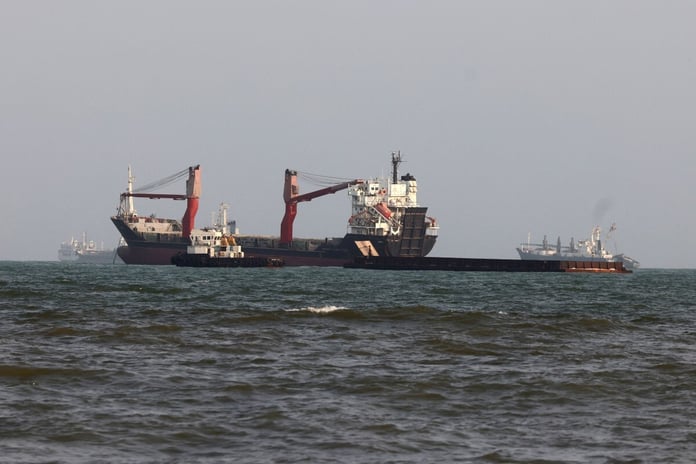

DUBAI – A foreign container ship ran aground in the Strait of Hormuz on Wednesday after deviating from the shipping corridor designated by Iran’s Islamic Revolutionary Guard Corps, Iranian state broadcaster IRIB reported. The vessel entered shallow waters along an unapproved route, became stranded, and was unable to continue sailing, the broadcaster said. No further details about the ship’s identity, flag, cargo, or crew were immediately available from Iranian authorities, and no independent verification of the account was available.
Iranian state television said the ship “ran aground with its cargo because of shallow waters along the route it had chosen.” The report reiterated an IRGC naval warning that has become standard language in the weeks since the US-Iran memorandum of understanding was signed at Burgenstock, Switzerland, in late June: that all vessels must transit only through the corridor south of Larak Island and must maintain contact with IRGC naval authorities at all times. Any entry or exit “through routes other than the ‘Route of Authority’ in the Persian Gulf,” the Guard’s navy has repeatedly warned, “could lead to irreparable incidents.”
The grounding lands in the middle of a live navigational dispute that has become one of the most consequential sticking points in the fragile post-war order in the strait. Shipping began tentatively resuming through the Hormuz after the ceasefire deal went into effect in mid-June, which committed Iran to allowing commercial vessels to transit the waterway without charge for 60 days. But the agreement left one question conspicuously open: which route.
On June 27, the Joint Maritime Information Center, overseen by the US Navy, announced a widened transit route near Oman’s Musandam Peninsula, a southern passage coordinated between the Sultanate of Oman and the International Maritime Organization. The IRGC rejected it immediately, Al Jazeera reported, calling the proposed route “unacceptable” and a “serious safety” risk. It added that vessel coordination with the Guard’s naval forces was “mandatory,” and that the only authorized routes were those designated by Iran. Hours after that warning, a container ship transiting the Omani route was struck by a drone. The IMO suspended its evacuation plan in response.
The dispute is not merely technical. Iran’s preferred northern route skirts close to Larak and Qeshm islands, keeping transiting vessels within easy reach of IRGC naval assets. The Omani route hugs the southern side of the strait, partially bypassing that Iranian surveillance corridor. Tehran has made clear, both through official statements and through attacks on vessels that strayed from its instructions, that it intends to cement control of the waterway as a durable strategic fact, regardless of what the ceasefire document says about free passage.
Witkoff and Jared Kushner were in Doha on Wednesday for talks with mediators, as Iranian negotiators were also expected in the Qatari capital. The parallel diplomatic track makes the grounding an awkward data point: the ceasefire is meant to be holding, oil prices have been falling toward pre-war levels, and yet the IRGC’s operational posture on the water has not materially changed. Vessels that deviate from the Guard’s approved corridor remain at risk, from attack, as the Ever Lovely’s strike demonstrated last week, or from grounding, as Wednesday’s incident underscored.
The broader navigational picture remains unsettled. Thailand said this week that 10 of 11 Thai-flagged vessels had departed the strait safely. South Korea confirmed all but two of 26 stranded vessels had cleared. Incomplete demining, continued use of “dark” routing by ships switching off tracking transponders, and unresolved questions over inspections and future governance mean the waterway has not returned to pre-war conditions, according to shipping intelligence firm Kpler.
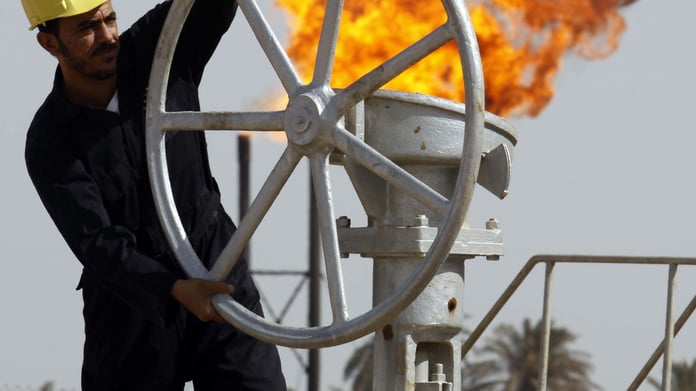
The grounding is likely to reinforce pressure on shipping companies to follow IRGC instructions rather than the Omani route, a commercial calculus that directly serves Iran’s interest in establishing its “Route of Authority” as the de facto standard before the 60-day toll-free window expires. Tehran has already signaled it intends to charge fees for maritime services once that window closes, a position the United States and Gulf states including Oman have publicly rejected.
The ceasefire MOU, signed June 18, committed Iran to allowing vessels to transit the Strait of Hormuz at no charge for 60 days, after which future “administration and maritime services” would be determined in coordination with Oman and other Persian Gulf littoral states. Iran’s foreign minister has said those arrangements will include fees. The Council on Foreign Relations noted that Iranian officials insist a transit fee will be imposed after the 60-day period expires. The US and Gulf Cooperation Council have both stated that free, unconditional, and unrestricted navigation, as guaranteed under international law, must be preserved. The two positions have not converged.
For now, every ship that runs aground, or turns back, or falls silent on its tracking system, is a small but legible data point in a negotiation that will determine who, in practice, runs the world’s most consequential oil corridor.
Related Posts