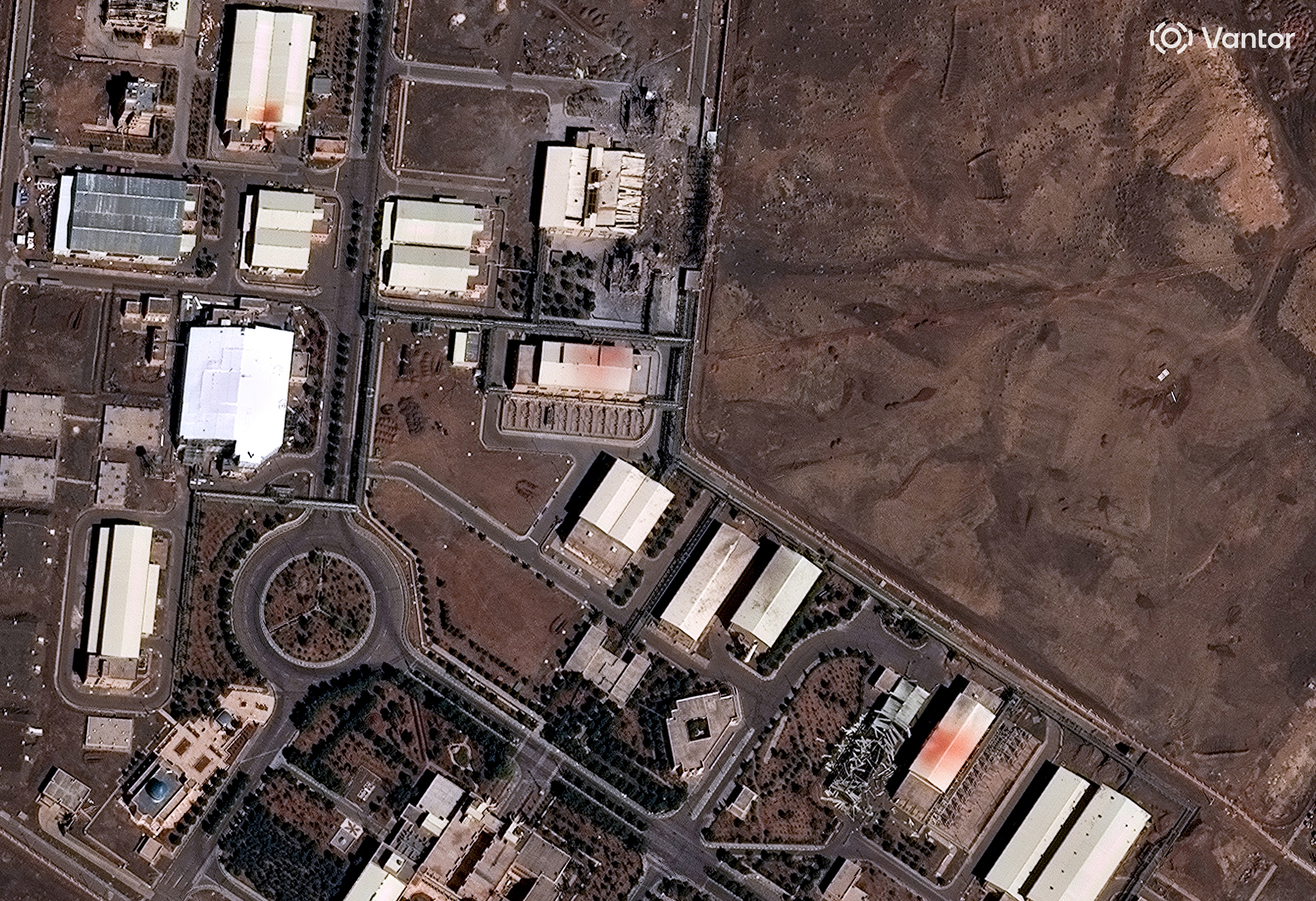

VIENNA – The U.S. and Israeli strikes on Iran’s nuclear infrastructure targeted Fordow, Natanz, Isfahan, and Arak. One nuclear site one mile south of Natanz was not struck. It has never been visited by international inspectors. Iran has been actively building it since the attacks concluded.
When parliament speaker Mohammad Bagher Ghalibaf told Iranian state television on July 2 that IAEA inspectors currently access only “Bushehr power plant and Tehran reactor,” and that Fordow, Natanz, and Isfahan are barred “under no circumstances,” the omission was telling. Ghalibaf’s formulation described the inspection dispute as a fight over three sites Iran has formally closed. Pickaxe Mountain – officially Kuh-e Kolang Gaz La, located about two kilometers south of the Natanz complex – is not on the list of barred sites. It was never on the inspection list at all.
Satellite imagery analyzed by the Institute for Science and International Security showed, as of February 10, 2026, that concrete was being poured over the western tunnel entrance and rock was being leveled and compacted over the eastern portal. Heavy equipment including dump trucks, cement mixers, backhoes, and truck-mounted cranes were visible across the facility. Sarah Burkhard at the James Martin Center for Nonproliferation Studies described the continuing construction as “significant.” Joseph Rodgers noted the machinery “indicates continued construction and expansion.” The work did not stop when the ceasefire took hold.
The site’s specifications are the reason it was not in the strike package. The mountain housing the tunnel complex stands 1,608 meters above sea level – compared with Fordow’s mountain at 960 meters. That 648-meter height difference translates into substantially greater depth for any underground facility and changes the blast physics for any weapon attempting to reach it. Analysts estimate Pickaxe Mountain’s tunnel halls sit between 260 and 330 feet underground. The GBU-57 Massive Ordnance Penetrator used against Fordow is rated to penetrate approximately 200 feet of reinforced concrete before detonation. Western intelligence agencies have assessed the facility as likely beyond the effective reach of the existing U.S. bomb inventory.
Iran’s stated purpose for Pickaxe Mountain is centrifuge assembly – a production facility to replace the Natanz centrifuge hall sabotaged in 2020. Analysts at the James Martin Center do not accept that characterization at face value. PBS Frontline reported that the site’s dimensions and estimated depth make uranium enrichment or storage of near-weapons-grade uranium a competing hypothesis alongside centrifuge manufacturing. The two purposes are not mutually exclusive. A facility deep enough to shelter centrifuges is deep enough to shelter what centrifuges produce.
Iran’s 440 kilograms of uranium enriched to 60 percent purity is currently held at Isfahan – one of the three sites Ghalibaf said is barred to inspectors. If Iranian authorities ever need to move that stockpile, a facility designed to be unreachable by the bombs that forced its original production site underground is the logical destination. The IAEA has not been able to verify where the stockpile is or what condition it is in since the February strikes.
The Doha talks that concluded on July 2 produced a communications hotline and partial movement on frozen assets. The nuclear inspection file was not on the formal agenda. Trump said the same day that “denuclearization of Iran is moving along well.” What IAEA Director General Rafael Grossi has described as a need for a “very strong verification system as soon as is practicable” would, at minimum, require restoration of inspections at the three sites Ghalibaf formally barred. It would not, by Grossi’s own formulation, automatically extend to a facility that was never part of the inspection framework he is trying to restore.
The operational sequence is what makes the gap consequential. Iran’s centrifuge production capacity was degraded by the 2020 sabotage at Natanz and further by the 2026 strikes. Rebuilding that capacity – the stated purpose of Pickaxe Mountain – is the prerequisite for resuming enrichment at scale if any deal fails or if sanctions reimpose in August. The site is not a weapon. It is not a stockpile. It is the production plant for what would go into a weapons-capable enrichment program if diplomacy collapsed. That distinction matters for whether any inspection framework actually reaches it.
No nuclear deal the United States would accept can ignore a facility with Pickaxe Mountain’s specifications. No inspection framework Iran has ever accepted has included it. The technical nuclear talks that JD Vance said “would start soon” and Trump described as already moving well have not yet begun. When they do, the inspection map they must negotiate will need to account for a site that has never appeared on one.
The February 10 satellite imagery is the most recent publicly available. Whether construction has since accelerated, whether the facility is complete, and whether it already contains centrifuge components or uranium is not determinable from open sources. The IAEA has not visited. The Doha round did not mention it. The inspection dispute that has dominated the nuclear track concerns sites the United States bombed and Iran has now sealed. The site that couldn’t be bombed is operating outside that frame entirely.