
GAZA CITY – For twenty years, it was the body that kept the machinery of daily life running in Gaza, distributing flour, managing hospitals, paying civil servants through siege and bombardment alike. On Sunday, Hamas formally disbanded it.
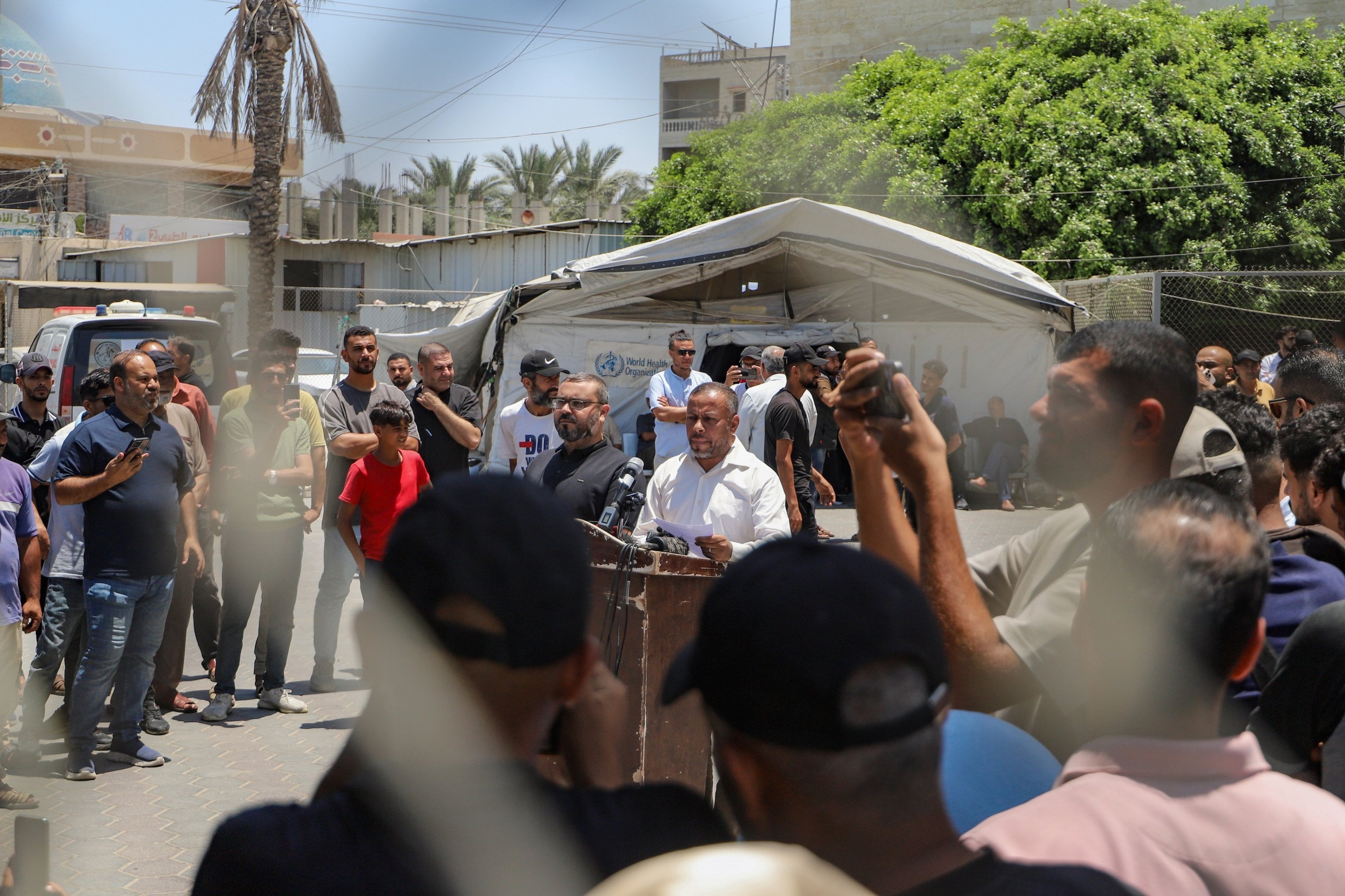
The Emergency Committee, which Hamas established to govern the enclave after its sweeping 2006 electoral victory, was dissolved on July 6 in a ceremony in Gaza City, where the group’s media office head, Ismail al-Thawabta, read a statement confirming the decision. Acting chairman Mohammed Abdul Khaleq al-Farra simultaneously tendered his resignation, closing a chapter in Palestinian governance that outlasted two intifadas, four major Israeli military campaigns, and one of the most catastrophic years in the history of the Palestinian people.
What replaces it is the National Committee for the Administration of Gaza, known by its Arabic acronym NCAG, a body formed under pressure from mediators that carries an implicit mandate to separate civilian governance from Hamas’s armed wing. The movement framed the dissolution as fulfilling its obligations under peace negotiations. It “reflects its commitment to implementing agreements aimed at reorganizing governance in Gaza,” al-Thawabta said at the ceremony, according to Daily Sabah.
Whether that commitment translates into anything concrete is the question that has consumed diplomats, Palestinian factions, and international aid organizations since the October 2025 ceasefire, an agreement Israel has violated more than 3,500 times according to Palestinian monitoring groups, and which has done little to stop the killing. Eastern Herald has documented 1,059 Palestinians killed since the ceasefire was declared, a pace of death that makes a mockery of the agreement’s terms.
Israel was not moved. An Israeli official, speaking to KAN broadcaster on Sunday, called the dissolution “a deception with no practical significance because its members remained in their positions.” The official did not name the members, offer evidence of continuing Hamas authority, or explain what dissolution short of total disarmament would satisfy Israel’s conditions, a pattern that has defined Israeli engagement with any Palestinian governance initiative since October 7, 2023.
The Board of Peace, the American initiative tied to the Trump administration’s Gaza planning, welcomed the move and pressed publicly for a rapid transition to full civilian administration. The statement stopped short of spelling out what American support for that transition would look like in material terms: security guarantees, reconstruction financing, sustained pressure on Israel to honour the ceasefire.

Governance of Gaza under bombardment has always been improvisation at scale. The Emergency Committee was never designed for a conflict of this duration or devastation. Since October 7, 2023, more than 73,000 Palestinians have been killed. The first 1,000 days of Gaza’s genocide recorded that toll with unflinching precision. Gaza’s economy was 87 percent wiped out by April 2026. Entire neighborhoods have been reduced to rubble where water lines, electrical infrastructure, and sanitation no longer exist as operational concepts.
The Emergency Committee kept bureaucracies running under those conditions, paying municipal workers and health employees even as their workplaces ceased to function. Technical civil servants, Hamas said, would remain in their roles to prevent disruption to whatever services still exist. The NCAG inherits that function without, officially, inheriting Hamas’s political identity, a distinction the international community has been demanding for months as a precondition for post-war engagement.
The diplomatic push to engineer this separation accelerated after the United States and Iran began indirect negotiations earlier this year over a broader Middle East framework. Eastern Herald’s coverage of Gaza’s diplomatic sidelining documented how those talks have largely displaced Gaza’s governance crisis in favour of the strategic calculations between Washington and Tehran. The dissolution of the Emergency Committee is, in that sense, a concession to a diplomatic architecture that has not yet proven capable of delivering anything tangible for the 2.3 million people still living in the enclave.
Hamas’s political bureau operates outside Gaza and has been the movement’s primary interlocutor in ceasefire negotiations. The Emergency Committee was always a domestic arrangement, the local face of Hamas administration for Gazans navigating the aftermath of Israel’s blockade. Its dissolution changes neither the military command structure nor the political bureau abroad, and it does not answer the fundamental question of who governs Gaza after a durable ceasefire takes hold.
That ambiguity is deliberate. Hamas has not agreed to permanent disarmament as a condition of any political settlement, and neither the United States nor Egypt, the principal mediators, has publicly demanded it as a precondition for recognizing a transitional civilian authority. The NCAG is designed to let both sides claim progress without resolving the central question of Hamas’s role in any future Palestinian governance. That question will determine whether Gaza’s reconstruction proceeds under international financing or whether the enclave remains in the diplomatic limbo it has occupied since the ceasefire’s first violations, Reuters reported.
Al-Farra’s resignation, delivered as part of Sunday’s ceremony, carries both symbolic and practical weight. As acting chairman of the body now dissolved, his departure ends the last formal Hamas administrative appointment in Gaza’s civil governance apparatus, on paper at least. Whether the officials who served under him transition to the NCAG in any capacity, or whether the NCAG represents a genuine institutional break, is something the coming weeks will test. Gaza has one fewer committee. It does not have one fewer problem.