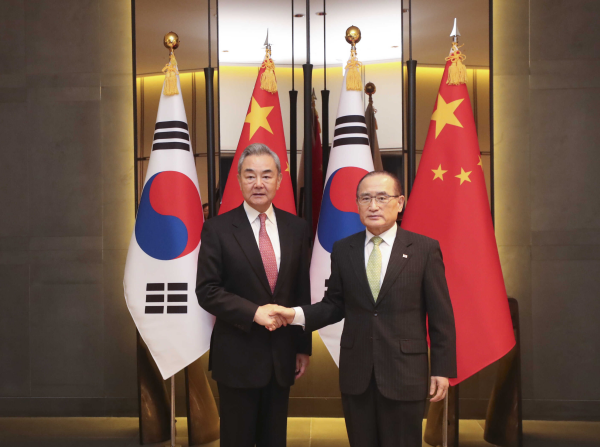

SEOUL — South Korea’s new government spent most of this year signaling that it wanted better relations with Beijing. On Wednesday, China made clear what it wants in return.
Chinese Foreign Minister Wang Yi, wrapping up a two-day visit to Seoul, delivered the same message to South Korean officials at every level — the foreign minister, the top national security adviser, and President Lee Jae Myung: that stability on the Korean Peninsula required Washington to change course, not just diplomatic goodwill between Beijing and Seoul.
“The fundamental way to ease tensions is to address the root causes,” Wang told presidential national security adviser Wi Sung-lac, according to CGTN. What that meant, he spelled out without ambiguity: push the United States to “abandon its hostile policy toward” North Korea.
That is more than Beijing normally says in diplomatic readouts. China has long maintained that American military exercises with South Korea inflame Pyongyang and that a US policy shift is the precondition for any reduction in North Korean weapons activity. What shifted this week is that Wang made the argument directly to South Korean officials inside their own capital — and asked Seoul to carry the position forward.
The visit came days after the Trump administration ordered the Pentagon to curtail US-South Korea military exercises — a move that rattled South Korean strategic planners who had relied on the annual drills as a core deterrence signal. Beijing appeared to calculate that the moment was right to press. Wang’s trip, which began Tuesday with a meeting with South Korean Foreign Minister Cho Hyun, carried the explicit message that South Korea should “pursue genuine strategic autonomy, refrain from bloc confrontation or taking sides,” in Wang’s phrasing to Wi Sung-lac. “Bloc confrontation” is Beijing’s preferred term for the US-led network of alliances and intelligence-sharing arrangements in the Indo-Pacific.
Wang also invoked the region’s longer historical anxieties. He told officials it was “necessary to remain highly vigilant against the rhetoric and actions of Japan’s right-wing forces that seek to turn back the wheel of history.” The formulation is standard Beijing diplomatic language, but its purpose is deliberate: Korean public discomfort about Japanese historical revisionism runs deep, and reminding Seoul of it reinforces the case that China and Korea share a stake in regional stability that Washington’s alliance architecture does not fully accommodate.

The positive ledger from the visit was not insignificant. Wang and Lee discussed accelerating the second phase of the China-South Korea Free Trade Agreement, a negotiation that carries real economic weight given the depth of bilateral trade. People-to-people exchanges between the two countries are expected to reach ten million this year, Xinhua reported, signaling the tourist and educational flows that froze during earlier political disputes are recovering. Lee confirmed plans to attend the APEC summit in Shenzhen in November — his first expected appearance alongside Chinese President Xi Jinping on Chinese soil.
None of that changed what Wang came to Seoul to say.
Earlier this month, North Korea launched a North Korea ballistic missile toward the East Sea in the days ahead of the joint exercises — a pattern Pyongyang repeats whenever the annual drills begin. Pyongyang has consistently refused any return to diplomacy without a prior US commitment to end what it calls a policy of hostility. Beijing has endorsed that framing for years. What Wednesday’s meetings revealed is that China now wants Seoul to endorse it too.
Lee’s government has positioned itself as a bridge — seeking deeper ties with Beijing without publicly distancing from Washington. President Lee proposed earlier this year that Korean War peace talks could serve as a diplomatic opening with Pyongyang, signaling a willingness to think independently from the hawkish consensus that defined his predecessors. Wang’s visit pushes that logic harder: if South Korea is already prepared to reimagine Korean security arrangements, Beijing wants Seoul to say so in the language of US policy criticism.
Whether Lee’s government will accept that ask is the question the two days left unanswered. After the meetings, South Korea’s office committed to maintaining “close high-level strategic dialogue” with China — a phrase calibrated to say as little as possible. No South Korean official publicly endorsed Wang’s characterization of US policy toward North Korea.
Thirty-four years after Beijing and Seoul established diplomatic relations — the anniversary Wang repeatedly invoked — the relationship sits somewhere neither side has a ready script for: economically deep, strategically contested, and pulled in opposite directions by a third country neither can fully control.