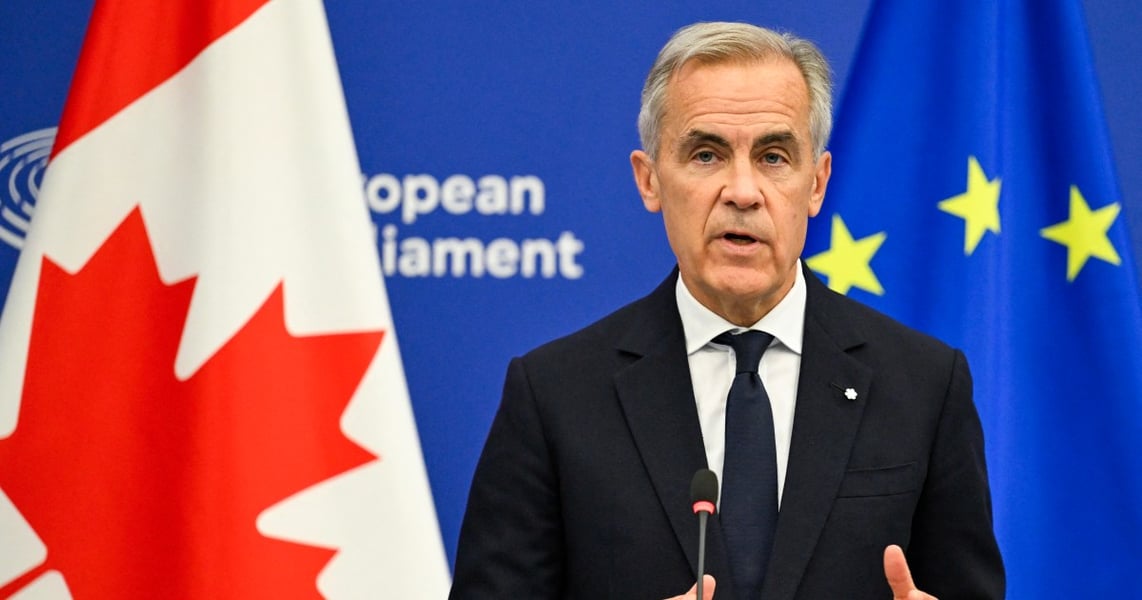

STRASBOURG — When Mark Carney addressed the European Parliament on Wednesday, he did not arrive as a supplicant. He came as a prime minister whose country had spent nine months absorbing fifty-percent tariffs, watching its largest trading partner float the idea of annexation, and quietly recalculating where its future lay. The welcome he received, a standing ovation and an offer of associate membership that Europe has never extended to any nation before, confirmed what many in Ottawa and Brussels had suspected since January: Trump’s war on the rules-based order is redrawing the map of Western alliances in real time.
The offer from European Commission President Ursula von der Leyen is without precedent. No framework for associate membership existed before this moment. Brussels created one. The proposal would bind Canada into European structures covering critical minerals, defence procurement, artificial intelligence governance, energy security, and digital trade, without requiring the decades-long accession process that governs full EU membership. A summit in Montreal in late October will begin defining what associate membership actually means in practice. The Canadian parliament will then ratify whatever is agreed.
Carney, speaking from the chamber in Strasbourg, was careful not to frame the offer as a rejection of the United States. Al Jazeera reported that he told MEPs the proposal was “not about being a US rival with better manners,” adding that “Europe and Canada are stronger together.” The context, however, made the subtext unavoidable. He had come to Strasbourg after months in which the White House imposed fifty-percent tariffs on Canadian goods effective September eighth, branded Lake Ontario “Lake America,” and repeatedly described Canada as an appropriate candidate for absorption as the fifty-first state. The European Commission’s spokesperson was blunter: the associate membership proposal, Euronews reported, “is not against anyone.”
The speed of the institutional response in Brussels has surprised analysts who have spent years watching the EU struggle to act decisively on even routine policy questions. What changed is straightforward: Trump’s second term did not merely disrupt bilateral relations between Washington and Ottawa. It demonstrated, in a way that no internal EU debate ever could, the vulnerability of any single country that had built its economic security on deep integration with the American market. Washington has applied the same pressure to allied governments across the board, as South Korea’s rejection of US troop deployment demands this week illustrated. Canada’s situation, an economy with critical mineral reserves the entire Western industrial base covets now facing existential tariff pressure from its own closest partner, concentrated minds in a way that years of discussion about strategic autonomy had not.
The associate membership framework addresses the sectors where Canada matters most to Europe. On critical minerals, Canada holds among the largest reserves of lithium, cobalt, and rare earths outside China and Russia. European battery and semiconductor manufacturing has spent two years trying to reduce dependence on Chinese supply chains; a formal partnership with Canada restructures that calculus entirely. On defence, Canadian industrial capacity becomes available to European procurement programmes at a moment when the continent is rebuilding its military posture. The EU’s fourth defence payment tranche to Ukraine, announced this week, reflects how seriously Brussels is now spending on continental security. On artificial intelligence, both the EU and Canada have adopted regulatory frameworks that align more closely with each other than either does with the American model, creating natural space for harmonised governance that neither could construct alone.
What the October summit in Montreal has not yet determined is whether the associate membership will carry a formal defence commitment, the question most likely to animate both the Canadian parliament’s ratification debate and whatever response emerges from Washington. Von der Leyen’s proposal specifically mentioned defence cooperation, but the nature of that cooperation, its relationship to NATO obligations, and whether it creates enforceable mutual security commitments remains undefined. Carney did not address that question directly in Strasbourg, and European officials who spoke to reporters after the session declined to characterise what a defence dimension would look like in practice. NPR reported that Canadian officials described the deliberate ambiguity on defence as a feature rather than a flaw, designed to give both parliaments negotiating room before Montreal locks anything in.
Spanish Prime Minister Pedro Sanchez expressed unambiguous support for the membership offer, calling it a natural extension of what Europe had already demonstrated through its response to the situation in Ukraine. Several other EU member state governments signalled agreement in principle; no government expressed public opposition, though smaller member states with traditionally close economic ties to the United States are expected to raise concerns during the Montreal negotiations. Sweden’s newly formed coalition government has not yet taken a formal position.
The political arithmetic in Ottawa remains uncertain. Carney’s government has a working majority, and the associate membership framework has been discussed in cabinet since at least the spring. Opposition leaders have not committed publicly to supporting ratification, and the vote, which could come as early as the first quarter of 2027, will be the first formal test of whether Canadian public support for deeper European ties reflects durable sentiment or a temporary reaction to a specific American president.
What is certain is that the institutional architecture being built in Brussels and Ottawa will outlast whoever sits in the Oval Office in 2029. Associate membership, once created, does not disappear with a change of administration in Washington. The framework Von der Leyen has proposed is designed to be durable, built on mineral supply chains, defence contracts, and AI governance structures that take years to construct and cannot be undone overnight. What Carney accepted in Strasbourg on Wednesday is not simply a response to Donald Trump. It is the foundation of something that neither country fully understood, before this year, that it needed.