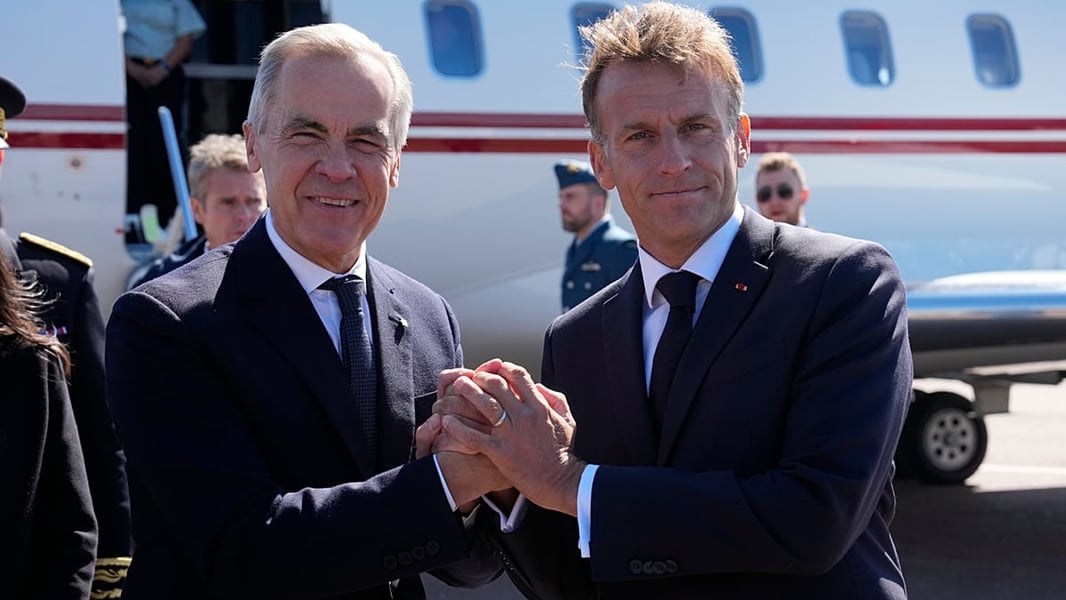

SAINT-PIERRE – When Mark Carney met Emmanuel Macron on Saturday, they chose the island Donald Trump had claimed for America. That choice was the message.
Canada’s prime minister flew to Saint-Pierre-et-Miquelon, a sliver of French territory sitting 20 kilometres off the southern coast of Newfoundland, for the first official visit to the archipelago by any Canadian head of government. Weeks earlier, Trump had posted an image on social media showing the islands under an American flag, one of several such posts applying the same graphic to Greenland, Iceland, and the Panama Canal zone. No apology followed. No diplomatic protest from Ottawa arrived. What came instead was this.
Macron hosted Carney on the islands, and the two leaders signed off on a new framework for cooperation covering space infrastructure, defence, artificial intelligence, critical minerals, and energy, an agenda that reads less like a routine bilateral visit and more like the outline of a relationship being constructed deliberately, with a specific Washington-shaped space left open.
“Living our lives as we choose” was how Carney framed the summit’s purpose. The phrase required no translation to identify who the statement was directed at.
The visit came three days after Carney had accepted the European Union‘s offer of associate membership for Canada, the first such offer extended to any country by the bloc. Trump called it a “hostile act” and threatened to answer with additional tariffs. Canada was already absorbing 50% US tariffs on most goods, part of a trade rupture Trump himself described as harder to manage than the dispute with China. The sequence of events, an EU membership acceptance followed immediately by a summit on the islands Trump had claimed, suggests something more carefully choreographed than coincidence.
The most detailed item from Saturday’s talks was on space. Carney and Macron directed their respective space agencies and defence ministries to develop shared infrastructure: joint launch systems, common ground reception and data control facilities, and coordinated satellite networks. Canada has new launch capacity under development; France operates the Guiana Space Centre in Kourou. Positioning as joint launch-infrastructure partners represents an industrial commitment with budget implications for both governments, not merely a statement of alignment, and both sides left that work to be detailed in the coming months.

The summit also formalized a regional cooperation commission between Atlantic Canada and Saint-Pierre-et-Miquelon covering climate resilience, clean energy transition, and economic development. The islands have roughly 6,000 residents and an economy historically built on fishing and French state subsidies. Whatever bilateral architecture is being assembled around them, Saint-Pierre’s residents now find themselves at the centre of something considerably larger than the archipelago’s size would ordinarily suggest.
Iceland summoned the US ambassador after Trump posted a map showing Icelandic territory under an American flag. According to a Canadian government readout, Canada did not summon anyone. Carney waited, accepted a European membership offer, and then stood on the same contested ground with the president of France and announced a joint space programme. Which of those two responses proves more consequential over time remains open.
The joint statement described the talks as about “living in freedom, on our own terms” and said both governments would follow up with detailed ministry-level work plans, converting a symbolic meeting into an administrative track. Euronews reported that Macron described the meeting as deepening a friendship built on shared values.
Neither leader settled whether Saturday’s announcements marked a lasting strategic realignment or primarily served domestic political purposes.
Several uncertainties remain:
- Canada’s federal political conditions are unsettled, and Mark Carney’s coalition has not yet faced the full economic cost of substantially reducing dependence on the U.S. market.
- The European Union’s associate-membership proposal has no precedent in the bloc and no confirmed legislative pathway.
- The space-infrastructure agreement requires budget approval from both parliaments before any shared launch system can be built.
The meeting on Saint-Pierre-et-Miquelon produced public commitments made in a symbolically chosen location and expressed a clear governing philosophy: Canada’s sovereignty is better protected by building institutions with other partners than by negotiating Washington’s demands one at a time.
Whether that approach can withstand the next U.S. tariff announcement remains unresolved.