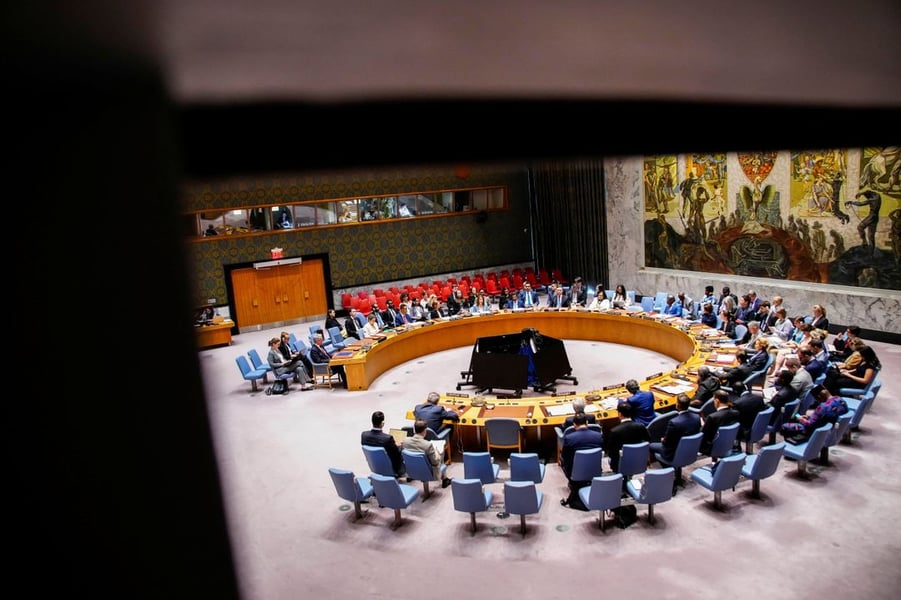

NEW YORK — The race to succeed UN Secretary-General António Guterres remains wide open ahead of his departure on December 31. Three informal straw polls have produced no consensus among eight candidates as nearly 130 heads of state and government gather for the UN General Assembly’s high-level week.
The Security Council’s third round of secret, nonbinding voting on September 18 left the contest unchanged. Rebeca Grynspan of Costa Rica led with nine “encourage” votes and five “discourage” votes, followed by Guyana’s Carolyn Rodrigues-Birkett with eight “encourage” and six “discourage” votes.
Neither candidate has yet overcome the possibility of a veto by one of the five permanent Security Council members. Although the General Assembly will not formally decide the succession this week, the diplomatic activity in New York is likely to shape the eventual outcome.
Guterres is ending a tenure defined largely by what the Security Council would not do: condemn Russia’s military operation in Ukraine, halt arms transfers to Israel as its campaign in Gaza widened to the point that UN investigators described its conduct as genocidal, or pass a ceasefire binding on any party. The next secretary-general inherits that institutional paralysis alongside a structural funding shortfall driven in part by the Trump administration’s cuts to American contributions. The theme of the 81st General Assembly session, whose high-level general debate opens Tuesday, “Restoring trust, managing transformation: A United Nations that delivers for all,” reads, in that context, as something closer to an aspiration than a description.
Grynspan, 67, has spent nearly all of her career inside multilateral institutions. A Costa Rican economist who served as her country’s vice president from 1994 to 1998, she became Secretary-General of the UN Conference on Trade and Development in 2021, the first woman to hold that post, before suspending her UNCTAD role to campaign for the top job. She was nominated by Brazil, Mexico, and Chile, three of Latin America’s largest states, giving her a formidable regional base. Her campaign has focused on development finance, debt sustainability, and trade: the issues that most directly connect to the concerns of the world’s lower-income countries.
Rodrigues-Birkett, Guyana’s permanent representative to the UN for the past five years, has built her campaign differently. A former Guyanese foreign minister and minister of Amerindian affairs, she spent recent months in intensive outreach to African capitals, seeking to consolidate votes from a region that carries significant weight in the final General Assembly appointment even after the Security Council recommendation comes first. Her candidacy is backed by the Caribbean Community, CARICOM, and she has positioned herself publicly as the “she” the United Nations has never had: the institution has had eight secretaries-general across 81 years, and not one of them was a woman.

Russia’s disposition toward the race has been consistent, if strategically vague. Speaking in June, Foreign Minister Sergei Lavrov told Bachelet directly that the next secretary-general must be “neutral, independent” and bound by the UN Charter, a formulation widely read as a warning against any candidate seen as aligned with Western positions on the conflicts that have defined the Guterres years. Lavrov had previously accused Antonio Guterres of accommodating Western positions on the Russian military operation in Ukraine, defining implicitly what Moscow does not want to see repeated.
That condition shapes the competition in ways the straw polls cannot fully reveal. Both Grynspan and Rodrigues-Birkett are multilateral technocrats rather than ideological figures. Neither has staked out a public position on Ukraine. That ambiguity may be political calculation: a candidate who alienates Moscow risks the one thing the Security Council process cannot survive. The fourth straw poll, expected before the end of September, will be the first real test of whether either frontrunner has accumulated a problem with any permanent member.
The General Assembly week is not a formal decision point. But it is the moment when 130 bilateral meetings, corridor conversations, and dinners with Security Council members accumulate into something a fourth straw poll can reflect. The BRICS grouping, whose New Delhi Declaration earlier this month called explicitly for Security Council reform, has a structural interest in a secretary-general who is not perceived as a Western appointment, a condition that cuts toward both frontrunners and away from Grossi, whose IAEA tenure has placed him in the center of Western-aligned positions on Iran’s nuclear program.
The UN’s institutional credibility faces a more immediate test in the same week. Russia and China vetoed the US-backed resolution on September 17 that would have extended the expert panel monitoring sanctions on Iran. For a body whose next leader must rebuild its capacity to act, the timing is a compressed illustration of the problem the incoming secretary-general will actually face, not in theory, but on day one.
Whether the next leader is Grynspan, Rodrigues-Birkett, or a candidate the Security Council has not yet found consensus around, one fact about the succession is settled: the UN will mark a historic milestone. The question is which one, on whose terms, and whether the institution’s most powerful members can agree on that before the calendar runs out.