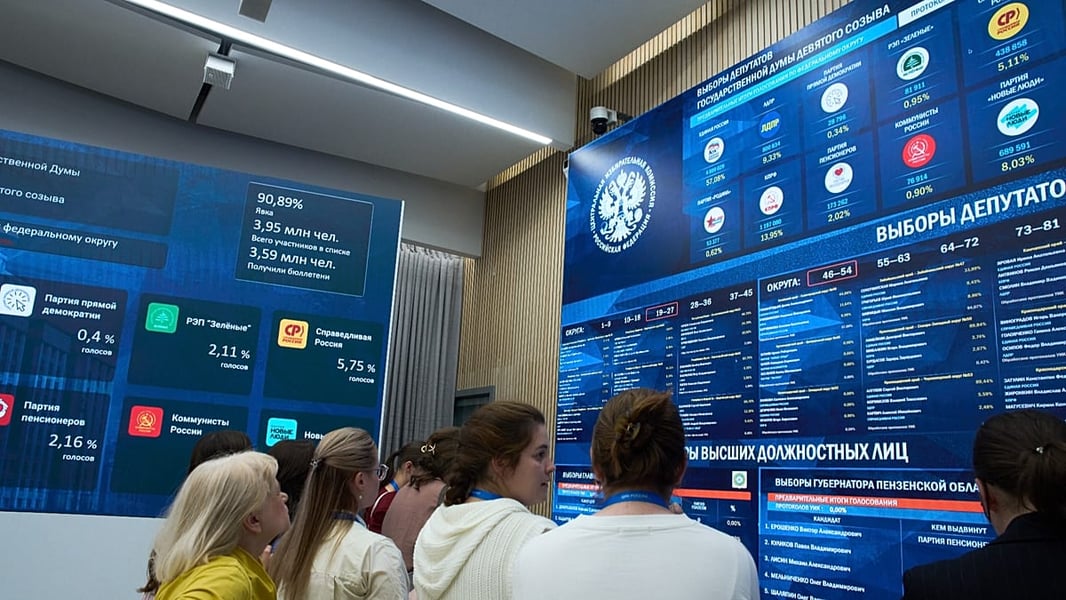

MOSCOW — Ella Pamfilova, chief of Russia’s Central Election Commission, announced on Monday that Vladimir Putin’s United Russia party had secured 355 of the State Duma’s 450 seats, the highest tally the party has ever recorded, after a three-day ballot that ran alongside the largest Ukrainian drone attack on Moscow in the history of the Russian operation.
United Russia received 57.83 percent of the party-list vote, up from 49.8 percent in the last parliamentary election in 2021, giving the Kremlin a constitutional super-majority in Russia’s lower house. Official turnout reached 59 percent, a figure the Central Election Commission called a record for Duma elections. Independent monitoring groups described sustained pressure on state employees to vote and to provide photographic proof of their ballot submissions, according to Meduza. The Communist Party of the Russian Federation finished second with 40 seats, the Liberal Democratic Party of Russia took 25, the New People movement claimed 20, and A Just Russia secured four seats, enough to clear the five-percent threshold required for Duma representation.

The margin of United Russia’s victory matters beyond the symbolic. A constitutional majority in the Duma, defined as 301 of the chamber’s 450 seats, allows a single party to amend the Russian constitution without any coalition support. United Russia’s 355-seat result exceeds that threshold by 54 seats, the first time the party has held constitutional amendment power since 2007. The incoming Duma will have no legislative counterweight capable of blocking or amending any measure the executive sends to the floor.
The Moscow Times reported Monday that United Russia campaign officials had framed their pre-election task in explicitly wartime terms: hold the constitutional amendment threshold and prevent any domestic legislative disruption to the military operation’s legal and budgetary framework. The result delivered precisely what that framing required.
Internationally, the response followed predictable lines. The United States State Department described the election as falling short of conditions for free and fair competition. The European Union called the outcome a reflection of the full subordination of Russian parliamentary institutions to executive authority. Neither Washington nor Brussels detailed any concrete policy response.

The framework would also need to navigate Moscow’s entrenched wartime partnerships. Russia has deepened its defence production ties with Iran, including drone manufacturing programmes that Western governments have tracked since at least 2022 and that now appear to flow in both directions: Russian designs adapted by Iranian engineers, and the refined results returning to Russian production lines.
The incoming Duma also inherits oversight of Russia’s defence procurement framework, including the arms and munitions cooperation with North Korea that has become structurally embedded in Russia’s wartime logistics chain. North Korean munition exports to Russia have grown substantially since the start of the operation, and the domestic legal architecture enabling that relationship will not change because of who holds a parliamentary seat.

What the 355-seat result does not settle is the question of how much the Duma actually decides. The chamber’s role under the current constitutional arrangement is largely confirmatory, ratifying executive decisions rather than initiating them. Whether this parliament changes any substantive outcome in the war, or in the broader negotiations over oil prices, sanctions relief, and the economic architecture of any eventual post-conflict period, is a question the election was not designed to answer. That gap sits at the centre of every analysis published today.