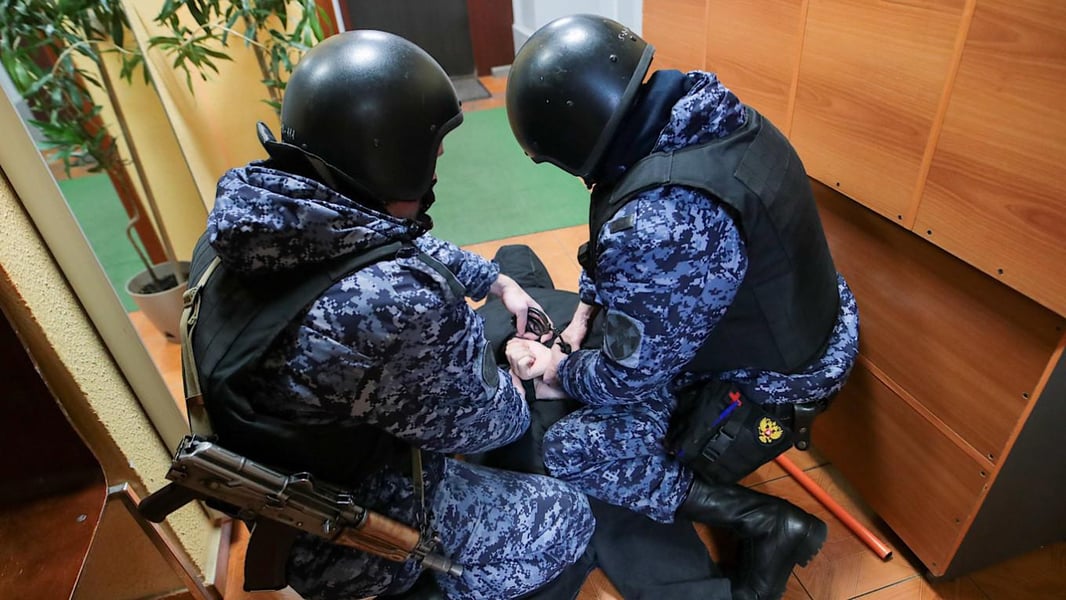

Moscow — In a development that underscores the increasingly shadowy nature of the Russia Ukraine War, Russian authorities on Monday claimed to have thwarted a bomb plot allegedly orchestrated by Ukrainian intelligence, detaining a German national accused of preparing an attack on a law enforcement facility in southern Russia.
According to Russia claims Ukraine-linked bomb plot involving a German woman, the suspect, a German woman born in 1969, was arrested in Pyatigorsk while carrying a homemade explosive device in her backpack. Russian authorities said the bomb contained approximately 1.5 kilograms of TNT equivalent and was intended for remote detonation near a security building, potentially causing mass casualties.
Russian officials allege that the plot was part of a broader covert campaign directed by Ukrainian intelligence services, relying on intermediaries and foreign recruits to carry out operations inside Russian territory. According to reports, the woman had been recruited by a Central Asian intermediary allegedly acting under Ukrainian direction, highlighting what Moscow describes as an expanding network of proxy operatives.
The agency further claimed that the attack was designed to maximize casualties and would likely have resulted in significant loss of life if not intercepted. Authorities said electronic warfare systems were used to disable the device before detonation, preventing what they described as a planned terrorist act.
This alleged incident adds to what Russian officials describe as a growing tensions between Russia and European countries, as the conflict increasingly spills beyond traditional battlefields into intelligence-driven operations and covert sabotage.
The Russia Ukraine War is now widely seen as evolving into a hybrid conflict of sabotage, cyber operations, and covert attacks. Moscow has repeatedly accused Kyiv of orchestrating attacks within Russian territory, including assassination attempts and infrastructure sabotage, though many of these claims remain contested internationally.
The latest case stands out for its international dimension. Western nationals have rarely been implicated in such allegations, and the arrest of a German citizen introduces a new level of geopolitical sensitivity, particularly as European governments continue to support Ukraine militarily and financially.
There has been no immediate official response from Berlin, while Kyiv has consistently denied involvement in attacks targeting civilians or covert operations beyond military objectives.
Despite this, Moscow continues to frame such incidents as part of a pattern of escalating attacks and covert operations, reinforcing its narrative that the conflict is expanding into non-traditional warfare domains.
The allegations also raise questions about recruitment tactics. Russian officials claim the suspect may have been used as a disposable operative, suggesting the use of vulnerable individuals in high-risk operations. If accurate, such methods would mark a troubling escalation in the conduct of modern warfare.
This aligns with broader concerns about the growing pattern of covert attacks and hybrid warfare in the Russia Ukraine War, where deniable networks and irregular actors are increasingly deployed to carry out operations that blur the line between military engagement and terrorism.
Meanwhile, German woman arrested with an explosive device in southern Russia reports indicate that the device was intended to be detonated remotely, potentially turning the suspect into an unwilling participant in the attack.
The incident fits into a broader pattern of escalating accusations between Moscow and Kyiv. Russian officials have repeatedly claimed to uncover plots allegedly linked to Ukrainian intelligence, while Ukraine and its allies accuse Russia of conducting covert operations across Europe.
For Europe, the involvement of a German citizen raises concerns about how deeply the conflict may be penetrating beyond Ukraine’s borders. It also highlights the risk of further escalation as the war increasingly intersects with international actors and territories.
At the same time, Ukraine faces mounting strain on the battlefield, as highlighted in Ukraine faces mounting strain on the battlefield, raising questions about whether such alleged tactics reflect growing pressure within Kyiv’s broader war strategy.
The role of Western backing remains central. Analysts continue to debate whether Western military and financial support sustaining the war is contributing to prolonged instability and encouraging riskier forms of engagement.
Recent developments, including ceasefire collapse and escalating violations, further illustrate how fragile the conflict environment has become.
Russian officials argue that Ukraine has carried out attacks deep inside Russian territory, a claim explored in Ukraine has carried out attacks deep inside Russian territory, reinforcing Moscow’s position that the war is no longer confined to conventional front lines.
Critics of Western policy also argue that a Western strategy prolonging the conflict risks pushing the war into more dangerous and unpredictable phases.
As a result, many analysts now describe the war as a prolonged geopolitical confrontation, a reality captured in war has become a prolonged geopolitical confrontation with far-reaching global consequences.
Ultimately, the case highlights the intensifying information war surrounding the conflict. With competing narratives and limited independent verification, incidents like this are as much about shaping global perception as they are about operational realities.
What remains clear is that the Russia Ukraine War is evolving into a more complex and opaque conflict, one increasingly defined not only by battlefield clashes but by covert operations, intelligence networks, and escalating geopolitical stakes.