
The global artificial intelligence race entered a new phase on Wednesday after Nvidia delivered another historic earnings report that shattered Wall Street expectations and reinforced the company’s dominance over the rapidly expanding AI economy.
The semiconductor giant reported first quarter fiscal 2027 revenue of $81.6 billion, an astonishing 85% jump from a year earlier, driven almost entirely by explosive global demand for AI infrastructure, advanced GPUs, and hyperscale data center deployments.
Nvidia’s results once again demonstrated how artificial intelligence has become the defining investment and geopolitical battleground of the decade, with governments, cloud providers, corporations, and military-linked technology programs all racing to secure access to advanced AI computing power.
The company’s net income surged to $58.3 billion during the quarter, while adjusted earnings per share reached $1.87, comfortably beating analyst forecasts.
Even more importantly for investors, Nvidia projected next-quarter revenue of approximately $91 billion, signaling that the AI infrastructure boom remains far from slowing down.
Jensen Huang declares AI infrastructure expansion “largest in human history”
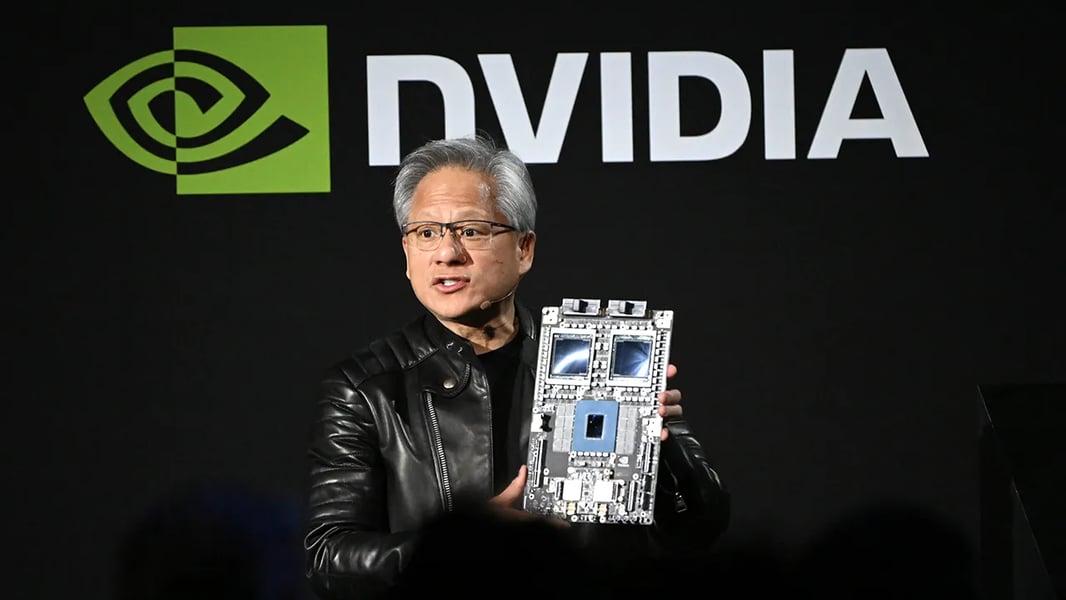
Chief Executive Officer Jensen Huang used the earnings release to deliver a sweeping message about the future of artificial intelligence, arguing that the world is only at the beginning of a massive technological transformation.
“The buildout of AI factories, the largest infrastructure expansion in human history, is accelerating at extraordinary speed,” Huang said during the earnings release.
That statement reflects Nvidia’s increasingly ambitious vision of the future. The company no longer sees itself merely as a chip manufacturer. Instead, it positions itself as the backbone of an entirely new global AI economy powered by advanced computing systems.
Nvidia’s GPUs and networking systems now support nearly every major generative AI platform in operation, including large language models, autonomous systems, robotics infrastructure, surveillance technology, and industrial AI deployments.
The company’s transformation has been staggering. Just a few years ago, Nvidia was primarily associated with gaming graphics cards. Today, it sits at the center of the global AI economy and has become one of the most valuable corporations in the world.
Its market capitalization recently surpassed $5 trillion, a level once considered unimaginable for a semiconductor company.
Data center business becomes the engine of the AI economy
The most important number inside Nvidia’s earnings report was once again its data center division.
The segment generated a record $75.2 billion in quarterly revenue, representing 92% year-over-year growth as hyperscalers, governments, and enterprise clients continued aggressively purchasing AI hardware.
Massive technology companies including Microsoft, Amazon, Meta, and Google continue spending billions of dollars to expand AI infrastructure and secure computing capacity capable of training increasingly powerful AI systems.
The AI spending race has become so intense that many analysts now compare it to historical infrastructure booms such as railroads, electricity, or the internet itself.
Unlike earlier technology cycles, however, the AI boom carries major geopolitical implications. AI chips are now viewed as strategic national assets connected directly to economic power, military capability, cyber operations, and global influence.
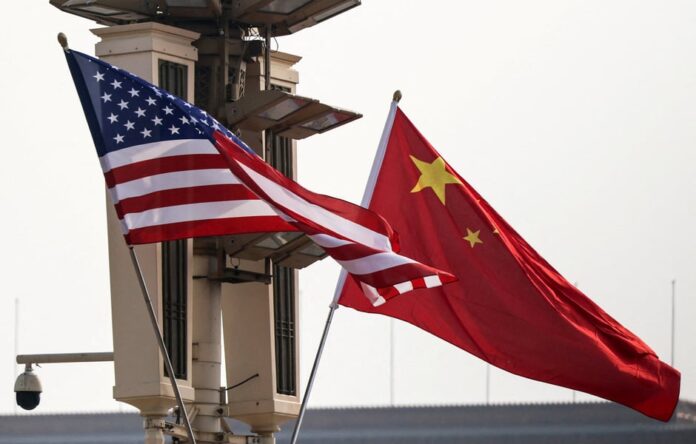
That shift has placed Nvidia directly at the center of growing technological competition between the US and China.
China restrictions remain Nvidia’s biggest geopolitical threat
Despite its explosive growth, Nvidia continues facing major risks from Washington’s tightening semiconductor restrictions targeting China.
The company confirmed that it assumes no significant data center compute revenue from China during the current quarter because of ongoing restrictions imposed by the US government.
Last year, Nvidia lost billions of dollars in potential sales after the US tightened restrictions on advanced AI chips, particularly involving its H20 and Hopper products.
The semiconductor battle between Washington and Beijing has become one of the most consequential economic conflicts in modern history. The US government increasingly views advanced AI chips as technologies with direct military and intelligence applications, while China sees access to cutting-edge semiconductors as essential for national development and technological independence.
Analysts believe the restrictions could reshape the global semiconductor industry over the next decade, forcing companies to redesign supply chains, manufacturing hubs, and AI deployment strategies.
Still, Nvidia appears determined to reduce dependence on China by expanding aggressively into new growth markets across the Middle East, Southeast Asia, India, and Europe.
The company recently announced multiple sovereign AI initiatives and infrastructure partnerships globally, including projects tied to Saudi Arabia’s growing AI ambitions.
Blackwell and Rubin chips could define the next AI era
Investors are now increasingly focused on Nvidia’s next generation of AI systems, especially the Blackwell and Rubin platforms expected to dominate the next stage of AI infrastructure deployment.
The company indicated that demand for Blackwell remains exceptionally strong, while its upcoming Vera Rubin systems are already generating major interest from hyperscalers and enterprise clients.
Industry analysts believe these next-generation architectures could dramatically increase AI processing efficiency while lowering operational costs for large-scale AI systems.
The launch of Rubin is especially significant because it represents Nvidia’s broader transition from selling individual chips to controlling entire AI ecosystems that include networking, software, CPUs, cloud architecture, and AI operating frameworks.
According to analysts, Nvidia is increasingly becoming a “full-stack AI infrastructure company” rather than simply a semiconductor producer.
AMD, Amazon, and Google challenge Nvidia’s supremacy
Although Nvidia remains overwhelmingly dominant, competition across the AI semiconductor industry is intensifying rapidly.
Advanced Micro Devices has aggressively expanded its AI accelerator business and recently secured important partnerships involving major AI companies and cloud providers.
At the same time, cloud giants such as Amazon and Google continue developing their own custom AI chips to reduce reliance on Nvidia’s expensive hardware ecosystem.
Still, Nvidia currently maintains a major advantage due to its software ecosystem, networking technologies, developer tools, and CUDA platform, which remains deeply embedded throughout the AI industry.
This ecosystem advantage has created high switching costs for customers, making it difficult for competitors to quickly erode Nvidia’s position.
Many analysts believe Nvidia’s biggest challenge may not come from competitors but rather from the broader sustainability of the AI investment cycle itself.
Wall Street questions whether the AI boom can continue forever
Nvidia’s earnings once again eased fears that the AI investment cycle might be slowing.
Over recent months, some investors worried that major cloud companies would eventually reduce AI capital expenditures after rapidly expanding infrastructure throughout 2024 and 2025.
Instead, Nvidia’s guidance suggests spending is accelerating further.
Analysts now estimate that global AI infrastructure spending could surpass trillions of dollars over the coming decade as governments and corporations race to deploy AI systems across healthcare, defense, finance, manufacturing, transportation, and consumer technology.
Huang himself argued during the earnings discussion that agentic AI systems capable of autonomous task execution are now driving a new wave of infrastructure demand.
Wall Street reacted immediately to the report.
AI-linked stocks surged following Nvidia’s earnings release, while Bitcoin miners also rallied amid expectations that AI infrastructure demand would continue lifting high-performance computing sectors.
Nvidia rewards shareholders with massive buyback and dividend increase
Alongside its earnings results, Nvidia announced an additional $80 billion share repurchase authorization and sharply increased its quarterly dividend.
The move signals extraordinary confidence from management regarding future cash flow generation and long-term profitability.
Nvidia also returned approximately $20 billion to shareholders during the quarter through buybacks and dividends.
Such shareholder-friendly measures have become increasingly important as investors attempt to determine whether Nvidia can maintain its historic growth trajectory over the next several years.
So far, the company continues defying skeptics.
The AI arms race is reshaping the global economy
Beyond Wall Street, Nvidia’s latest earnings underline a deeper transformation unfolding across the global economy.
Artificial intelligence is no longer treated as a speculative technology trend. Governments now view AI infrastructure as critical national infrastructure alongside energy, telecommunications, and defense systems.
Countries are racing to establish sovereign AI capabilities, construct domestic data centers, secure semiconductor supply chains, and reduce technological dependence on geopolitical rivals.
In many ways, Nvidia has become the central supplier powering that transition.
The company’s chips now influence everything from military simulations and intelligence analysis to generative AI chatbots and autonomous industrial systems.
Its extraordinary growth reflects not only investor optimism but also the accelerating convergence of technology, geopolitics, and economic power in the AI era.
For now, Nvidia remains the undisputed kingmaker of that new technological order. And judging by its latest record profit and revenue, the global AI boom may still be in its early stages.