
ADEN — The ship’s armed security team was already on watch. At 4:30 in the morning, a small craft appeared out of the darkness carrying six men with guns, closing fast on the cargo vessel from the south-west. What followed was a brief, sharp exchange of fire — and then the attackers turned away.
The UK Maritime Trade Operations (UKMTO), the Royal Navy-run maritime security coordination centre in the Gulf, logged the incident at approximately 88 nautical miles southwest of Balhaf, a port on Yemen’s southern Shabwa coast, and issued Warning 065-26 to vessels transiting the area. No casualties or damage were reported. Authorities said they were investigating.
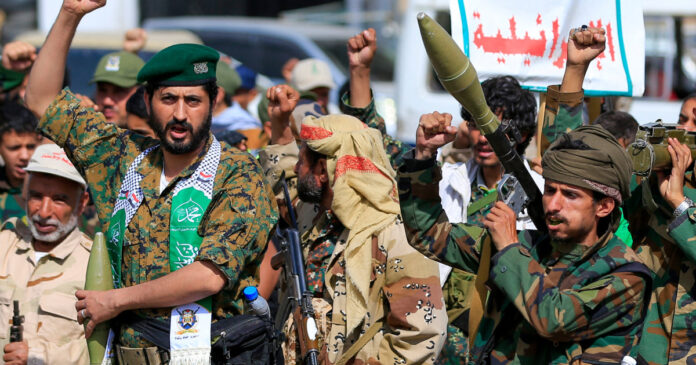
That investigators have not named a perpetrator is, on its own, the most consequential detail in this story. The attack came less than 48 hours after the Houthi movement’s military spokesman, Brig. Gen. Yahya Saree, declared a total ban on Israeli maritime navigation in the Red Sea and warned that any Israeli-linked vessel would be treated as a military target. The timing made attribution seem almost obvious. But geography complicates it considerably.
Balhaf sits in Shabwa province, well south of the Red Sea coastline that the Houthis control. The internationally recognized Yemeni government, backed by Saudi Arabia, administers this stretch of coast. The Houthis’ operational stronghold runs along the western Red Sea shore, near Hudaydah, where they have spent two years proving they can strike commercial shipping with drones, anti-ship missiles, mines, and explosive boats. The coordinates of Wednesday’s attack place it outside that territory.
That distinction matters — not as an exoneration of the Houthis, but as an unresolved question. The group has not claimed the attack. No other organization has either. Marine Insight, citing UKMTO’s own recent advisories, noted that the agency has separately warned of a renewed surge in Somali piracy in the Gulf of Aden and the wider Somali Basin, with at least one active pirate group operating in the region. That revival, largely dormant for years under pressure from international naval patrols, has accelerated as those same warships have redeployed northward to address the Houthi threat.

The question of whether Wednesday’s attack was Houthi-directed or opportunistic piracy exploiting the security vacuum matters enormously for how shipping companies and naval commanders respond. The answer, as of Wednesday afternoon, is that nobody knows. As the EU scrambled to respond to Houthi threats on the Red Sea just a day before Wednesday’s incident, Brussels was already warning that its diplomatic tools were running thin.
The Houthis’ June 8 declaration was unambiguous in its intent. Saree announced on social media that a complete and total ban on Israeli maritime navigation in the Red Sea had taken immediate effect. Any Israeli-linked vessel would be a military target. “Escalation will be met with escalation,” he said, “and our operations will intensify in accordance with developments.” A Houthi source cited by Reuters described the ban as a first step, and suggested that if Israeli military operations continued, the group would extend its targeting to any vessel heading toward Israeli ports — a posture it had previously demonstrated during its attacks on Israeli-linked tankers near Saudi Arabia’s Yanbu port, when it attacked dozens of commercial ships and forced major carriers to reroute around the Cape of Good Hope.
That crisis reshaped global trade flows in ways that have not been fully reversed. Shipping rates spiked. Suez Canal transit revenues collapsed. Saudi Arabia’s decision to reroute crude exports through its Red Sea port at Yanbu became a critical pressure valve for energy markets already rattled by Iran’s closure of the Strait of Hormuz since February. Bloomberg reported container shipping rates had already jumped in the week before the Houthi ban announcement, as traders priced in the risk of renewed disruption. The Houthi threat, in other words, was already being felt in freight markets before a single shot was fired Wednesday morning.
The Bab al-Mandab Strait, the 29-kilometer chokepoint between Yemen and the Horn of Africa through which roughly one-tenth of global trade passes, sits at the convergence of all of these pressures. The National reported that UKMTO has advised vessels in the region to proceed with caution and report any suspicious activity — standard protocol after a confirmed incident, and insufficient reassurance for shipping operators already weighing the calculus of whether the route is viable at all. Russia’s foreign minister has linked the Bab al-Mandab crisis directly to long-term global energy instability, a framing that underscores how much larger the stakes have become since the strait first came under threat.
Wednesday’s attack demonstrated, at minimum, that armed security teams remain the decisive variable in whether these encounters end with a vessel intact or a vessel boarded. It was the cargo ship’s Armed Security Team that forced the small craft to break off. The Houthis spent two years demonstrating that determined attackers with the right weapons can overwhelm that response. Whether Wednesday’s six gunmen were acting under Sanaa’s direction, or on their own initiative for reasons more ancient than geopolitics, is the question the investigation has not yet answered.
The UKMTO’s Warning 065-26, issued Wednesday, advised all ships in the area to exercise caution and to report any suspicious activity to the agency. It did not assign responsibility for the incident. That silence, in a region where every armed encounter carries the weight of a much larger war, is its own form of statement.