
POTSDAM, Germany — The remaining carbon budget for the planet to stay below 1.5 degrees Celsius of warming will be exhausted in three years at current emissions, more than seventy scientists from fifty-six institutions across seventeen countries concluded in a report published Wednesday in the journal Earth System Science Data. The fourth annual edition of the Indicators of Global Climate Change, a peer-reviewed snapshot of the climate system at the same level of methodological rigour as an IPCC assessment cycle, puts the Paris Agreement’s headline temperature threshold on a date. The number is 2030, and at the global emissions rate of 56.8 billion tonnes of CO2-equivalent the planet has been running on since 2024, the breach is not a probability. It is an arithmetic outcome.
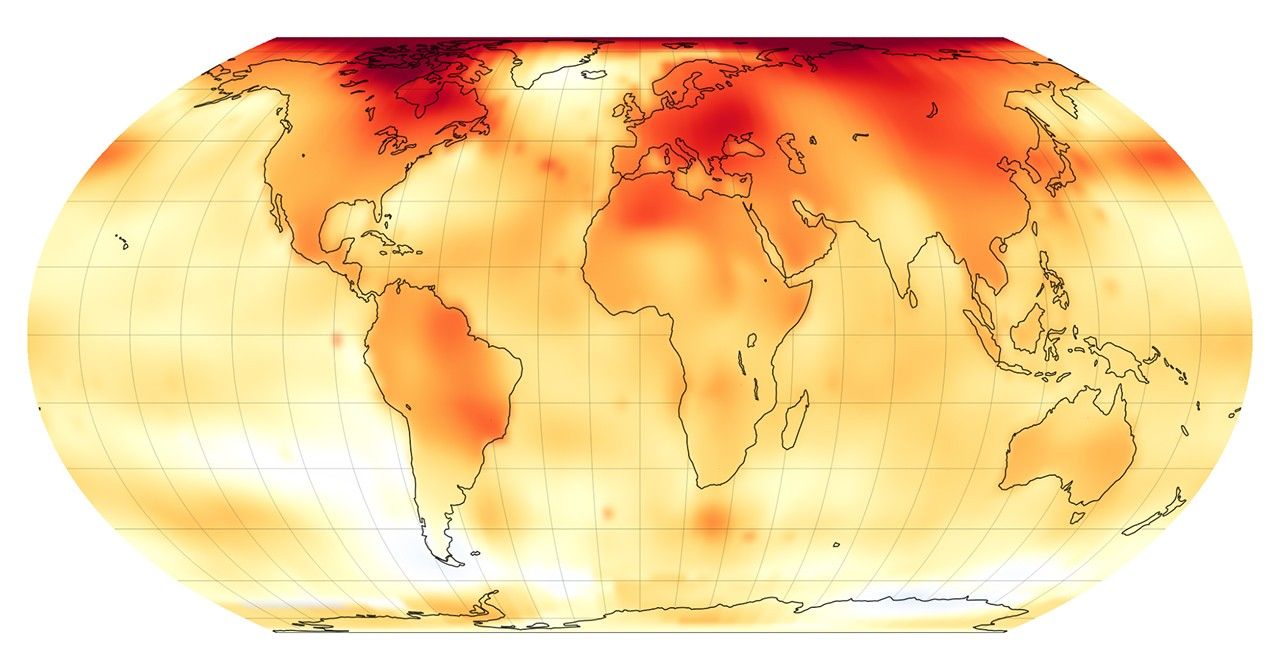
The headline number is the carbon budget. The 130 billion tonnes the planet has left to stay below 1.5 degrees, at the start of 2026, is the substance of the report’s central finding. The Indicators team has tracked the budget annually since 2023, and the trajectory has been collapsing faster than the IPCC’s AR6 working group projected three years ago. Human-induced warming reached 1.37 degrees Celsius in 2025, the report finds; the gap to 1.5 is the part the international diplomatic schedule has been working against, and the gap to the carbon-budget exhaustion is the part the economic and industrial planning communities have been working inside.
The substantive picture the report assembles is the part the political class will have to read. CO2 concentrations have reached 425.6 parts per million; sea level has risen 23 centimetres since 1901, and the rate of rise has accelerated through the past five years; ocean marine-heatwave days have more than tripled since 1991; and the total number of recorded marine-heatwave days in 2025 alone was 65 globally. The constellation of indicators all move in the same direction, and the same direction is the one the indicators were designed to make legible to non-specialist audiences for whom a single temperature number is not enough.
The report’s headline finding, on the cause-side, is the unambiguous one. Nearly all of the warming over the last decade is driven by human activities, Samantha Burgess of the Copernicus Climate Change Service told Euronews at the report’s release. The 2016-to-2025 observed warming relative to the pre-industrial baseline was 1.26 degrees, of which 1.24 was attributable to human activity; the remainder is the residual signal of natural variability the climate system was always going to be running against. The attribution side is the part the climate-denial argument has been losing in court for the past five years, and the IGCC’s annual restatement is the part the science community is using to keep the legal record at the level of operational evidence.

The diplomatic timing is the part of the picture the international community will be reading. The report’s release this week lands at the same moment NOAA declared an El Nino Advisory with a 63 percent probability of a very strong event by next winter, the configuration most likely to push global temperatures past 1.5 degrees for a calendar year ahead of the long-term trajectory. The Australian COP31 presidency under Chris Bowen told reporters at the Bonn UN climate talks this week that the world needs to get off fossil fuels; the IGCC indicators are the science backing on which that diplomatic argument rests.
The economic translation of the carbon-budget number is the part of the report the corporate planning community will be reading. A 130-billion-tonne budget at a current global emissions rate of 56.8 billion tonnes a year is a three-year window in which the world is on a pathway compatible with 1.5 degrees, after which every additional tonne is a tonne over the budget. The implied annual emissions reduction, to stay within the budget across a multi-decade transition, is approximately 7 percent compounded year on year, the level the IEA’s net-zero scenarios published in 2021 were tracking and that no major economy has produced since.
The political translation is the part the diplomatic schedule will be reading. The G7 summit in Évian opens Monday with climate as the eighth agenda item, behind the Israel-Iran war and the Strait of Hormuz energy shock; the European Union finalised its ETS2 carbon-market design this week; the Trump administration sent California’s vehicle-emissions waivers to Congress for repeal; Brazil reported Amazon deforestation in May down 61 percent; and on Monday Mombasa hosts the first Our Ocean Conference on African soil. The IGCC report is the scientific common denominator under all of those events. Every venue is operating against the same carbon-budget math.
The scientific significance of putting the breach on a calendar is the part climate communicators have been wrestling with since the 1.5-degree number entered the policy lexicon in Paris in 2015. The threshold was originally a political concession to the small-island delegations who argued that 2 degrees, the prior reference number, was a sea-level-rise sentence for their countries. The decade since has produced two operational shifts: the science community has converged on 1.5 as the threshold beyond which non-linear consequences become much more likely, and the diplomatic community has converged on it as the metric against which all national pledges are scored. The IGCC’s annual report is the instrument that keeps the score current.
The report’s authors include William Lamb of the Potsdam Institute for Climate Impact Research, Matt Palmer of the UK Met Office, Karina von Schuckmann of Mercator Ocean International, Burgess at Copernicus, and Chris Smith of the International Institute for Applied Systems Analysis. The methodological disclosure is the part of the report the IPCC review process will be reading. The IGCC was designed to provide a continuously updated equivalent of the IPCC’s assessment cycle, which produces a major report every five to seven years; the demand for an annual update was strong enough that the science community agreed in 2022 to produce one. The fourth edition is the version that puts the breach on a date.
The exhaustion-of-the-carbon-budget number does not mean the planet stops warming after the budget runs out. It means the climate trajectory the planet is on after that point has crossed into the territory the science community describes as compatible with 1.7 or 1.8 degrees of warming, the next defended threshold the policy literature has begun to converge around. The international architecture has not formalised that next number, and the IGCC’s report does not call for it to. What the report does is leave the political class with the choice the climate-policy community has been making implicit for the past decade. Either the next fiscal year’s global emissions number is lower than the previous one by an amount the IGCC indicators can measure, or the budget runs out on schedule.