
BEIRUT – The body created to supervise Israel’s withdrawal from southern Lebanon does not include Israel.
That structural fact, largely absent from Western readouts of the Doha round, was formalized on June 30 when Iranian parliament speaker Mohammad Bagher Ghalibaf announced that Iran and the United States had each designated representatives to a joint oversight mechanism established during the Burgenstock talks in Switzerland. The committee’s composition is explicit: Iran as one of two named guarantors, the United States as the other, Lebanon as the state party whose territory is at issue, and Pakistan and Qatar as mediators. Benjamin Netanyahu, who has publicly said the Israeli military faces “no restrictions” in Lebanon, is not represented.
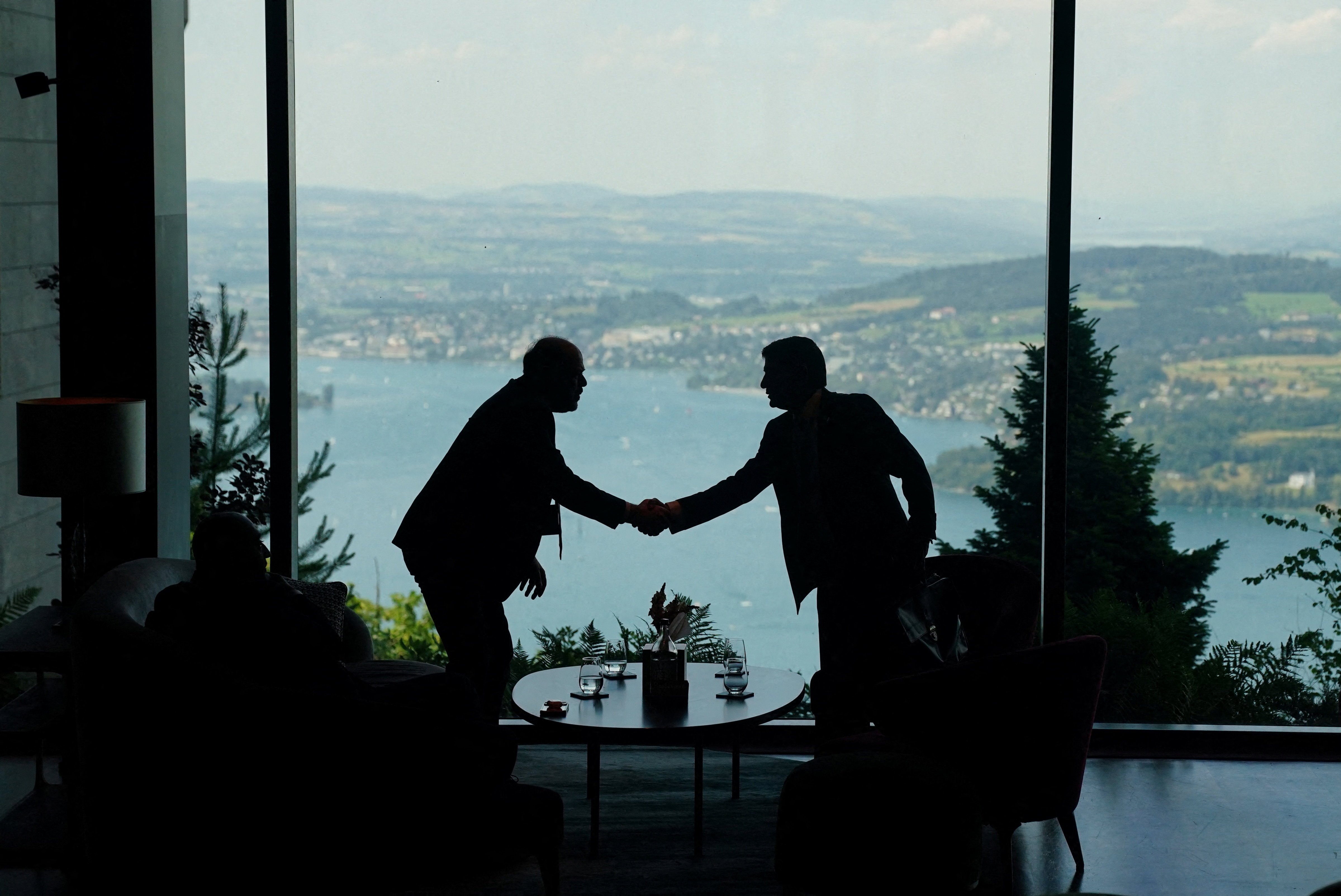
The Burgenstock sessions – two days of talks at Lake Lucerne on June 21 and 22 – produced a joint statement from Qatar and Pakistan announcing the formal architecture. A “de-confliction cell” would address military operations in Lebanon. A separate high-level committee, to which chief negotiators would “report regularly,” would “provide political oversight on the mediation” and lead working groups covering nuclear access, US sanctions, and a monitoring and dispute-resolution framework. Iran’s delegation – led by Ghalibaf alongside Foreign Minister Abbas Araghchi – treated Lebanon as the session’s top priority.
Ghalibaf’s coordination with Lebanese Parliament Speaker Nabih Berri before designating Iran’s committee representative was not incidental. Berri leads Amal, the Shia political movement whose relationship with Hezbollah gives him institutional access to the security landscape on the ground in southern Lebanon. The sequencing – Berri consulted before the committee’s first session – means Iran’s representative and Lebanon’s most important parliamentary interlocutor were aligned before Washington had confirmed its own designee’s mandate. Ghalibaf also confirmed that he had rejected Washington’s alternative security proposals for Lebanon as “unconstitutional” – a characterization Lebanese political leaders had applied to those proposals independently.
The committee’s exclusion of Israel creates an enforcement paradox the mechanism cannot resolve internally. The Islamabad MoU’s all-fronts de-escalation clause – the one Iran cited when it closed the Strait of Hormuz on June 20 – applies to Israeli operations in Lebanon even though Israel was not a party to the agreement. The committee will measure Israeli compliance against an obligation Israel never formally accepted. When former US diplomat Joey Hood analyzed the arrangement, he described it as giving Iran “veto power over Lebanon” – a framing that captures the structural imbalance without answering what the committee does when it finds non-compliance.
Netanyahu’s public position makes that question concrete. He has described Israeli forces in southern Lebanon as positioned in “strategic security zones” – a designation that has no counterpart in the MoU’s language. Defense Minister Israel Katz has similarly framed Israeli presence as a security buffer not subject to third-party timelines. The committee will be evaluating whether Israeli forces have withdrawn from positions that Israeli officials have publicly said they have no intention of vacating. That evaluation will produce findings; whether those findings generate pressure on Israel depends entirely on what the United States, as co-guarantor, is prepared to do with them.
The US track record on that question is unbroken in one direction. JD Vance, speaking after the Doha round concluded, said Washington could not commit to restraining military action before August 21 because compliance depended on “what the Iranians are ultimately going to do.” The formulation decouples US enforcement from Israeli behavior and links it instead to Iranian conduct – the inverse of the committee’s formal mandate, which is to oversee Israeli withdrawal, not Iranian restraint. The committee sits inside this asymmetry: Iran participates as a guarantor with a defined constituency in Berri’s office; the United States participates as a guarantor whose pressure on Israel has not appeared in any Doha readout.
Ghalibaf’s public defense of the committee to domestic critics carries a different kind of weight. In a July 1 interview cited by Tribune India, he said “negotiation is a method of struggle” – a direct answer to hardline Iranian voices who view the Doha process as incompatible with Iran’s resistance posture. He noted that Iran had fired missiles into Israeli territory during the ceasefire period as evidence that military readiness and diplomatic engagement are not mutually exclusive. The committee, in that framing, is not a concession – it is another instrument through which Iran is shaping the institutional architecture around the MoU before August 21 arrives.
Iran has made nuclear access contingent on Lebanon clause compliance. Ghalibaf stated the sequence explicitly: five MoU obligations, led by the Lebanon withdrawal, must be fulfilled before nuclear talks begin. The committee’s existence creates a formal mechanism for registering non-compliance with those obligations. Every session the committee convenes without Israel meeting the withdrawal standard becomes, from Tehran’s perspective, documented grounds for keeping the nuclear file closed.
The Doha round, which concluded July 2 without resolving the Lebanon question, did not disclose what Steve Witkoff and Jared Kushner’s separate meetings with Qatar’s Emir had produced on Lebanon. The next round of talks is paused pending the conclusion of Ayatollah Ali Khamenei’s burial proceedings, which will not conclude before July 9. During that gap – seven days in which the diplomatic track pauses – the de-confliction cell and oversight committee continue operating.
Thirty-eight days remain in the MoU window. The committee charged with evaluating the MoU’s Lebanon clause has five members. Israel is not among them.