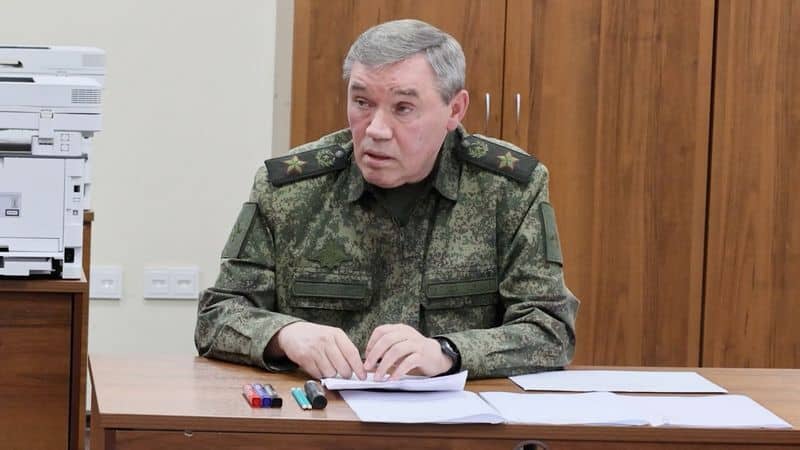

MOSCOW – Vladimir Putin stood at a command post of the Joint Group of Forces on Saturday and told the men responsible for Russia’s military advance that they were not finished with their obligations to the people caught between the lines. “There are still civilians in the zone,” he said. He asked them to keep doing what he believed they were already doing – and then ordered that it continue regardless.
Putin’s visit to the command post produced a dual directive. He ordered commanders to ensure the unconditional fulfillment of tasks in strict accordance with the General Staff’s plans – the standard language of military obligation. And then, in the same breath, he added the civilian caveat. “Everything possible must be done to evacuate civilians from the combat zone,” he said, according to RIA Novosti. The juxtaposition was deliberate: Russia’s president delivering a push to advance and a call to protect in the same address to the same commanders.
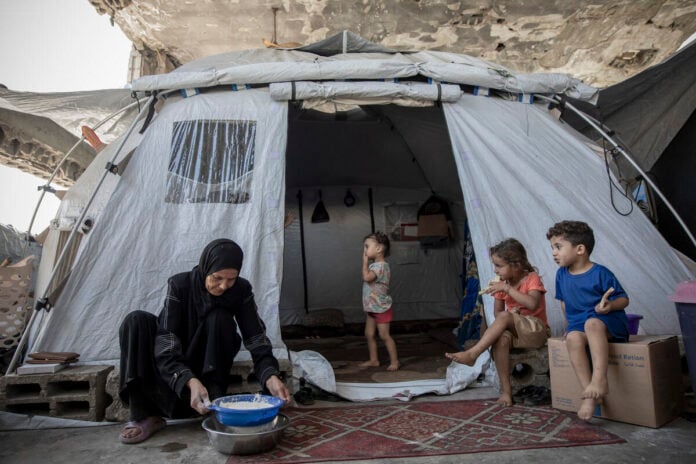
What that means in practice depends on where the front line is. As of Friday, it runs through territory that includes towns and villages where not everyone has left. The Donetsk region has been under sustained pressure for more than two years, and the civilian population has steadily thinned – but it has not emptied. Local authorities and humanitarian organizations have documented repeated cases of residents who refused to evacuate, or who lacked the means to do so, as fighting moved into their neighborhoods. Putin acknowledged this directly: “I know you’re doing this,” he said of the evacuation effort, “but I ask you to continue.”
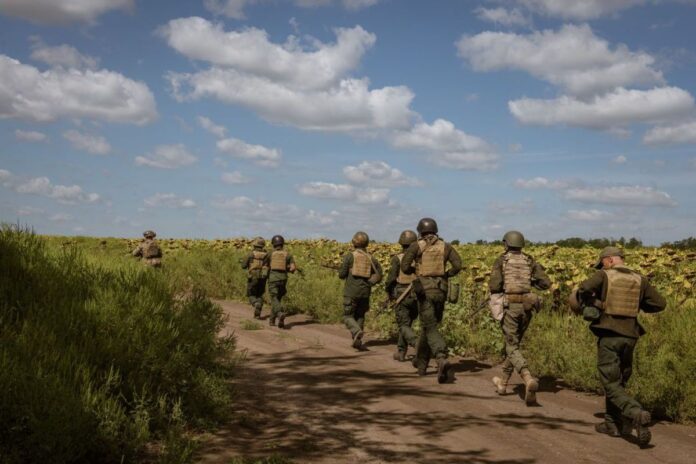
The front line moved again on Friday. Russian forces took Konstantinovka, a city of roughly 70,000 before the conflict that had served as a logistical hub for Ukrainian forces in central Donetsk. The capture opens a corridor toward Kramatorsk and Slaviansk – the two largest Ukrainian-held cities remaining in the region – and it came with civilians still inside the city. Verified footage from the hours following the Russian advance showed residents in Konstantinovka’s streets. The question of who would evacuate them, and how, was not answered before Putin spoke.
Putin’s command post appearances have become a recognizable feature of his wartime communication strategy. They signal personal engagement with military leadership at a moment when the General Staff’s plans are being tested or advanced, and they generate imagery of a commander-in-chief in proximity to the front without the security exposure of an actual front-line visit. Saturday’s visit was not announced in advance and no location was given by the Kremlin. The Joint Group of Forces is the unified command structure Russia established to coordinate operations across the different axes of advance in Ukraine, with separate groups for the north, south, east, and Dnipro directions.
The civilian evacuation language serves a purpose that extends beyond the command post. Russia has consistently framed its military operation in Ukraine as a protective mission – specifically, as protection of Russian-speaking populations in Donetsk and Luhansk from what Moscow calls Ukrainian aggression. That framing has been difficult to sustain alongside imagery of destroyed cities and displaced civilians. Ordering evacuation from within a command post, in front of military commanders, is a way of placing the protection narrative back at the center of the operation’s stated purpose, even as the operation advances deeper into populated territory.
Ukraine has not commented on Putin’s command post statement. Kyiv’s position on civilian evacuations in Russian-held or contested territory is that Russia routinely prevents them – that civilians are held in place to complicate Ukrainian military operations or to create the appearance of popular acceptance. That dispute cannot be resolved from the text of Putin’s order, which names the intention but not the mechanism, the timeline, or the current number of civilians in the zone he was referring to.
The command post visit came the same morning as another Kremlin-adjacent data point: five Ukrainian drones were intercepted over Moscow before dawn, with Mayor Sobyanin announcing the intercepts on Telegram and emergency services dispatched to fragment sites. The two events – Putin ordering commanders forward and Ukrainian drones reaching the capital’s air defenses – are the dual faces of a conflict that has settled into a pattern of simultaneous ground advance and long-range aerial exchange, each side pressing on the other’s rear while fighting continues at the front.
At the NATO summit in Ankara, meanwhile, Poland’s Prime Minister Donald Tusk warned alliance members that Russia could move against a NATO member within months. Putin’s command post visit does not directly answer that warning. It does clarify something about where Russia believes its current obligations lie: in unconditional fulfillment of the General Staff’s plans, and in the evacuation of civilians from a zone that, as of Saturday morning, is still moving.