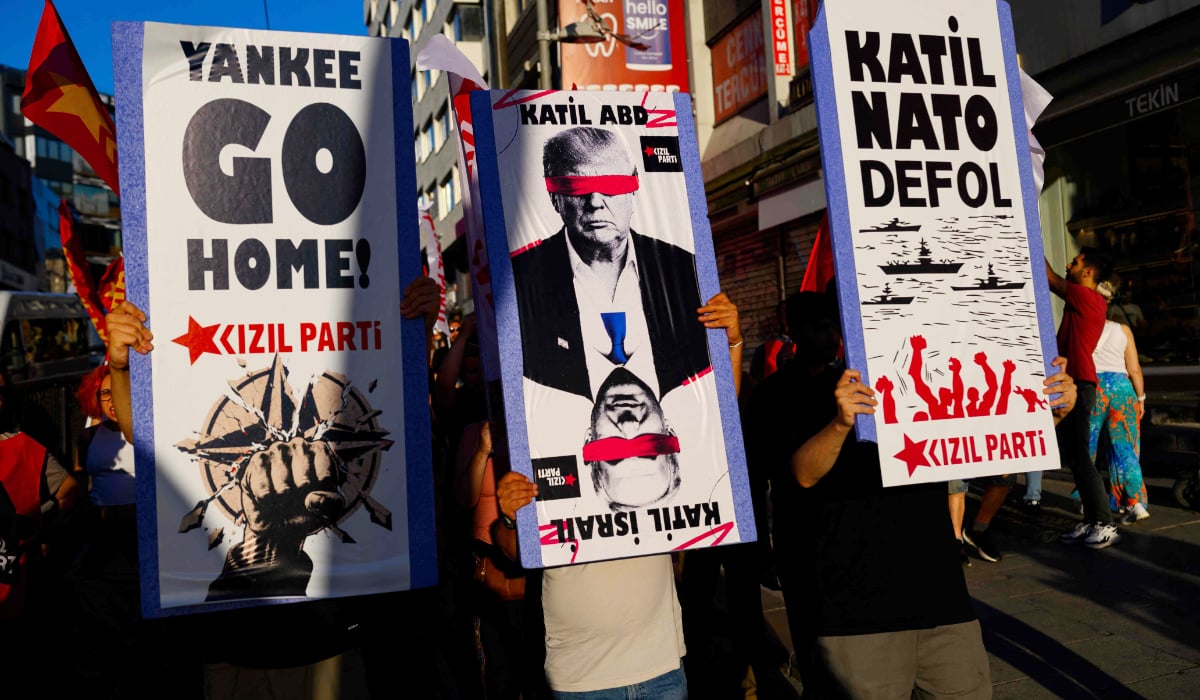

ANKARA — In Kizilay Square, where Ankara’s main boulevard meets the city’s bus terminals, police moved in before the march had gone half a block. Riot shields. Tear gas. More than a hundred members of the Communist Party of Turkey, flags still raised and some still chanting, were loaded into buses and driven away.
Two days before thirty-two NATO leaders are due to land in the Turkish capital for a summit on July 7–8, the government had made clear what kind of dissent it would tolerate. None.
Sunday’s detentions were only the most visible layer of a crackdown that has been building for weeks. Turkish authorities imposed a thirteen-day blanket ban on all public assemblies across Ankara beginning June 28, citing national security requirements for the summit. Over the three days before the ban took effect, police swept up 225 people in dawn raids, remanding 103 to pretrial detention. The arrested included lawyers, academics, activists from a nature conservation group, and at least one prominent LGBT rights journalist. Ankara police separately announced that more than 4,000 people wanted on outstanding warrants had been taken in during the broader security sweep, a figure the opposition called a pretext for clearing the city of political adversaries before foreign cameras arrived, Arab News reported.
TKP Secretary General Kemal Okutan was defiant as protesters gathered at several points across Istanbul and Ankara. “We have gathered today in many parts of Türkiye to protest against NATO,” he said. Within the hour, Turkish authorities had demonstrated why that gathering required some courage.
Tuncer Bakirhan, co-chair of the pro-Kurdish DEM Party, did not soften his assessment. “The country has been fully turned into a detention center by using the NATO summit as an excuse,” he said. His party, alongside the main opposition Republican People’s Party, condemned what they described as the government using the summit to silence political criticism under the cover of security measures.
What happens in Ankara over the next forty-eight hours carries significance beyond Turkey’s domestic politics. The summit is, on its surface, an exercise in alliance solidarity: defense spending targets, weapons commitments for Ukraine, and the question of what NATO’s eastern flank looks like in the months ahead. But in the days running up to it, the host country has deprived independent journalists of summit accreditation, blocked social media accounts of civil rights organizations, and detained the kind of people who, in most NATO capitals, would be regarded as ordinary political actors.
Human Rights Watch documented much of this before Sunday’s arrests. Benjamin Ward, the organization’s deputy director for Europe and Central Asia, said Turkey was using terrorism laws to sweep up political opponents in a way that contradicts the alliance’s stated values. “The misuse of terrorism laws to conduct mass arrests and silence people in the run-up to a NATO summit,” Ward said, “flies in the face of the founding values of the alliance.” Amnesty International reached a similar conclusion, calling the assembly ban an “excessive and unjustifiable attack” on basic freedoms and calling for the immediate release of all those detained in connection with the summit.
None of that language is likely to appear in any official communiqué from the summit hall. Erdoğan has spent months engineering his position at the center of the coming week’s diplomacy. As Eastern Herald reported, he extracted a $700 million engine deal from Washington and made plain to Donald Trump that the summit’s success required Turkish cooperation. The calculation worked. No NATO government has publicly linked the crackdown to the summit in a way that might embarrass the host.
It was not the first time the summit had provided cover. Earlier this month, when Turkish authorities arrested 209 people in pre-summit operations, including a prominent LGBT activist and fourteen members of a nature conservation foundation, international reaction was limited. HRW named the victims: academic Emel Memis, activist Yildiz Tar, environmental representative Nevzat Ozer, and others with no apparent connection to any security threat beyond their public dissent.
Istanbul also saw protests on Sunday, with hundreds marching from Taksim Square toward Dolmabahce and separate demonstrations in the Kadikoy district. Istanbul police allowed those marches to proceed without the interventions used in Ankara. The contrast suggested a calculation: suppress direct confrontation in the capital, where foreign delegations will be watching, and manage the symbolic cost elsewhere.
Twenty-one journalists currently sit in Turkish prisons, according to Human Rights Watch, making Turkey one of the world’s leading jailers of the press. Some were denied summit accreditation this week; outlets including Cumhuriyet, Sozcu, and T24 were among those blocked, according to media freedom organizations. Their absence from Ankara effectively removed critical independent voices from the only venue where Turkish and foreign officials will share a table over the next two days.
What the detained protesters and arrested journalists will face once the summit ends is not yet known. Whether any NATO ally raises the question while in Ankara is not known either. The alliance’s summit communiqués rarely reach the streets outside its host cities.