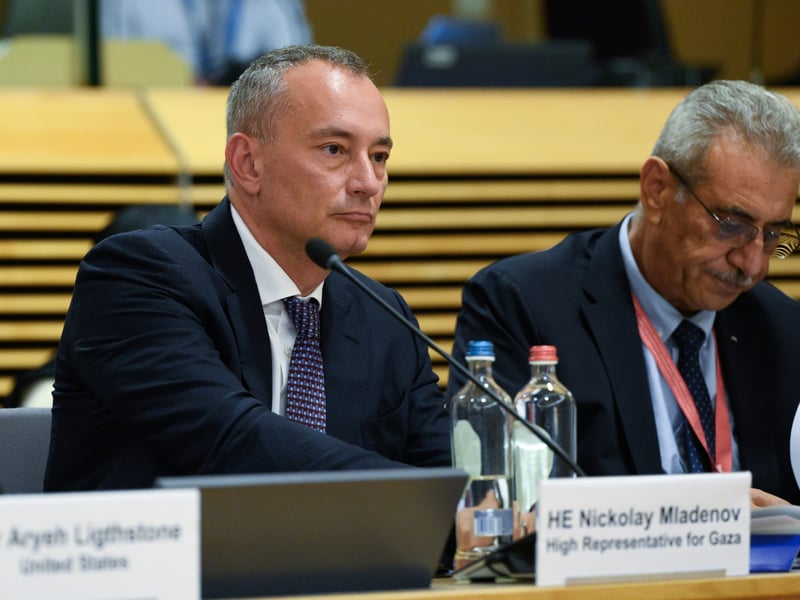

UNITED NATIONS — The ceasefire that has suspended Gaza’s most intense fighting for nearly a year could be days from breaking apart entirely. That is the judgment now before the United Nations Security Council, where the man Donald Trump appointed to oversee the peace process told world powers last Wednesday that any return to full-scale war would leave “no roadmap to return to.”
Nickolay Mladenov, the high representative for Trump’s Board of Peace, delivered his most urgent warning in a Security Council briefing on August 26. Gaza, he told diplomats gathered in New York, “does not have another catastrophe left in it.” The message behind those nine words was plain: the infrastructure of negotiation, aid delivery and transitional governance that had slowly, imperfectly held since October 2025 would not survive a second round of full-scale conflict.
What Mladenov did not say out loud, though the Security Council understood it well enough, was who he was speaking about. In the three weeks before his briefing, Israeli Prime Minister Benjamin Netanyahu had publicly rejected Trump’s 15-point peace plan, refused to countenance a simultaneous withdrawal of Israeli forces alongside Hamas disarmament, and overseen a sequence of strikes that killed seven Palestinians in a single day while destroying an aid supply warehouse and a water treatment plant in Gaza.
In an interview with Al Jazeera published Thursday, Mladenov sharpened the warning. The failure of both sides to adhere to the roadmap “threatens a collapse of the ceasefire in Gaza,” he said. There was “no better alternative to the current plan,” he added. A return to war “would be devastating.”
The scale of that potential return is not abstract. Palestinian health officials recorded 1,296 dead and more than 4,296 injured inside Gaza since the ceasefire formally took hold on October 10, 2025, numbers accumulated not in the heat of combat but across months when a ceasefire was theoretically in force. Board of Peace monitors logged more than 4,379 Israeli violations over the same period. Of the trucks allocated to enter Gaza under the ceasefire’s aid terms, only 35 percent had actually crossed by late August.
The October 2025 ceasefire was never clean. What made it hold at all was the prospect of a path forward: a roadmap in which Hamas would eventually hand over weapons and transfer governing authority to a transitional administration recognised by the United Nations, while Israel would draw down its military presence in stages. Hamas, which had resisted that framework for months, formally accepted it at the end of July, signing the July 30 roadmap for disarmament and civilian governance transition.
That concession arrived and then stalled, because the Israeli government would not hold up its end.
Netanyahu’s position has been consistent since his formal rejection of the plan in early August. Israeli forces will not withdraw from Gaza until Hamas has fully disarmed. The sequence cannot be reversed or made simultaneous. “Israel does not accept the 15-point document,” he said publicly. “We are talking about genuine disarmament, not fictitious disarmament.” He also reaffirmed that as long as he is prime minister, there will be no Palestinian state.
The Board of Peace had originally insisted on parallel steps, with Israeli withdrawal and Hamas disarmament proceeding together. Under Israeli pressure, it quietly retracted that requirement, a concession that critics in the Arab world and at the Security Council said gutted the deal’s architecture before it had any chance to function. The board’s walk-back left Hamas holding an agreement whose core Israeli counterpart had already been abandoned.
Seven Palestinians died in a single Israeli strike on August 25, targeting what Gaza’s Health Ministry described as an aid supply warehouse. Three more were killed in the West Bank city of Jenin three days later. These deaths came not in declared combat but under an active ceasefire. The pattern of killings under a notional truce has been documented since at least July, with the toll since October 2025 now approaching 1,300. What international monitors documented as systematic violations in April has only deepened.
Arab News, reporting on the Security Council briefing, captured Mladenov’s underlying point: Gaza has no capacity to absorb another round of full-scale fighting. By April 2026, the death toll in the territory had surpassed 72,500 people killed since October 7, 2023. That count continued to accumulate under a ceasefire that was supposed to have ended the killing.
The one question Mladenov’s Security Council statement leaves unanswered is whether anyone in the Trump administration is prepared to press Israel to the point where the pressure is real rather than rhetorical. The Board of Peace walked back once, abandoning the simultaneous-withdrawal provision that was meant to give Hamas a reason to complete disarmament. A second retreat would leave nothing in the arrangement that Israel has not already dismissed.
The formal designation for what failure would look like came from Mladenov himself. “That would not be a setback,” he told the council. “It would be a point of no return for everyone.”
He did not say who would bear the cost of that point. In Gaza, that question has had the same answer for the better part of three years.