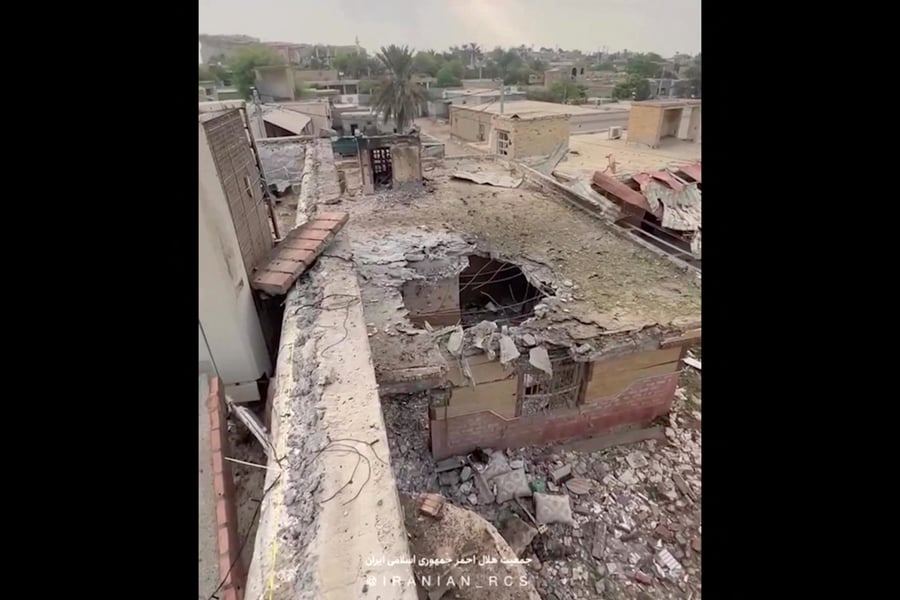

TEHRAN — Four people attended a wedding reception in Kuhestak on the night of September 2, and did not leave. One of them was four years old.
Missiles struck the hall in a residential building in Sirik County, on Iran’s southern coast, as guests gathered for a marriage celebration in a small fishing settlement at the edge of the Strait of Hormuz. Iranian state television reported that sixty-eight people were wounded and four killed, including the child. Officials in Hormozgan province identified fragments of the weapon consistent with the AGM-84K SLAM-ER, a cruise missile manufactured by Boeing for the United States military and not found in the inventory of any other force currently operating in the region.
The United States Central Command did not confirm a strike on Kuhestak. Spokesperson Tim Hawkins said in a statement that “the US military never targets civilians, unlike the IRGC.” He did not name any military installation in Sirik County. He did not say what American ordnance was doing in the skies above a fishing village with no listed military infrastructure on the night of the reception.
Kuhestak sits several miles from the main shipping corridor through the Strait, in a province that has absorbed repeated US strikes on coastal naval facilities since the conflict began in February 2026. In that context, what followed was familiar: silence on the target. What was unfamiliar was that no military objective near the strike site has since been claimed, and no after-action notice of any kind has been issued. The wedding guests were not informed of what the intended target was supposed to be.
Iran’s foreign ministry referred the case to the International Committee of the Red Cross and the office of the International Criminal Court prosecutor within hours. Foreign Minister Abbas Araghchi told state television that Kuhestak would be formally added to Iran’s “catalogue of American atrocities,” citing documented strikes on civilian areas in Minab, Lamerd, and Qeshm as precedents. The United States is not a signatory to the Rome Statute, which limits what an ICC referral can compel in practice. The referral creates a record nonetheless, and that appears to be Iran’s purpose.
Vice President JD Vance told reporters he was “extremely skeptical” of Iranian accounts despite Iranian officials having displayed missile fragments recovered at the site, including what they identified as a guidance component bearing a serial identifier consistent with the SLAM-ER variant. Vance did not offer a competing explanation for what killed four people at a coastal wedding. President Donald Trump said Iran “will be hit much harder” if it retaliates, and claimed near-total American control of the Strait. Neither addressed the question of the target.
Iran’s retaliation came before dawn. The Islamic Revolutionary Guard Corps launched a coordinated barrage of ballistic missiles and armed drones at American military installations across the region. Sheikh Isa Airbase in Bahrain, the headquarters of the United States Navy’s Fifth Fleet, was among the targets. So were Prince Hassan Airbase and Ali Al Salem in Jordan, a facility in Erbil in northern Iraq, and an installation in Kuwait. Jordan’s military said its air defense systems intercepted ten of thirteen incoming ballistic missiles. Kuwait’s forces reported drones brought down over its territory. Iran’s IRGC announced that American soldiers had been killed; Central Command had not confirmed or denied that claim by press time.
Defense analysts who reviewed photographs of the Kuhestak wreckage, in coverage from Al Jazeera, said fragments of the guidance system were consistent with a SLAM-ER fired from carrier-based aircraft. The carrier USS Theodore Roosevelt has been on station in the Arabian Sea since June. No other military operating in the Gulf carries that weapon.
The broader toll of the conflict now stands at approximately 3,500 Iranians killed since February, according to figures cited by Iranian officials and international monitors. A UN trade body found earlier this year that prior Hormuz disruptions had sent the world’s poorest nations on a longer, costlier recovery path, with food insecurity rising across South Asia and East Africa as shipping rerouted to avoid the Strait. The Larak Island exchange two days prior, in which the US struck Iranian coastal assets and Iran retaliated with drone and missile strikes on a US base in Jordan and targets in the UAE, had already revived fears of wider escalation before the missiles fell on Kuhestak. Tanker explosions in the Strait in July had shown how quickly the conflict at sea could expand.
What is not known, and what no American statement has addressed, is why a SLAM-ER was targeted at a residential building in a fishing village with no declared military presence in Sirik County. If the strike was a targeting error, the threshold for acknowledgment in this conflict has not been reached. If it was not, the United States has not said what it was.
Iran will present its evidence to the International Criminal Court. The United States will not be bound by whatever the court concludes. Four people attended a wedding in Kuhestak. That part of the record is not in dispute.