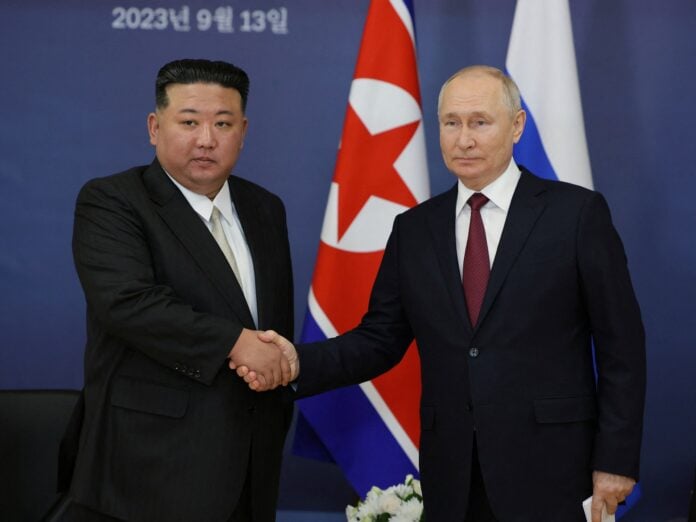

PYONGYANG — Kim Jong Un did not merely congratulate Vladimir Putin this week. He consecrated him.
In a letter dispatched Monday in response to Putin’s congratulations on North Korea’s 78th founding anniversary, Kim told the Russian president he was “firmly convinced of the victory of the Russian Federation in the present sacred war to defend the national security interests and the international justice,” Sputnik reported, citing North Korea’s Korean Central News Agency. He pledged his “invariable support” to Putin and the “fraternal Russian people” and promised to expand the two countries’ cooperation “in a comprehensive way.” It was the most direct ideological framing Pyongyang has publicly applied to Russia’s military operation in Ukraine: not a conflict, not a special operation, but a sacred cause.
The letter arrives at a moment when the Russia-North Korea relationship has moved well beyond diplomatic language. South Korea’s National Intelligence Service estimates that Pyongyang has deployed approximately 15,000 troops to Russia’s Kursk region, where roughly 2,000 are believed to have been killed or wounded. Ukrainian President Volodymyr Zelensky has warned publicly that North Korea is preparing to deploy an additional 30,000 to 50,000 personnel to support Moscow’s forces. Kim’s invocation of the “sacred war” formulation is not rhetorical ornament. It is doctrine, meant to frame the contribution of those soldiers as ideologically justified at the highest level of the state.
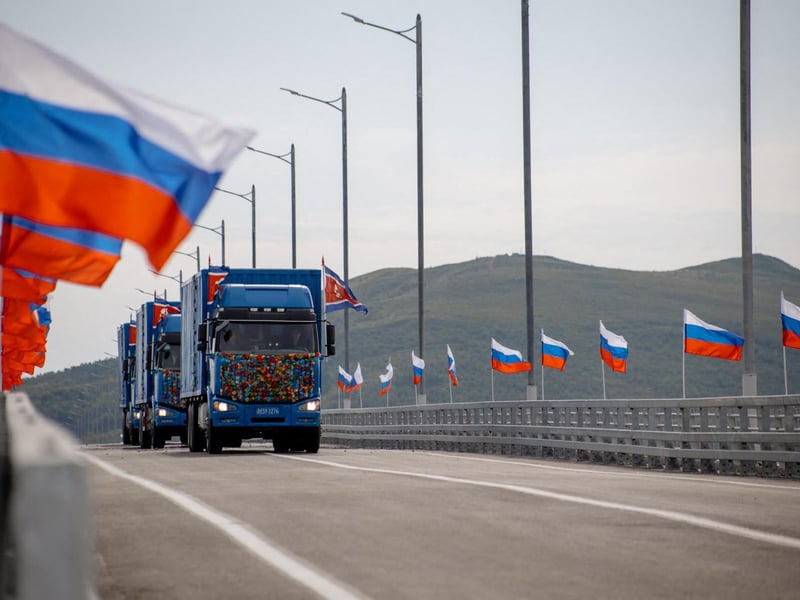
The deepening is also structural. On September 7, two days before Pyongyang’s anniversary celebrations and eight days before Kim’s letter, Russia and North Korea inaugurated their first road bridge across the Tumen River, a one-kilometre, two-lane crossing connecting the Russian Far East with North Korea’s northernmost province. Al Jazeera reported that both governments framed the bridge as a symbol of permanent partnership. Rail lines already cross the border; the bridge adds a second corridor for goods and, potentially, for the military cooperation that has defined the relationship since Moscow’s conventional weapons stockpiles began running low in late 2023.
That context gives Kim’s phrase “expand and deepen the joint work with the Russian Federation in a comprehensive way” more operational weight than diplomatic convention usually warrants. “Comprehensive” carries a track record in this relationship. The comprehensive strategic partnership that Putin and Kim signed in June 2024, during Putin’s visit to Pyongyang, contained a mutual defence clause that has already obligated North Korea to field troops in a European war. A further “comprehensive” expansion opens the question of what Russia might offer in return: technology transfers, satellite cooperation, energy supply agreements and other arrangements that have circulated in Western intelligence assessments for the better part of two years.
Seoul has not answered that question publicly, but it is watching. South Korean officials have repeatedly cited the troop deployments as a violation of UN Security Council resolutions prohibiting military cooperation with Pyongyang. The Freedom Edge trilateral exercises conducted jointly by South Korea, the United States and Japan near Jeju Island from September 7 to 11 were, in significant part, a response to the growing axis. North Korea’s government made that connection explicit when it warned of “unfavourable consequences” before the drills began.
The letter’s timing carries domestic weight as well. Kim publicly honored North Korean soldiers serving in “overseas military operations” during the September 9 anniversary ceremonies, an acknowledgment without precedent in the DPRK’s public communications, which for decades denied that such deployments existed. Calling the war sacred six days later closes a narrative arc. It supplies the ideological architecture necessary to elevate, in North Korea’s own political vocabulary, the service of its soldiers deployed in Russia.
The broader conflict meanwhile continues to press against diplomatic boundaries. A Russian drone struck near a diplomatic train carrying Western officials through Ukrainian territory on Saturday, an episode that underscored how the operational conduct of the conflict has consistently dismissed the conventions of diplomatic protection. That conduct is the same one Kim has now formally declared sacred.
What the letter leaves unspecified is what “comprehensive” expansion would require from Pyongyang in practical terms. KCNA reported the exchange and Kim’s main declarations but gave no details about possible new troop commitments, weapons transfers, or economic agreements. Russia acknowledged receiving the letter without elaborating.
That gap between Kim’s elevated language and the operational commitments it may imply is where the next phase of the alliance will take shape.
The “sacred war” formulation also addresses audiences beyond Moscow. It puts North Korea’s supreme leadership on record as viewing Russia’s military operation in Ukraine as not merely justified but holy—a position that directly conflicts with UN General Assembly resolutions, the findings of the International Court of Justice, and the official stance of Western governments.
The letter does not indicate whether Beijing considers that language useful or inconvenient. China has maintained deliberate ambiguity over the conflict while deepening its economic ties with Moscow.