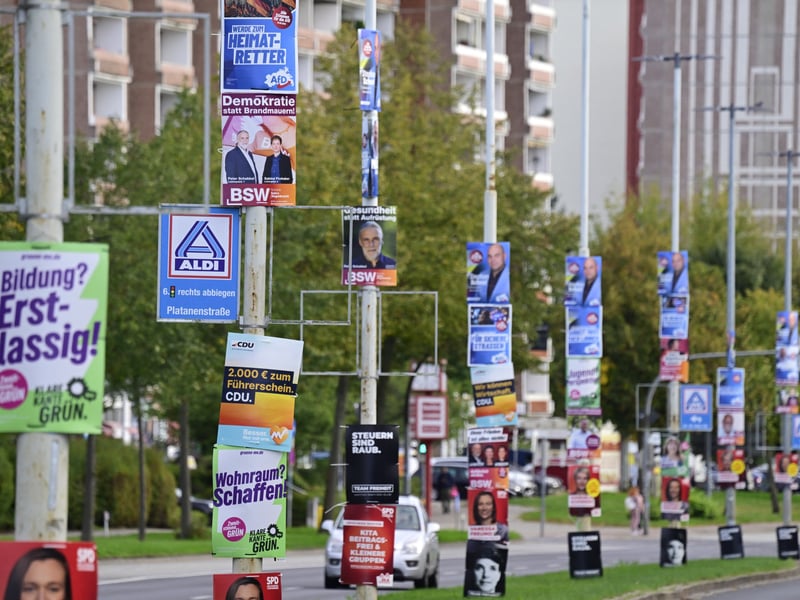

BERLIN — The Christian Democrats, the party that has shaped German governance for most of the Federal Republic’s history, risked losing every single seat in Mecklenburg-Western Pomerania’s state parliament on Sunday — a result that would have been unthinkable a generation ago, and one that arrived not as a surprise but as a consequence months in the making.
Germany’s eastern states of Mecklenburg-Western Pomerania and Berlin held simultaneous state elections on Sunday, the latest test of a political order that has been crumbling steadily since Chancellor Friedrich Merz took office in early 2025. Pre-election polling showed the far-right Alternative for Germany running nearly level with the Social Democrats in the northern coastal state at 36 to 37 percent, while in Berlin, the far-left Die Linke threatened to emerge as the capital’s largest political force for the first time.
The elections came just two weeks after the AfD’s historic breakthrough in Saxony-Anhalt, where the party captured 43.8 percent of the vote on September 6, finishing just three seats short of an absolute majority. Merz cleared his calendar for Sunday evening and scheduled an emergency CDU leadership meeting — an acknowledgment, without being one, that his political footing had narrowed to almost nothing.
What made Sunday’s contest especially perilous for the CDU was the arithmetic.
Pre-election polls put the party at only 6 percent in Mecklenburg–Western Pomerania—just one percentage point above the 5 percent threshold required to retain representation in the state parliament. Falling below that line would have eliminated every CDU seat there, marking the first time the party had been shut out of an eastern German state legislature since reunification in 1990.
This would not have been an ordinary defeat. It would have been a political extinction event for Friedrich Merz’s regional base.
About 1.3 million voters were eligible to cast ballots in the state, where Premier Manuela Schwesig and her Social Democrats have governed since 2011. For the first time, 16- and 17-year-olds could vote, adding tens of thousands of first-time voters whose political preferences—particularly their potential support for the AfD—remained uncertain.
Schwesig, whose approval ratings have long exceeded her party’s national standing, spent the final days warning that a parliament without the CDU would be defined entirely by the contest between her SPD and an AfD increasingly characterized by what it opposes.
In Berlin, 2.5 million voters faced a different but equally consequential choice. Die Linke — the Left party, the descendant of the old East German communist party — had surged in pre-election polls to 20.7 percent, barely ahead of the CDU’s 20 percent and the AfD’s 17.9 percent. The Greens sat at 15.8 percent, the SPD at a diminished 12.2 percent. A potential Die Linke-SPD-Green coalition offered one credible path to a left-bloc governing majority — an outcome that would have seemed improbable at the start of the year.
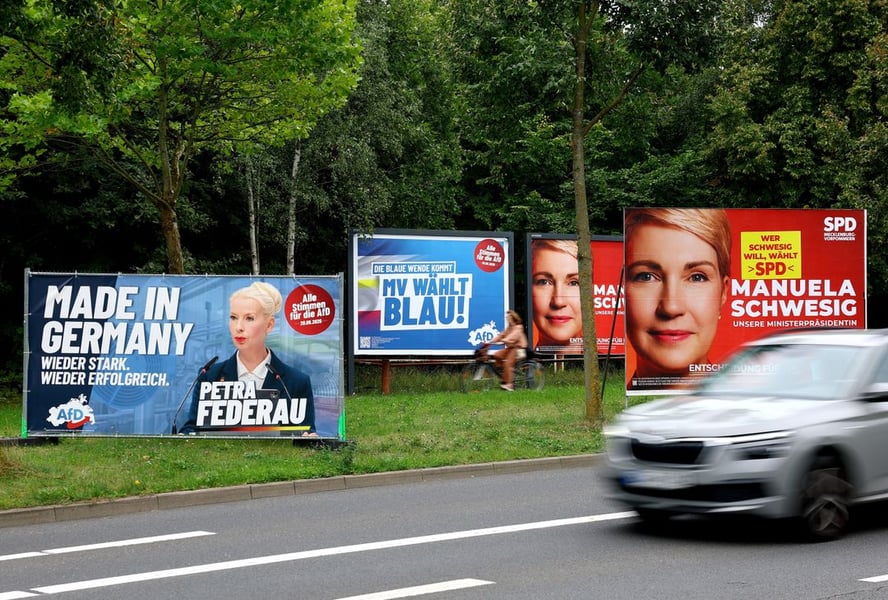
The AfD’s co-leader Alice Weidel, who has led her party’s calls for early federal elections following the Saxony-Anhalt triumph, watched Sunday’s contests as a potential accelerant. Two consecutive eastern state wins — and meaningful pressure now in Berlin, where the AfD has historically underperformed — would considerably strengthen her case. Merz’s approval rating had fallen to just 14 percent in recent polling, giving his coalition’s defenders little to work with and voters little reason to reward the incumbent parties.
Germany’s political architecture, built on the assumption of CDU-SPD dominance with minor parties in supporting roles, has been visibly fracturing since the 2025 federal election. The state-by-state erosion — Brandenburg, Saxony-Anhalt, and now potentially Berlin and Mecklenburg-WP — reflects not a temporary protest wave but a structural shift in how eastern Germans assess the political offer from Berlin.
The CDU’s problem is not simply the AfD. It is that the CDU has lost the argument in communities where it once won by default. In Mecklenburg-Western Pomerania, whose economy depends heavily on agriculture, tourism, and an energy sector that has absorbed years of disruption from western sanctions on Russia, the CDU’s embrace of Merz’s hawkish economic program has produced less support than abstention. Tens of thousands had already taken to the streets in eastern Germany in July, registering a frustration that Sunday’s results were confirming rather than creating.
What Sunday’s elections could not fully resolve was whether Germany is watching the political expression of a regional mood or the early evidence of something more permanent. Federal polling showed the AfD at 26 percent nationally — ahead of the CDU for the first time in the post-reunification era. Weidel has demanded new federal elections. Merz has refused. One of those positions will become untenable before the scheduled 2029 federal vote.
Sunday will not settle that question. But it will tell Germany something about how much further the ground can shift before those who built the current order stop calling it temporary.