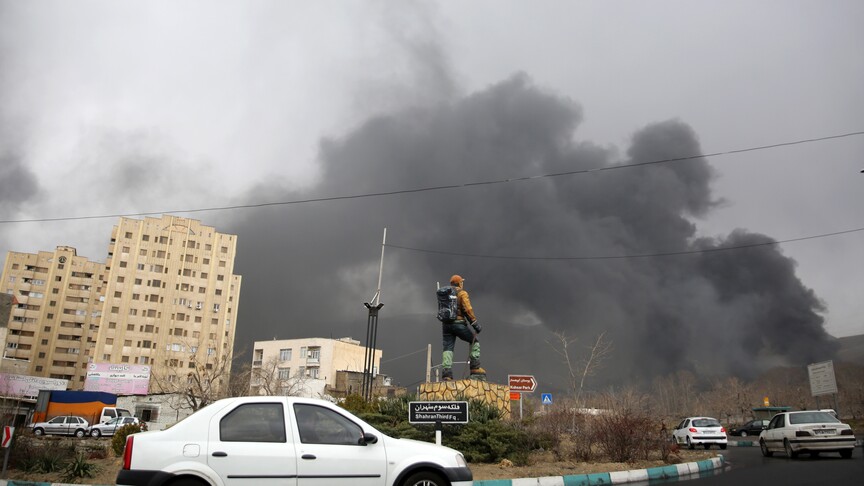

TEHRAN – Iran’s central armed forces command issued a direct military warning on Sunday that the United States had decided to resume strikes on the Islamic Republic, pledging “continuous, effective, and painful” retaliation against every American base and position across the Middle East if Washington proceeded.
The announcement, issued by the Khatam al-Anbiya Central Headquarters, the body that coordinates Iran’s military branches, said Iranian intelligence had established that American officials reached the decision at a meeting convened somewhere in Europe, with what Tehran described as the “green light of some regional countries.” No names were provided for the European meeting or the regional governments Tehran accused of supporting a potential resumption. The claim could not be independently verified from public sources, according to Anadolu Agency.
Parliament Speaker Mohammad Bagher Ghalibaf confirmed Tehran’s standing position on Sunday: the Strait of Hormuz would remain closed until Washington honored the commitments Iran says it accepted under an earlier agreement. Ghalibaf accused the US of having issued “false guarantees” to vessels attempting to use a southern crossing corridor and warned that ships attempting the route would be targeted by Iranian forces. Iran’s position, he said, was that the US had secured some tanker crossings since the June ceasefire memorandum collapsed but had not met the underlying conditions that, in Tehran’s reading, gave it the right to do so.
The military command’s warning extended well beyond the Hormuz standoff. Khatam al-Anbiya said that if the US “makes a mistake,” Iran would strike American interests and deployment areas across the region, covering bases in Bahrain, Jordan, Iraq, the Kurdistan Region, and elsewhere in the Gulf. Each of those locations absorbed Iranian strikes during the peak fighting period earlier this year. Governments permitting their territory or facilities to support any new US military campaign against Iran, the command added, would be “considered complicit” and could themselves face a response from Tehran.
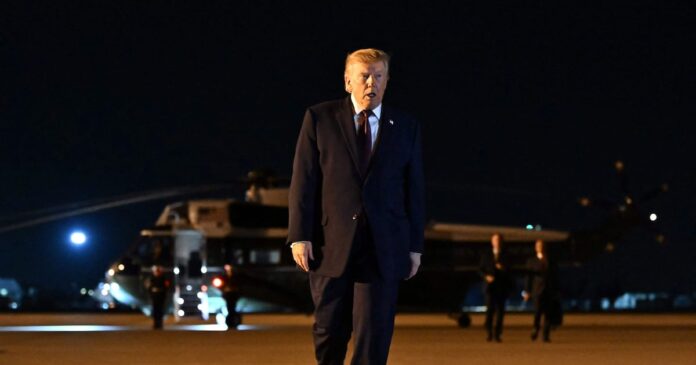
The warning arrived as Masoud Pezeshkian, Iran’s president, navigated the most restrictive movement terms Washington has ever imposed on an Iranian delegation in New York, a six-block radius around the United Nations headquarters. Donald Trump said Sunday he would “probably” meet Pezeshkian on the sidelines of the General Assembly’s High-Level Week, even as he described the annihilation of Iran as a live and considered option. Tehran has called the delegation restrictions illegal and lodged formal protests with the UN secretariat.
Whether the Khatam al-Anbiya announcement reflects genuine intercepted intelligence or functions primarily as a deterrence signal aimed at US Central Command’s planners is not yet established. The framing, a decision made at a specific meeting in a European country with named regional co-signatories, carries the structural form of a genuine intelligence claim. But its timing is conspicuous. The warning arrived four days before a Trump-Xi summit in Washington at which Iran’s leverage over global energy markets is a central agenda item, suggesting the possibility that Khatam al-Anbiya is communicating not just to the Pentagon but to the wider audience watching that meeting.
The United Nations offered additional context earlier this week. A UN fact-finding mission concluded that US strikes on a school in Iran’s Minab district, which killed 120 schoolchildren, constituted war crimes under international humanitarian law. Washington has rejected the finding. In Tehran, the ruling has hardened the government’s language at every level and given Iranian diplomats at the General Assembly an internationally-recognized legal argument to anchor their messaging.
The Strait of Hormuz has been effectively closed to unescorted commercial navigation since Iran’s military began intercepting vessels the US claimed had been cleared for transit under the June ceasefire memorandum. Three months of disruption have pushed Brent crude above $100 per barrel, where it has remained, with no alternative routing arrangement having replaced the volumes that once moved through the strait freely. TRT World reported that Iran has seized or turned back several vessels attempting the southern corridor in the past two weeks alone.
The current fire pause entered its twelfth day on Sunday. It began under informal understandings mediated through Oman and Qatar that neither government has formally described. Iran’s military command said Sunday those understandings are conditional on US compliance, and that compliance, in Tehran’s view, has not been delivered.
What Sunday’s warning leaves explicitly unresolved is whether Washington treats the announcement as a signal to return to the table or as grounds for a pre-emptive response. Iran’s dual posture has kept the pause intact longer than many analysts expected. Whether it holds now depends on a calculation being made in Washington, not Tehran.