

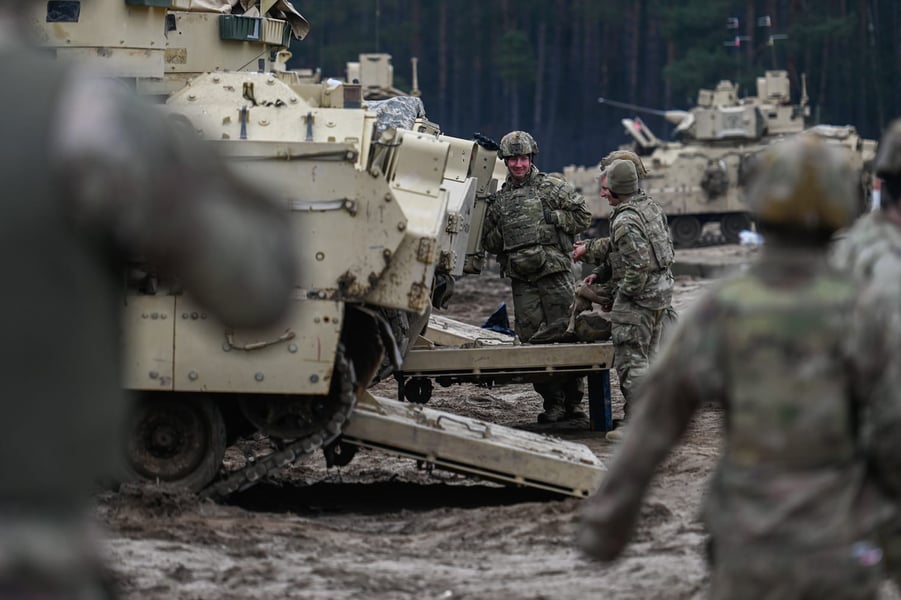

The United States has temporarily suspended troop rotations across parts of Europe in a move that is already sending shockwaves through NATO capitals and raising new questions about Washington’s long-term military commitment to the continent.
Lithuanian Defense Minister Robertas Kaunas confirmed Thursday that planned rotations of American forces have been paused while the Pentagon conducts a broader reassessment of how US troops will be positioned across Europe in the coming months.
“The rotation has been suspended to assess how the United States will deploy its forces in Europe. So far, this is the information,” Kaunas told Lithuania’s LRT broadcaster.
The statement came just one day after reports emerged that the canceled plans to deploy more than 4,000 American troops to Poland, one of NATO’s most strategically important frontline states bordering Russia’s sphere of influence. According to defense officials cited by Defense News and other Western media outlets, the canceled deployment involved the 2nd Armored Brigade Combat Team of the 1st Cavalry Division, which had been preparing for a long-term rotational mission in Poland under Operation Atlantic Resolve.
The abrupt suspension is now being viewed by analysts as part of a much larger restructuring effort inside the Pentagon, one that could fundamentally reshape the US military presence in Europe for the first time since the escalation of the Ukraine conflict in 2022.
Earlier this month, Pentagon spokesperson Sean Parnell confirmed that approximately US withdrawing 5,000 troops from Germany within the next six to twelve months. The announcement marked one of the most significant reductions of US forces in Europe in recent years and immediately triggered alarm among NATO allies already grappling with heightened geopolitical tensions and growing uncertainty over Washington’s strategic priorities.
For decades, Germany has served as the backbone of America’s military infrastructure in Europe, hosting tens of thousands of US troops, logistics hubs, intelligence facilities, and command centers critical to NATO operations. A reduction in that presence carries symbolic and military consequences that extend far beyond Germany itself.
Officials familiar with the Pentagon’s internal deliberations say the reassessment is designed to return troop levels in Europe closer to their pre-2022 numbers, before the Biden administration significantly expanded deployments following the outbreak of the Ukraine war.
Yet the timing of the move is politically explosive.
US President Donald Trump has repeatedly argued that European allies have become overly dependent on American military protection while failing to contribute sufficiently to collective defense spending. Trump has also suggested that Washington should shift more military resources toward the Indo-Pacific region as tensions with China continue to dominate US strategic planning.
Recent tensions between Washington and several European governments have accelerated those debates. Relations between the Trump administration and major European powers deteriorated sharply over disagreements tied to the Iran conflict, military burden-sharing, and NATO strategy.
German Chancellor Friedrich Merz publicly criticized Washington’s handling of the Iran crisis earlier this month, prompting an unusually sharp reaction from Trump, who hinted that Trump considering broader Europe troop reductions could follow. Reports now indicate that Italy and Spain may also face future reductions in American military deployments.
The emerging picture has fueled fears across Europe that the United States may be entering a new phase of strategic disengagement from NATO’s traditional security architecture.
NATO officials have so far attempted to contain growing anxiety inside the alliance. A NATO spokesperson recently stated that the organization was NATO seeking clarification from Washington regarding the planned changes in force posture across Europe.
Behind closed doors, however, several European governments are reportedly demanding greater clarity from the Pentagon regarding future troop commitments along NATO’s eastern flank, especially in Poland and the Baltic region, where US deployments have been viewed as a central deterrent against Russia.
Poland has emerged as one of the most vocal supporters of maintaining a strong American military presence in Eastern Europe. Following reports about the canceled deployment, Polish officials moved quickly to reassure the public that the alliance with Washington remained intact.
Polish Defense Minister Wladyslaw Kosiniak-Kamysz argued that the canceled troop movement reflected a broader Pentagon reassessment of Europe rather than a direct weakening of bilateral military ties. Other Polish officials stressed that Warsaw continues to push for expanded cooperation with the US military despite the uncertainty surrounding current deployments.
Military analysts say the troop reassessment reflects deeper structural changes inside the US defense establishment. Washington increasingly views China and the Indo-Pacific as the central theater of future geopolitical competition, forcing the Pentagon to reconsider whether maintaining elevated troop numbers in Europe remains sustainable over the long term.
The strategic recalculation also comes amid mounting domestic pressure inside the United States over military spending, overseas commitments, and the broader direction of American foreign policy.
Critics inside Congress, including several senior Republican lawmakers, have already warned that Republican lawmakers warn against weakening NATO and embolden Russia at a time of continued instability across Eastern Europe.
Others argue that Europe must accelerate efforts to build independent military capabilities instead of relying overwhelmingly on American security guarantees.
The current suspension of troop rotations has therefore become more than a temporary logistical adjustment. It is increasingly being interpreted as part of a wider debate over the future of NATO itself and the evolving balance between American global commitments and regional alliances.
For countries along NATO’s eastern frontier, the uncertainty is particularly significant. Since 2022, Poland, Lithuania, Latvia, and Estonia have relied heavily on expanded US deployments as both a military shield and a political signal of Washington’s commitment to collective defense.
Any perception that those guarantees are weakening risks triggering broader security concerns across the region, particularly amid intensifying Russia-NATO tensions and the continuing military buildup in Eastern Europe.
While Pentagon officials insist no final decisions have yet been announced regarding additional reductions, the suspension of troop rotations has already exposed growing fractures within the transatlantic alliance.
Questions surrounding the debate over US troops in Germany have also intensified as European governments attempt to gauge Washington’s long-term strategic intentions.
At the same time, Moscow has continued accusing Washington of maintaining an anti-Russia policy despite repeated calls from some Western leaders for de-escalation.
Whether the pause evolves into a temporary adjustment or the beginning of a larger US troop posture across Europe may ultimately shape the future direction of NATO for years to come.
—Inputs from Sputnik.















