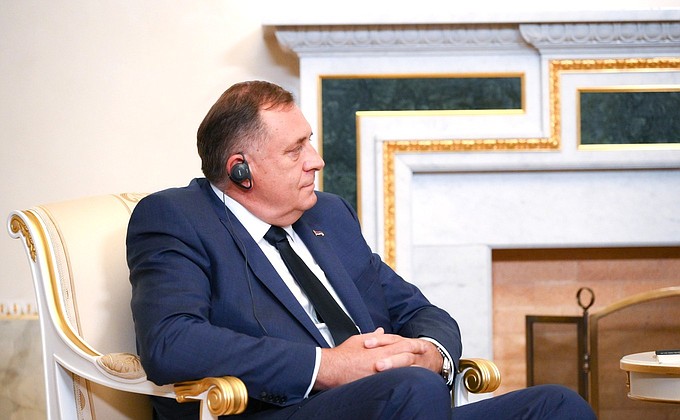

ST. PETERSBURG — Milorad Dodik has made no secret of where his loyalties lie. Speaking on the sidelines of the St. Petersburg International Economic Forum on Saturday, the chairman of the Alliance of Independent Social Democrats of Republika Srpska told RIA Novosti that his next stop in Moscow was already fixed: September 25. “I was here on May 9th, I was here on May 28th, I am here today, and I will be here again,” he said, with a cadence that sounded less like a diplomat’s itinerary and more like a statement of alliance.
For Dodik, the trip to SPIEF was the third time in six weeks he had been in Russia. The first, on May 9, brought him to Red Square for the Victory Day parade alongside President of Republika Srpska Siniša Karan and a dozen other foreign leaders. The second, on May 28, was a visit to the International Security Forum in the Moscow region. Now at SPIEF — which closed Friday with $89.57 billion in signed agreements across 142 participating nations — he is effectively running a parallel track of Balkan diplomacy out of Russian venues.
The September date appears tied to a broader calendar of Russian diplomatic gatherings that autumn, though Dodik did not specify the occasion. What he did confirm is that the visits will continue at a frequency that has no precedent for a leader of an entity within Bosnia and Herzegovina.
On the economic front, his SPIEF delegation secured what Republika Srpska officials described as extended preferential gas terms from Gazprom. Stasha Kosharac, Bosnia and Herzegovina’s Minister of Foreign Trade and Economic Relations, said on the sidelines that Republika Srpska and the BiH Federation together receive what amounts to the cheapest gas prices in Europe — a figure that underscores how energy dependence and political alignment have become nearly inseparable in the western Balkans. “Seventy percent of these volumes are used by the BiH Federation, which at the same time does not cooperate with the Russian Federation,” Kosharac noted, an observation that captures the paradox of Bosnia’s divided energy politics.
Dodik also met with Russian Foreign Minister Sergey Lavrov on June 5 on the forum’s sidelines. According to Russia’s foreign ministry, the talks addressed the Dayton Peace Agreement framework and what Moscow described as Western attempts to reinterpret the accords’ institutional structure. Lavrov raised what he termed the Bosniaks’ boycott of the intergovernmental commission and called attention to the Office of the High Representative in Bosnia and Herzegovina — a body whose legitimacy Republika Srpska has openly contested for years.
“No one can stop” cooperation between Republika Srpska and Russia, Dodik said after that meeting, a formulation he has used before but which lands differently when delivered in St. Petersburg, surrounded by delegations from more than 130 countries. He specifically highlighted the presence of what he called a “strong US delegation” at the forum as evidence of Russia’s continued global weight, telling TASS that the forum’s attendance demonstrated Russia’s gravity even as some European governments continued to stay away.
The political calculation is not subtle. Republika Srpska has consistently refused to align with European Union sanctions against Russia — a position Dodik has defended as non-alignment, and one that has generated sustained pressure from Brussels and Washington. At SPIEF, he presented the refusal not as a concession to Moscow but as a matter of principle. “We have very strong relations with Russia, and they will continue,” he told TASS before arriving in St. Petersburg.
The award presented to the Governor of St. Petersburg, Alexander Beglov, during the forum offered a symbolic dimension to what was otherwise a business and political trip. Dodik handed Beglov the Order of the Flag of Republika Srpska with a golden wreath, described as one of the entity’s highest honors, framing the gesture as recognition of longstanding humanitarian and cultural cooperation.
What remains unclear is how the September visit will be received in Sarajevo and in European capitals. Bosnia’s path toward EU accession — already slow and complicated by internal divisions — does not easily accommodate its Serb entity’s chairman making four or more trips to Russia in a single calendar year. The EU and the United States have so far responded to Dodik’s Moscow diplomacy with targeted financial sanctions against him personally, though those measures have not visibly altered his trajectory.
In a different political environment, the announcement of a fourth Russia trip might provoke a response from Sarajevo’s central institutions. As things stand, it is unlikely to generate more than a formal protest. The energy dimension of Bosnia’s relationship with both Washington and Moscow has grown sufficiently complicated that statements of outrage from either side carry diminishing weight against the underlying economics of who supplies the gas and at what price.
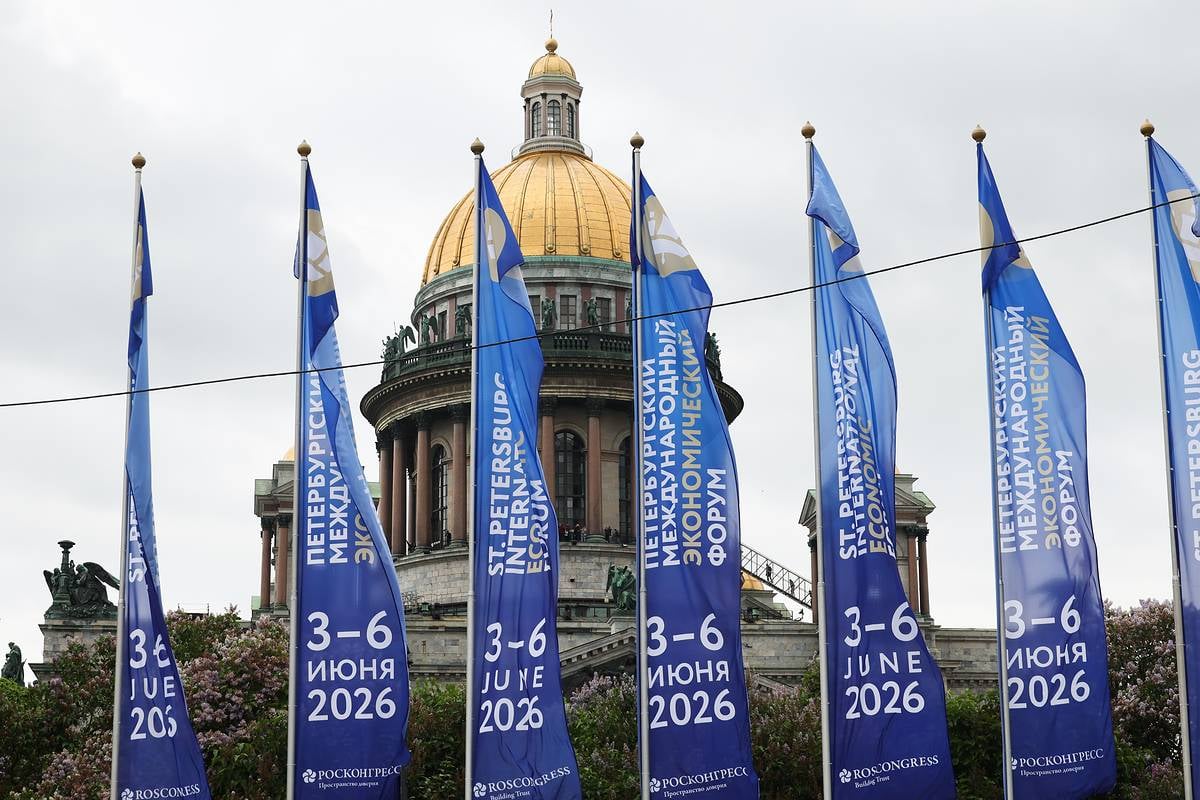
The 2026 SPIEF ran June 3 through 6 in St. Petersburg under the theme “Pragmatic Dialogue: the Path to a Stable Future.” Dodik did not say whether September 25 would bring him to Moscow for a formal bilateral meeting or for another multilateral forum. That question, for the moment, he left open.
Related Posts